





Open any serious nootropic label and you will find a choline source near the top of the ingredient list. That is not marketing. Choline is the raw material your brain uses to build acetylcholine, the neurotransmitter that governs attention, working memory, and how quickly you can recall a name, a number, or the thread of an argument. But "choline" on a label is not one thing. The two forms that actually earn their place in a focus formula are citicoline and alpha-GPC, and they behave differently once they hit your bloodstream. So the real question, the one worth answering before you spend money, is citicoline vs alpha-GPC: which choline source genuinely supports focus, and why.
This is an ingredient decision, not a brand slogan. Let's walk through the mechanism of each, look at what the research actually shows, and explain why FOCUS+FLOW sources its choline from citicoline.
Why choline is the hinge for focus in the first place
Acetylcholine is the brain's attention chemical. It sharpens signal-to-noise in the cortex, supports the encoding of new memories in the hippocampus, and drives the cholinergic system that neuroscientists like Andrew Huberman routinely tie to focused, deliberate work. To make acetylcholine, neurons need a steady supply of choline. Here is the catch: research indicates that brain choline uptake declines with age, and a lower supply of extracellular choline is thought to contribute to age-related dips in cognitive performance, as reviewed in the trial literature on citicoline and memory in older adults.
In other words, keeping choline available is not a fringe biohack. It is upstream plumbing for the exact circuits you rely on to concentrate. The debate is simply which delivery vehicle gets choline where it needs to go, and what else it does along the way.
Alpha-GPC: the direct-delivery choline
Alpha-GPC (L-alpha-glycerylphosphorylcholine) is the more choline-dense of the two by weight, at roughly 40% choline. On paper that sounds like a decisive win: 1,000 mg of alpha-GPC delivers about 400 mg of free choline. Its mechanism is straightforward. Alpha-GPC is a phospholipid metabolite that gets hydrolyzed and delivers choline for acetylcholine synthesis, and it also supplies glycerophosphate, a building block for cell membranes.
Alpha-GPC has the more interesting acute-performance résumé. In a controlled resistance-exercise study, a single 600 mg dose taken about 90 minutes before training increased post-exercise growth hormone and peak bench-press force versus placebo. That points to a real neuromuscular effect, which is why alpha-GPC shows up in pre-workout formulas more than in daily focus stacks.
Two honest caveats belong here. First, the human pharmacokinetic data is thin. Radiolabelled tracing studies show alpha-GPC is rapidly broken down after ingestion, and intact alpha-GPC has not been reliably detected in human plasma, meaning what actually circulates is choline. Second, some observational research has flagged a possible cardiovascular signal with long-term high-dose use that deserves further study before anyone treats alpha-GPC as a daily default. Neither point makes alpha-GPC "bad." It makes it a tool with a specific, mostly acute use case.
Citicoline: the dual-pathway choline
Citicoline (CDP-choline, sold in its patented form as Cognizin) is lower in raw choline by weight, around 18%, and that is the number alpha-GPC marketing loves to quote. But focusing on total choline content misses what makes citicoline distinct. When citicoline is absorbed, it splits into two active pieces: choline and cytidine. The choline feeds acetylcholine production, exactly like alpha-GPC. The cytidine is where citicoline pulls ahead.
In humans, cytidine is readily converted to uridine, and uridine supports the synthesis of phosphatidylcholine + the formation of synaptic membranes, per the mechanistic work summarized in the citicoline memory literature. Translation: citicoline does not just fuel the neurotransmitter, it also supplies material for the physical structure of the synapses that use it. That is a two-lane road, one lane for signaling + one for maintenance, rather than a single choline dump.
The randomized evidence in healthy people is also cleaner than most supplement ingredients can claim. In a randomized, double-blind, placebo-controlled trial published in The Journal of Nutrition (Nakazaki et al., 2021), 500 mg of citicoline per day for 12 weeks produced significantly greater improvements in episodic memory + a composite memory score versus placebo in adults with age-associated memory concerns. An older Cochrane systematic review similarly found evidence for citicoline's benefit on memory + behavior in aging populations. This is a dose-defined, duration-defined outcome in people who are not sick, which is precisely the bar a focus ingredient should clear.
Side by side: citicoline vs alpha-GPC vs plain choline
| Citicoline (CDP-choline) | Alpha-GPC | Plain choline salts | |
|---|---|---|---|
| Choline by weight | ~18% | ~40% | Varies (bitartrate ~41%) |
| Second pathway | Cytidine to uridine: synaptic membrane support | Glycerophosphate: membrane building block | None |
| Best-supported use | Daily cognitive + memory support | Acute pre-training performance | Basic nutritional choline |
| Evidence in healthy adults | RCTs at defined doses + Cochrane review | Acute exercise studies; thin PK data | Poor brain uptake at typical doses |
| Open questions | Few at studied doses | Long-term high-dose cardiovascular signal | Efficacy for cognition |
One naming note that trips people up: CDP-choline and citicoline are the same compound, + Cognizin is a branded, patented form of that same citicoline used in much of the published research. Three names, one molecule. Plain choline salts (like choline bitartrate) are a fourth thing entirely: cheap dietary choline with poor brain uptake at typical supplement doses, which is why serious focus formulas skip them.
Citicoline vs alpha-GPC: how to actually choose
Here is the fair, non-tribal read. A 2025 systematic review and meta-analysis in Frontiers in Neurology compared the two head-to-head across three RCTs and 358 patients with dementia-related decline, and found alpha-GPC scored better than citicoline on several clinical-rating domains. That is a genuine data point in alpha-GPC's favor, and we are not going to pretend it away. But notice the population: older patients with diagnosed cognitive disorders, not healthy high-performers trying to lock in for a workday. On memory + word-fluency measures specifically, the two performed similarly. So the citicoline vs alpha-GPC verdict is context-dependent, not absolute.
For a healthy adult optimizing daily focus, the decision comes down to a few practical filters:
- What is the job? Alpha-GPC has the stronger acute, pre-training and power-output signal. Citicoline has the stronger controlled evidence for sustained memory + cognitive support in healthy people.
- One pathway or two? Alpha-GPC is essentially a choline delivery system. Citicoline delivers choline plus cytidine/uridine for membrane + synaptic support, which fits a "support the system, don't just spike it" philosophy.
- How well characterized is it? Citicoline's absorption + effects have been studied for decades across defined doses. Alpha-GPC's human PK dataset is comparatively sparse, and the long-term cardiovascular question is still open.
- Clean, no-jitter feel. Citicoline supports focus without the stimulant edge, which matters when you are pairing it with the rest of a daily stack.
Why FOCUS+FLOW uses citicoline
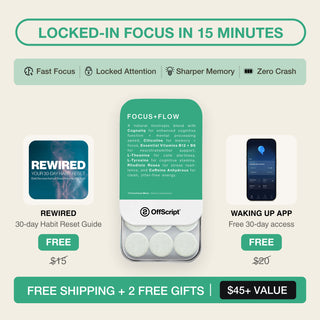
FOCUS+FLOW is built for how the product is actually used: daily, for sustained clarity, in a formula where every ingredient has a mechanism. The label reads Choline (as Citicoline), 18mg — standard supplement-facts format, where the nutrient is listed first and its source form in parentheses. That means the citicoline research above applies to this formula directly: the dual-pathway argument, the cleaner randomized evidence in healthy adults, the no-jitter daily-use profile. It is a daily focus product, so it uses the choline source with the better daily-use case. But choline is one lever among several, and it does its best work as part of a stack rather than a single hero dose.
Patented coffee-fruit extract, clinically studied to support BDNF.
Calm, focused attention without the jitters.
Dopamine precursor for drive + focus under pressure.
Adaptogen that supports mental stamina under stress.
Clean, measured energy — smoothed by L-Theanine.
Raw material for acetylcholine, the memory + learning neurotransmitter.
Supports neurotransmitter production.
Supports cellular energy.
Citicoline-sourced choline feeds the acetylcholine side. L-Theanine takes the caffeine's edge off for calm, jitter-free alertness. L-Tyrosine restocks dopamine precursors so motivation holds up under mental load. Rhodiola Rosea backstops mental stamina when stress runs long. And CognatiQ, a patented, clinically studied coffee-fruit extract, works on a different lever entirely: it has been studied for its ability to raise BDNF (brain-derived neurotrophic factor), the protein tied to neuroplasticity + long-term brain resilience. The point is not to lean on any single ingredient — it is to build a stack around mechanisms instead of buzzwords.
FOCUS ON COMMAND
Clean, crash-free focus — the cholinergic pathway, dopamine drive, and BDNF support in one daily mint.
SHOP FOCUS+FLOWThe bottom line
Neither choline source is a scam, and anyone telling you one is universally superior is selling certainty they do not have. Alpha-GPC is a legitimate tool, especially around training. But for the specific goal most people mean when they research citicoline vs alpha-GPC — steady, clean, daily focus backed by controlled human research — citicoline is the more complete choice. It supports the neurotransmitter + the hardware, and it does it with a well-documented track record.
That is why FOCUS+FLOW gets its choline from citicoline: support the pathways your focus already runs on, no prescription, no dependency — just the raw materials + mechanisms that hold up to scrutiny.
Key Takeaways
- Choline is the raw material for acetylcholine, the neurotransmitter behind attention, working memory, and recall — which is why a choline source sits near the top of any serious focus label.
- CDP-choline, citicoline and Cognizin are three names for the same molecule; plain choline salts are a different, weaker thing.
- Alpha-GPC is more choline-dense (~40%) and has the stronger acute, pre-training performance data, but its human pharmacokinetics are thin and a long-term cardiovascular question remains open.
- Citicoline is a dual-pathway compound: it delivers choline for signaling and cytidine/uridine for synaptic-membrane support, with cleaner randomized evidence in healthy adults.
- Head-to-head, alpha-GPC edged citicoline in dementia patients on some clinical ratings — but that population is not the healthy adult optimizing a workday, where citicoline's daily-use case is stronger.
- FOCUS+FLOW supplies Choline (as Citicoline) at 18mg to support the cholinergic pathway, paired with L-Theanine, L-Tyrosine, Rhodiola, CognatiQ, and B-vitamins in a mechanism-first stack.
Explore The Series
- Citicoline: The Memory Neurotransmitter Hack
- The Science of Natural Nootropics: Every Ingredient
- Best Natural Nootropics for Memory: An Honest Ranking
- Your Brain On Natural: How Nootropics Actually Work
- CognatiQ Coffee Fruit Extract and BDNF
References
- Nakazaki E, et al. Citicoline and Memory Function in Healthy Older Adults: A Randomized, Double-Blind, Placebo-Controlled Clinical Trial. The Journal of Nutrition, 2021. https://pmc.ncbi.nlm.nih.gov/articles/PMC8349115/
- Fioravanti M, Yanagi M. Cytidinediphosphocholine (CDP-choline) for cognitive and behavioural disturbances associated with chronic cerebral disorders in the elderly. Cochrane Database of Systematic Reviews, 2005. https://www.cochranelibrary.com/cdsr/doi/10.1002/14651858.CD000269.pub3/abstract
- Comparison of the effects of choline alphoscerate and citicoline in patients with dementia disorders: a systematic review and meta-analysis. Frontiers in Neurology, 2025. https://www.frontiersin.org/journals/neurology/articles/10.3389/fneur.2025.1649661/full
- Ziegenfuss T, et al. Acute supplementation with alpha-glycerylphosphorylcholine augments growth hormone response to, and peak force production during, resistance exercise. Journal of the International Society of Sports Nutrition, 2008. https://link.springer.com/article/10.1186/1550-2783-5-S1-P15
- Absorption, tissue distribution and excretion of radiolabelled compounds in rats after administration of [14C]-L-alpha-glycerylphosphorylcholine. European Journal of Drug Metabolism and Pharmacokinetics, 1993. https://pubmed.ncbi.nlm.nih.gov/8243501/
FAQ
Is citicoline or alpha-GPC better for daily focus?
For healthy adults optimizing everyday focus, citicoline has the stronger case. Its randomized, dose-defined evidence in non-clinical populations is cleaner, and its dual-pathway action supports both acetylcholine signaling and synaptic-membrane maintenance. Alpha-GPC shines more in acute, pre-training scenarios where a fast power-output effect matters.
Is CDP-choline the same as citicoline?
Yes. CDP-choline (cytidine diphosphate-choline) and citicoline are two names for exactly the same compound. So "alpha-GPC vs CDP-choline" and "alpha-GPC vs citicoline" are the same comparison, and everything in this article applies to both names.
Is Cognizin different from generic citicoline?
Cognizin is a branded, patented form of citicoline used in much of the published research, including memory trials. The molecule is the same; the brand signals a standardized manufacturing process. When comparing Cognizin vs alpha-GPC, you are still comparing citicoline vs alpha-GPC.
What about plain choline vs alpha-GPC?
Plain choline salts like choline bitartrate are inexpensive dietary choline with poor brain uptake at typical supplement doses, which is why cognition-focused formulas use citicoline or alpha-GPC instead. If the goal is brain support rather than basic nutrition, compare those two and skip the plain salt.
Why is citicoline "only" 18% choline if alpha-GPC is 40%?
Raw choline percentage only tells part of the story. Alpha-GPC is denser in choline by weight, but citicoline also releases cytidine, which converts to uridine and supplies material for phosphatidylcholine and synaptic membranes. So citicoline supports the neurotransmitter and the structure that uses it, not just total choline delivered.
Does FOCUS+FLOW contain citicoline?
Yes. The label reads Choline (as Citicoline), 18mg — that is standard supplement-facts labeling, listing the nutrient first and its source form in parentheses. So the choline in FOCUS+FLOW comes from citicoline, alongside L-Theanine, L-Tyrosine, Rhodiola Rosea, Caffeine Anhydrous, CognatiQ, and B-vitamins.
Can I take a choline source without caffeine jitters?
Yes. Choline itself is not a stimulant. In FOCUS+FLOW, the caffeine is deliberately paired with L-Theanine, which promotes calm, focused attention and smooths the stimulant edge — so the energy feels clean rather than jittery.
Are there any safety concerns with these choline sources?
Both are widely used, but some observational research has flagged a possible cardiovascular signal with long-term, high-dose alpha-GPC that warrants more study. Citicoline has a longer, better-characterized human safety and pharmacokinetic record at defined doses. As always, talk to your clinician if you have a medical condition or take medication.