




Watch a bench of professional athletes before a game and you'll see the same thing: half of them are chewing gum. Same with fighter pilots, surgeons between cases, and anyone white-knuckling a merge onto the freeway. It's one of the most common self-soothing behaviors humans have, and almost nobody chose it deliberately — the jaw just seems to know something. So the question is worth asking honestly: does chewing gum help with anxiety, or is it a nervous tic we've retroactively decided is therapeutic? The research here is more interesting than either camp expects. There's a real, replicated effect — and there's a genuine catch that most articles on this topic quietly skip.
What Chewing Actually Does to a Stressed Nervous System
Start with the mechanism, because there is one, and it isn't mystical. Mastication — the rhythmic act of chewing — is a repetitive motor behavior, and repetitive motor behaviors have measurable effects on the brain's stress circuitry. This class of movement recruits the trigeminal nerve and feeds rhythmic sensory input into brainstem and limbic structures, including the hippocampus, which is one of the brain's primary brakes on the stress axis.
That's not a marketing metaphor. A comprehensive review in the International Journal of Molecular Sciences mapped the association between mastication, the hippocampus, and the HPA axis — the hypothalamic-pituitary-adrenal cascade that governs your stress hormone output. The authors describe chewing during stressful conditions as suppressing hyperactivity of the HPA axis via glucocorticoid receptors in the hippocampus. In animal work, chewing on a wooden stick during a stressor reduced stress-induced ulcer formation, anxiety-like behavior, and cognitive disruption. A related review framed mastication as a stress-coping behavior outright.
So the jaw really is wired into the stress system. Chewing is a legitimate self-regulation input — closer in kind to paced breathing or walking than to a placebo. The honest question isn't whether chewing does something. It's how much, and how reliably, in actual humans under actual pressure.
Does Chewing Gum Help With Anxiety? What the Human Trials Found
The most-cited human study is a 2009 trial by Scholey and colleagues in Physiology & Behavior. Forty participants ran a demanding multi-tasking stressor on separate days, once while chewing gum + once without, in a randomized crossover design. Compared with not chewing, gum chewing was associated with significantly higher alertness, reduced subjective stress, and lower state anxiety. The paper also reported lower salivary cortisol — though even the authors cautioned that the cortisol results should be interpreted carefully.
That caution turned out to be well placed. When other teams went looking, the physiology stopped cooperating. A follow-up published in Appetite examining the contrasting physiological and subjective effects of chewing gum on social stress found the split plainly: gum moderated how stressed people felt, but cortisol concentrations were actually higher when chewing. Other work in the same literature has reported cortisol rising after gum chewing as well — chewing is itself mild physical work, and the act of chewing a flavored substance appears capable of nudging cortisol upward on its own.
Then there's the cautionary tale. A 2022 meta-analysis in the Journal of Healthcare Engineering concluded that chewing gum reduces anxiety across randomized trials, and it circulated widely as the definitive answer. It has since been retracted by the publisher. If you've read a confident headline claiming the science is settled on gum + anxiety, there's a decent chance it traces back to a paper that no longer stands.
Why the Felt Effect Is Real — And Where It Stops
Reconcile those findings and you get a clear, useful picture. Chewing gum is a behavioral intervention. It gives your nervous system a rhythmic motor task + a sensory anchor, which occupies attention and interrupts the rumination loop that turns a stressful moment into an anxious one. That's genuinely valuable, and it's free. Keep gum in the desk drawer.
But notice what's missing. There's no ingredient in gum doing anything to your neurochemistry. Sugar-free gum is a delivery system for flavor + jaw motion, nothing more. So the effect lasts roughly as long as you're chewing, does nothing for the physiological arousal underneath, and asks you to keep performing a visible, faintly restless behavior — which is exactly the wrong look in the meeting, the interview, or the moment you actually need composure. Chewing hard through a difficult conversation reads as agitation, because it usually is.
There's a second limitation worth naming, because it explains why the trial results look the way they do. Nearly every study putting gum head-to-head with stress used an acute stressor — a twenty-minute multi-tasking battery, a mental arithmetic test, a simulated social evaluation. That's the setting where a distraction tool shines: short, bounded, high-intensity. It tells you very little about the kind of stress most people are actually managing, which is low-grade + chronic. Nobody has shown that chewing gum does anything for the background hum of a demanding job over weeks. The evidence base is built for the sprint, not the season.
That's the ceiling. Chewing is a distraction strategy dressed up as a physiological one. It's a fine thing to reach for, and there's no reason to be snobbish about a tool that costs a dollar and works on the mind's attention rather than its chemistry. But if it's the whole toolkit, you're managing the sensation of stress + leaving the mechanism untouched.
What an Ingredient-Led Calm Does Instead
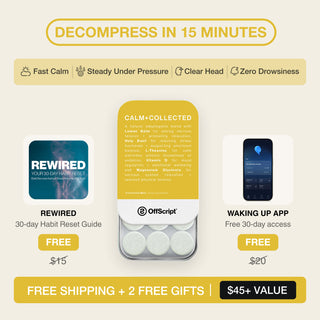
This is the gap we built CALM+COLLECTED to fill — and worth being precise about, since it's a fair question: OffScript doesn't make gum. CALM+COLLECTED is a fast-dissolving mint. You're not chewing it for twenty minutes; it dissolves, and the ingredients do the work your jaw can't. The point isn't to occupy your attention. It's to give your nervous system compounds with documented mechanisms.
The green-tea amino acid that crosses the blood-brain barrier and shifts brainwaves toward calm, focused attention — without drowsiness.
A traditional herb used to promote a settled mood + a quieter mind under pressure.
An adaptogen traditionally used to support resilience when the stress response is running hot.
A gentle, well-absorbed magnesium — a natural regulator of nervous system excitability, paired with calming glycine.
A foundational nutrient tied to normal mood regulation — one many high-performers are quietly short on.
L-Theanine is the anchor, and it's instructive to compare its evidence to gum's. In a randomized, triple-blind, placebo-controlled crossover trial, a single 200mg dose of L-theanine taken before a mental arithmetic stressor produced a significantly larger drop in salivary cortisol than placebo, alongside changes in brainwave activity + self-reported state anxiety. That's the measure gum keeps failing. A separate four-week trial in Nutrients found 200mg daily improved anxiety and sleep-quality scores in healthy adults — while candidly reporting no significant cortisol change, which is the kind of mixed result worth stating rather than hiding.
Magnesium glycinate works from a different direction entirely, modulating NMDA receptor activity + supporting the GABA system your body already uses to downshift — the same brake benzodiazepines amplify, approached from the raw-materials side rather than by overriding it. Lemon balm and holy basil round it out as traditional calming botanicals. None of this sedates you. That's the design constraint we held to: calm that doesn't cost you your edge, because the moments you most need to be steady are usually the moments you also need to be sharp.
It's also the difference between a tool you have to keep performing + a tool that works once you've taken it. You can't chew your way through a board presentation. You can walk into one already settled.
CALM UNDER PRESSURE
A mint that dissolves in seconds and works on the mechanism, not the distraction.
SHOP CALM+COLLECTEDThe Bottom Line
So — does chewing gum help with anxiety? Partly, and honestly, yes: it's a real behavioral tool with a plausible mechanism through the jaw-hippocampus-HPA pathway, and the subjective relief shows up consistently across trials. Use it. It costs a dollar. But don't mistake it for stress management. The cortisol data is contradictory at best, the effect ends when you spit it out, and the highest-profile paper claiming otherwise has been retracted.
If you want calm you can actually rely on when the pressure is real, you want something with an ingredient doing the work. Try CALM+COLLECTED for yourself — a fast-dissolving mint built to steady your nervous system without dulling you, no chewing required.
Key Takeaways
- Chewing has a genuine neural mechanism: mastication feeds rhythmic input to the hippocampus, which helps regulate the HPA stress axis.
- Human trials consistently show gum reduces self-reported stress + state anxiety and raises alertness during demanding tasks.
- The physiology doesn't match the feeling — several studies found cortisol went up during gum chewing, not down.
- The 2022 meta-analysis widely cited as proof that gum reduces anxiety has been retracted; treat confident claims about it skeptically.
- Gum is a distraction tool with no active ingredient. CALM+COLLECTED is a fast-dissolving mint delivering 200mg L-theanine + magnesium glycinate — compounds with documented mechanisms, not just motion.
Explore The Series
- Ashwagandha for Stress + Anxiety: What the Research Says
- Magnesium Glycinate: Benefits for Stress + Sleep
- GABA Supplements: Can They Really Calm Your Mind?
References
- Scholey, A., et al. (2009). Chewing gum alleviates negative mood and reduces cortisol during acute laboratory psychological stress. Physiology & Behavior, 97(3-4), 304-312.
- Gray, L., et al. (2012). The contrasting physiological and subjective effects of chewing gum on social stress. Appetite, 58(2), 554-558.
- Azuma, K., Kubo, K.-Y., et al. (2017). Association between Mastication, the Hippocampus, and the HPA Axis: A Comprehensive Review. International Journal of Molecular Sciences, 18(8), 1687.
- Kubo, K.-Y., et al. (2015). Mastication as a Stress-Coping Behavior. BioMed Research International.
- Luo, J., et al. (2022). [RETRACTED] The Effects of Chewing Gum on Reducing Anxiety and Stress: A Meta-Analysis of Randomized Controlled Trials. Journal of Healthcare Engineering.
- Williams, J. L., et al. (2021). A Randomized, Triple-Blind, Placebo-Controlled, Crossover Study to Investigate the Efficacy of a Single Dose of AlphaWave L-Theanine on Stress in a Healthy Adult Population. Neurology and Therapy.
- Hidese, S., et al. (2019). Effects of L-Theanine Administration on Stress-Related Symptoms and Cognitive Functions in Healthy Adults: A Randomized Controlled Trial. Nutrients, 11(10), 2362.
FAQ
Does chewing gum help with anxiety?
Partly. Randomized trials consistently show that chewing gum during a demanding task lowers self-reported stress and state anxiety while increasing alertness. The mechanism is plausible — rhythmic chewing feeds sensory input to the hippocampus, which helps regulate the HPA stress axis. But the physiological picture is inconsistent: several studies found salivary cortisol actually rose during gum chewing. Gum changes how anxious you feel more reliably than it changes your stress hormones.
Does chewing gum lower cortisol?
The evidence is contradictory. The frequently cited 2009 Scholey study reported lower cortisol but its authors urged caution in interpreting that result. A later study in Appetite found the opposite — subjective stress dropped while cortisol concentrations went up. Chewing is itself mild physical work, which may explain the increase. Anyone telling you gum dependably lowers cortisol is overstating the data.
Wasn't there a study proving chewing gum reduces anxiety?
You're likely thinking of a 2022 meta-analysis in the Journal of Healthcare Engineering that concluded chewing gum reduces anxiety and stress. It has since been retracted by the publisher, so it shouldn't be treated as evidence. This matters because it was widely quoted and still circulates in articles that never updated.
Does OffScript make chewing gum?
No. CALM+COLLECTED is a fast-dissolving mint, not gum. That's deliberate. Gum's benefit comes from the act of chewing, which means it ends when you stop and requires a visible, restless behavior. A mint dissolves in seconds and delivers actual ingredients — 200mg L-theanine, magnesium glycinate, lemon balm, holy basil, and vitamin D — so the effect comes from the compounds rather than the motion.
Should I use gum and a calm supplement together?
There's no conflict. Chewing gum is a free behavioral tool and there's no reason to give it up if it helps you settle. Just treat it as what it is — an in-the-moment distraction that occupies attention — rather than something addressing the physiology underneath. CALM+COLLECTED is designed to support the nervous system itself. Neither replaces medical care; if anxiety is significantly affecting your life, talk to a doctor.