




Same ingredients, different delivery, genuinely different products. Mints dissolve in your mouth + start absorbing before anything reaches your stomach. Powders mix into liquid + go through digestion. That single difference drives everything else: speed, dose control, portability + what it costs you. Here is the fair comparison, including the rounds powders win.
| Feature | Functional Mints | Nootropic Powders |
|---|---|---|
| Time to effect | ~15 minutes | 30 to 60 minutes |
| Dose flexibility | Fixed per mint | Adjustable by scoop |
| Portability | Pocket, no water | Needs liquid + a vessel |
| Cost per dose | Higher | Lower in bulk |
| Taste | Formulated to be pleasant | Often bitter, needs masking |
| Ingredient ceiling | Limited by mint size | Grams if needed |
Absorption: Where The Real Difference Is
Time to effect. A fast-dissolving mint begins absorbing across the tissue under your tongue and inside your cheek, which routes some of the dose into circulation without waiting on digestion. A powder has to be mixed, swallowed, emptied from the stomach + absorbed through the intestine. FOCUS+FLOW is built to work in about 15 minutes. Powders typically land in the 30 to 60 minute range, longer on a full stomach.
Be precise about the claim, though, because this is where the category overclaims hardest. A mint is not entirely sublingual. Some of it dissolves and gets swallowed like anything else. What you get is a faster front end, not a total bypass of digestion, + anyone promising complete sublingual delivery from a mint is selling past the evidence.
Whether faster matters depends on your use. For a planned morning routine, thirty minutes is irrelevant. For the fifteen minutes before a meeting you did not know about, it is the entire point.
Dose Control + Ingredient Ceiling
Dose flexibility. Powders win this cleanly. You can scale a scoop up or down, run half a dose on a light day, or adjust as tolerance shifts. A mint gives you one fixed amount + your only lever is how many you take.
Ingredient ceiling. Powders win here too, by physics. A mint has to fit in your mouth + taste acceptable, which caps total load at a few hundred milligrams across all ingredients. If you want three grams of something, a mint cannot do it, + no amount of formulation cleverness changes that.
This is the honest limit of our format + worth saying plainly. Compounds with genuinely large effective doses belong in a powder or a capsule. What a mint suits is a compact stack of ingredients that work at tens to low hundreds of milligrams, which is exactly the range caffeine, L-Theanine and L-Tyrosine live in.
Convenience + Cost
Portability. Mints win, decisively. Tin in a pocket, no water, no shaker, no bag of powder that splits in your gym bag. You can take one in a car, mid-commute or standing outside a meeting room without any of it being a production.
Cost per dose. Powders win. Buying raw ingredients in bulk is always cheaper per gram than paying for something formulated, flavored, pressed + tinned. If cost per milligram is your main criterion, powders are the rational purchase + we are not going to argue you out of it.
What you buy with the difference is compliance. The best formula is the one you actually take, + friction is the reason most supplement routines quietly die. A scoop that needs water, a vessel and thirty seconds gets skipped on the mornings you most needed it. A mint does not.
Taste, Honestly
Taste. Mints win, though it is worth understanding why rather than treating it as cosmetic. Several useful nootropic ingredients are genuinely unpleasant. Raw L-Theanine is flat and slightly bitter. Rhodiola is astringent. Sit any of it on your tongue undisguised + you will find out quickly.
Mint formats solve this with actual mint, which does two jobs: covering bitterness + delivering the cooling sensation people associate with alertness. Powders solve it by mixing into juice or a smoothie, which works fine but adds sugar, calories + one more step to the routine.
Taste is not a vanity metric here. It is a compliance metric. A product that tastes bad gets taken less often, + a formula you skip is worth exactly nothing regardless of how good the label looks.
Which One Fits You
Pick a powder if you want to tune your own doses, you are stacking compounds that need gram-scale amounts, cost per dose is your leading criterion, or you already have a stable routine at a fixed time and place.
Pick a mint if you want speed, you need it to work away from a kitchen, you want the decision made for you at a known dose, or your track record with multi-step supplement routines is poor. Be honest with yourself on that last one.
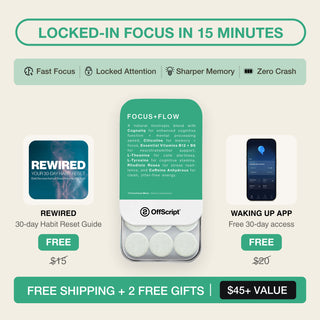
FOCUS+FLOW is a mint by deliberate choice. Eight ingredients at printed doses, sized to work in about 15 minutes, built for the moment before you need it rather than a morning ritual at the counter. That is the trade we made: less dose flexibility, far less friction.
For more on the format, read nootropic mints + sublingual absorption.
Key Takeaways
- Mints start absorbing in the mouth, so they work faster. Roughly 15 minutes against 30 to 60 for powders.
- A mint is not fully sublingual. Some gets swallowed. Faster front end, not a total bypass.
- Powders win on dose flexibility, ingredient ceiling + cost per dose. That is a real advantage.
- Mints win on portability + taste, which mostly means they get taken consistently.
- FOCUS+FLOW is a mint: eight printed doses, no water, built for the 15 minutes before you need it.
References
- Kamimori GH, et al. The rate of absorption and relative bioavailability of caffeine administered in chewing gum versus capsules. International Journal of Pharmaceutics. 2002. PMID 11839447
- Haskell CF, et al. The effects of L-theanine, caffeine and their combination on cognition and mood. Biological Psychology. 2008. PMID 18006208
- Fredholm BB, et al. Actions of caffeine in the brain with special reference to factors that contribute to its widespread use. Pharmacological Reviews. 1999. PMID 10049999
- Jongkees BJ, et al. Effect of tyrosine supplementation on clinical and healthy populations under stress or cognitive demands. Journal of Psychiatric Research. 2015. PMID 26424423
- Darbinyan V, et al. Rhodiola rosea in stress induced fatigue: a double blind cross-over study on the mental performance of healthy physicians during night duty. Phytomedicine. 2000. PMID 11081987
FAQ
Do functional mints absorb faster than powders?
Generally yes. A fast-dissolving mint begins absorbing across the tissue in your mouth, which routes part of the dose into circulation without waiting on digestion, while a powder has to be swallowed and absorbed through the intestine. In practice that is about 15 minutes against 30 to 60 minutes. A mint is not entirely sublingual though, since some of it does get swallowed.
Are nootropic powders more effective than mints?
They are more flexible, which is not the same thing. Powders let you adjust doses and carry gram-scale amounts a mint physically cannot hold, so for compounds with large effective doses they are the better format. For ingredients that work at tens to low hundreds of milligrams, like caffeine and L-Theanine, a mint delivers the same amounts faster + with less friction.
Is FOCUS+FLOW a powder?
No. FOCUS+FLOW is a fast-dissolving mint, never a powder or a capsule. It contains eight ingredients at printed doses: CognatiQ 100mg, L-Theanine 150mg, caffeine 100mg, L-Tyrosine 100mg, Rhodiola Rosea 100mg, Citicoline 18mg, plus B12 and B6. It is designed to be taken without water, about 15 minutes before you need it.
Why do nootropic powders taste bitter?
Because several of the ingredients genuinely are. Raw L-Theanine is flat and slightly bitter, Rhodiola is astringent, + most amino acids are unpleasant on their own. Powders usually solve this by mixing into juice or a smoothie, which works but adds sugar and a step. Mint formats use actual mint to cover the bitterness while adding a cooling sensation.
Which format is cheaper?
Powders, especially bought in bulk. You are paying for raw ingredients rather than formulation, flavoring, pressing and packaging, so cost per milligram is lower. What you spend the difference on with a mint is compliance: fewer steps means it actually gets taken on the mornings that matter, and a routine you skip is worth nothing.
