




How do you lower cortisol naturally? Short version: protect your sleep timing, get morning light, cap caffeine before noon, train hard but recover harder, use a slow-exhale breathing pattern for the acute spikes, + treat supplements as the supporting layer, with ashwagandha holding the best direct evidence. That is the whole playbook. The rest of this guide is the how + the why, told without the panic marketing that has attached itself to this hormone.
First: Cortisol Is Not Your Enemy
Cortisol is the output of your HPA axis, the hypothalamus-to-pituitary-to-adrenal chain that runs your stress response. It is supposed to be high in the morning: that pulse is what wakes you up. It is supposed to spike under threat: that is fuel mobilization. A healthy pattern is a rhythm, high in the morning, tapering to low at night, with spikes that come down quickly once the stressor passes.
The modern problem is a rhythm that flattens: not enough morning peak, not enough nighttime low, + spikes that never fully land because the inbox never closes. When people say they want to lower cortisol, what they should want is to restore that rhythm. Every lever below works on the rhythm, not on driving the number to zero.
The Big Levers, In Order of Impact
1. Sleep timing beats everything
Sleep restriction reliably elevates next-day cortisol + degrades every downstream system people blame on stress. The highest-return move in this entire guide is a consistent sleep + wake time, protected like a meeting with your most important client. Nothing in a capsule competes with this lever.
2. Morning light, evening dark
Your cortisol rhythm is anchored to light. Bright light shortly after waking strengthens the healthy morning pulse + helps time the whole daily curve; bright screens at midnight tell your brain the day is still going. Ten minutes outside before your first meeting is the cheapest hormone intervention that exists.
3. Caffeine dose + timing
Caffeine acutely raises cortisol, especially stacked on stress, + caffeine late in the day damages the sleep that regulates tomorrow's cortisol: even a dose six hours before bed measurably disrupted sleep in controlled testing (Drake et al., 2013). The move is not quitting; it is a measured morning dose + a hard afternoon cutoff. We cover the mechanism in does caffeine raise cortisol.
4. Train hard, recover harder
Exercise spikes cortisol acutely, which is fine + healthy: that is a spike that lands. Chronic overreaching without recovery is the version that keeps baseline stress load high. The tell is simple: if training is improving your sleep, it is helping your rhythm. If it is wrecking your sleep, the dose is wrong.
5. The acute reset: exhale longer than you inhale
For the spike that is happening right now, breathing is the fastest lever you own, because slow exhales engage the parasympathetic brake directly. The simplest protocol: inhale through the nose, then a long slow exhale, repeated for a minute or two. It is free, invisible in a meeting + works on the only timescale a spike cares about.
The Supplement Layer, Honestly Ranked
Supplements are the supporting cast here, not the star, + we say that as a company that sells one. The full ranked breakdown with trial citations lives in our cortisol supplements buyer's guide; the short version:
Ashwagandha holds the strongest direct evidence: a randomized controlled trial in stressed adults found meaningfully lower serum cortisol + perceived stress after 60 days of a standardized extract (Chandrasekhar et al., 2012). L-Theanine matches the acute spike, with a controlled trial showing a reduced response to an acute stressor from a single dose (Evans et al., 2021). Rhodiola is the stress-fatigue lever, magnesium the foundation to stop being low on, + holy basil + lemon balm the traditional supporting layer. Anything sold as a cortisol detox or blocker is marketing.
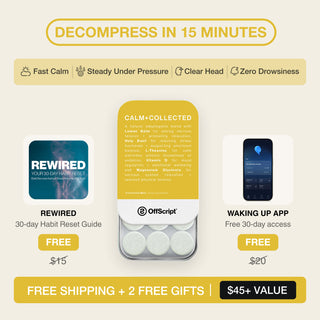
CALM UNDER PRESSURE
L-Theanine 200mg, lemon balm, holy basil + magnesium glycinate. The acute calm layer, in a mint.
SHOP CALM+COLLECTEDA Day Built To Keep Cortisol On Rhythm
Morning: consistent wake time, light within the first hour, caffeine after you have been up a little while rather than the second you wake, hardest work early while the healthy peak is doing its job.
Afternoon: caffeine cutoff by early afternoon, a real break that is not a screen, movement if the day allows. If the 2pm meeting is the spike generator, that is the L-Theanine moment, + the slow-exhale minute before you walk in.
Evening: dim the lights, close the loops you can + write down the ones you cannot, keep the bedroom dark + cool, same bedtime. The nighttime low is when the system repairs; protect it like revenue.
When It Is a Doctor Conversation, Not a Protocol
Genuinely abnormal cortisol, high or low, is a medical condition with real names + real tests, + persistent exhaustion has a differential list that includes depression, thyroid disease + sleep apnea. The honest rule: if weeks of decent sleep + the levers above do not move how you feel, the next step is bloodwork + a professional, not a stronger supplement. Nothing in this guide diagnoses or treats anything.
Key Takeaways
- The goal is a healthy cortisol rhythm, not a low number. Morning peak, nighttime low, spikes that land.
- Sleep timing, morning light, caffeine discipline + recoverable training are the big levers, in that order.
- Slow-exhale breathing is the fastest acute tool you own, free + invisible.
- Supplements are the supporting layer: ashwagandha for the baseline, L-Theanine for the spike, magnesium as foundation.
- Persistent exhaustion that rest does not fix is a medical conversation, not a supplement decision.
Explore The Series
- Cortisol Supplements: What Actually Works
- How Adaptogens Support Cortisol Balance
- Does Caffeine Raise Cortisol?
- The Complete Guide to Natural Calm + Stress Relief
- Supplements for Burnout
References
- Chandrasekhar K, Kapoor J, Anishetty S. A prospective, randomized double-blind, placebo-controlled study of safety and efficacy of a high-concentration full-spectrum extract of ashwagandha root in reducing stress and anxiety in adults. Indian J Psychol Med. 2012;34(3):255-262. PubMed
- Evans M, Sharma P, Guthrie N, et al. A Randomized, Triple-Blind, Placebo-Controlled, Crossover Study to Investigate the Efficacy of a Single Dose of AlphaWave® L-Theanine on Stress in a Healthy Adult Population. Neurol Ther. 2021;10(2):1061-1078. PubMed
- Drake C, Roehrs T, Shambroom J, Roth T. Caffeine effects on sleep taken 0, 3, or 6 hours before going to bed. J Clin Sleep Med. 2013;9(11):1195-1200. PubMed
FAQ
How can I lower my cortisol quickly?
On the minutes timescale, slow-exhale breathing is the most reliable tool: the long exhale engages the parasympathetic brake directly. L-Theanine is the supplement that matches this window, with controlled-trial evidence of a reduced acute stress response from a single dose. Everything else works on days to weeks.
What lowers cortisol the most?
Sleep, by a wide margin. A consistent sleep + wake schedule restores the rhythm every other lever depends on. After that: morning light, a caffeine cutoff by early afternoon, + training you actually recover from. Supplements support this system; they do not replace it.
What are signs my cortisol is high?
The commonly described pattern is poor sleep, wired-but-tired energy, cravings, irritability + slow recovery after stress. Those symptoms overlap heavily with sleep deprivation, depression + thyroid problems, so a persistent pattern deserves a doctor + bloodwork rather than self-diagnosis.
Does coffee raise cortisol?
Yes, acutely, + more so when stacked on top of stress. The practical answer is dose + timing rather than quitting: a measured morning dose, ideally paired with L-Theanine, + a hard cutoff by early afternoon so tonight's sleep can regulate tomorrow's cortisol.
Which supplement actually lowers cortisol?
Ashwagandha has the strongest direct evidence, with a randomized trial showing lower serum cortisol after 60 days of a standardized extract. L-Theanine covers the acute spike. Be skeptical of anything marketed as a cortisol detox or blocker; neither is a real category.
These statements have not been evaluated by the Food and Drug Administration. This product is not intended to diagnose, treat, cure, or prevent any disease.
