




Search "magnesium for anxiety" and you get two kinds of answers. One says magnesium is the forgotten mineral quietly wrecking your nervous system. The other says it's an expensive placebo. The accurate version is less satisfying than either: magnesium has a well-described role in how excitable your nervous system is, a lot of adults take in less than the recommended amount, and the human trials point in a good direction while being nowhere near good enough to settle the question. Here's the full picture — including which is the best magnesium for anxiety once you compare the forms honestly. Magnesium also shows up in our wider review of cortisol supplements.
The Mineral Almost Nobody Measures
Magnesium is a cofactor in hundreds of enzymatic reactions, including ATP production, nerve conduction + muscle relaxation. It isn't a niche nutrient — it's infrastructure.
It's also one of the few nutrients where national dietary intake surveys consistently find a large share of adults eating below the recommended daily allowance — 400–420mg for men, 310–320mg for women. Refining strips most of the magnesium out of grains, and the foods that carry it well (leafy greens, legumes, nuts, seeds) are the ones people skip.
Here's what gets glossed over: eating below the RDA is not the same as being deficient, and no easy test tells you which you are. Under one percent of your body's magnesium sits in your blood, and your body defends that number by pulling from bone — so a normal serum result means little. That measurement problem is exactly why the research here is so hard to run cleanly.
What Magnesium Does In An Anxious Nervous System
Anxiety, at the level of neurons, is partly a problem of excitability — too much accelerator, not enough brake. Magnesium sits on both sides of that equation.
The accelerator. The NMDA receptor is a glutamate-gated channel driving excitatory signalling, and a magnesium ion physically plugs its mouth in a voltage-dependent way, releasing only once the cell is depolarised enough. That's textbook neurophysiology, not a supplement claim. The plausible extension: when magnesium is scarce, that block sits looser + excitatory signalling runs hotter than it needs to.
The brake. Magnesium also supports GABAergic transmission — GABA being your brain's primary inhibitory neurotransmitter, the same system prescription sedatives target far more forcefully.
The stress axis. Magnesium appears to restrain the HPA axis, the hypothalamus-to-pituitary-to-adrenal cascade that ends in cortisol. Most of that work is mechanistic + preclinical, so treat it as a plausible route rather than a proven one.
Together that's a coherent story about why low magnesium would leave a nervous system quicker to fire + slower to settle. It is not a story about anxiety being "a magnesium deficiency" — the mechanism describes a dial, not a switch.
The Two-Way Street Nobody Mentions
The relationship runs both ways, which is the genuinely useful insight here. Stress increases how much magnesium you excrete through urine, and low magnesium status in turn appears to leave the stress response more reactive. So the people carrying the most sustained load are the most likely to be short on the mineral that helps them carry it — and it's one of the cheapest things to fix.
What The Research Actually Shows — And Where It Falls Down
The most-cited work here is a 2017 systematic review that pooled the available human trials of magnesium supplementation for subjective anxiety + stress (Boyle et al., 2017). It's the paper every magnesium brand quotes. Almost none of them quote it accurately.
What the authors concluded: the evidence is suggestive of a beneficial effect on subjective anxiety, particularly in people who were anxiety-vulnerable to begin with — but the quality of the underlying studies is poor enough that no confident conclusion can be drawn. The trials were small, used different magnesium salts at different doses, and relied on self-reported outcomes. And — back to the measurement problem — most had no way to establish whether participants were low on magnesium to begin with. The review called for properly designed, controlled trials.
So: a real mechanism, a plausible case, an evidence base that is encouraging + methodologically weak. Enough to justify including magnesium in a calm formula. Nowhere near enough to build one around — and any brand telling you magnesium is "clinically proven" to reduce anxiety hasn't read the review it's citing.
The Best Magnesium for Anxiety: Glycinate vs Citrate vs Threonate vs Oxide
Ranked for calm use, before the detail: 1. Glycinate — best overall for anxiety, gentle enough for daily use, and the glycine half pulls its own weight. 2. Citrate — best budget pick, well absorbed, fine if your gut tolerates it. 3. L-threonate — the interesting wildcard, priced ahead of its evidence. 4. Oxide — skip it. Now the reasoning.
This is where the practical difference lives. Magnesium always arrives bonded to something else, and that something decides how much reaches your bloodstream + how your gut feels about it.
Magnesium oxide dominates drugstore shelves because it's cheap + carries a lot of elemental magnesium by weight, which makes the label look strong. Absorption is poor. Much of the dose stays in your intestine pulling water in — hence magnesium's reputation as a laxative.
Magnesium citrate is a real improvement: better absorbed, inexpensive, everywhere. Still osmotically active, so at higher doses it has the same gut effect. A perfectly reasonable general-purpose choice.
Magnesium glycinate (also sold as bisglycinate) bonds each magnesium atom to two glycine molecules. It's well tolerated daily, and glycine isn't dead weight — it's an inhibitory neurotransmitter in its own right, which is why this form gets chosen for calm + sleep use. We go deeper on it in our guide to magnesium glycinate.
Magnesium L-threonate is marketed on raising magnesium in the brain rather than just the blood. The idea is legitimate. The human data is thin, largely about cognition rather than anxiety, and the price is several times higher. Promising, oversold, not where we'd send a first-time buyer.
Dose, Timing + Who Should Be Careful
The tolerable upper intake level for supplemental magnesium in adults is 350mg per day — a limit set by gut effects, not toxicity, and it doesn't apply to magnesium from food. Timing is flexible: magnesium isn't a sedative + won't knock you out, so evening dosing is a preference rather than a rule. Effects build with consistency, not in a single dose.
Two real cautions. If your kidney function is reduced, magnesium clearance is impaired — talk to your doctor before supplementing at all. And magnesium can interfere with the absorption of certain antibiotics + thyroid medication, so separate them by a few hours. Food first remains the best move: pumpkin seeds, almonds, spinach + black beans all carry meaningful amounts.
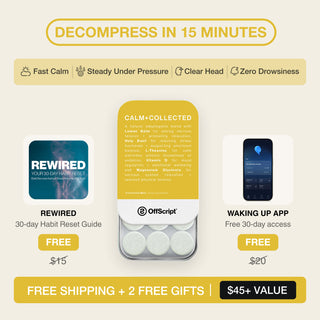
How Magnesium Fits In CALM+COLLECTED
We use 120mg of magnesium glycinate — deliberately not a mega-dose, and we'd rather explain why than let the number sit there. Magnesium is the slow, foundational input, working alongside faster-acting actives rather than carrying the formula: L-theanine has the stronger acute evidence, with a controlled trial showing a reduced response to an acute stressor from a single dose (Evans et al., 2021), while lemon balm works the GABA-breakdown route catalogued in a review of GABA-modulating plant medicines (Savage et al., 2018).
Different mechanisms, different timescales, one direction of travel. Full label, no proprietary blend:
Promotes calm, focused attention without drowsiness.
Traditional herb used to promote a settled mood.
Adaptogen traditionally used to support resilience under stress.
A gentle, well-absorbed form of magnesium.
Supports normal mood + immune function.
CALM UNDER PRESSURE
Magnesium glycinate, L-Theanine + lemon balm in a mint that dissolves in 60 seconds. 12 mints per tin, 2 tins per order.
SHOP CALM+COLLECTEDKey Takeaways
- Magnesium plugs the NMDA channel + supports GABA signalling — a well-described mechanism, and a stronger one than the clinical evidence built on it.
- The key systematic review called the effect on subjective anxiety "suggestive" but limited by poor study quality. That's the honest headline most brands leave out.
- Stress and low magnesium reinforce each other: stress increases excretion, and low status leaves the stress response more reactive.
- Form matters more than the number on the bottle — oxide is cheap and poorly absorbed, citrate is a solid all-rounder, glycinate is gentlest for daily use, threonate is oversold.
- Magnesium is not a treatment for an anxiety disorder. It's a foundational input worth getting right, most usefully for people whose intake is genuinely low.
Explore The Series
- Magnesium glycinate: why it's the best form for stress + sleep
- GABA supplements: can they really calm your mind?
- The complete guide to natural calm + stress relief
References
- Boyle NB, Lawton C, Dye L. The Effects of Magnesium Supplementation on Subjective Anxiety and Stress—A Systematic Review. Nutrients. 2017;9(5):429. PubMed
- Evans M, et al. A Randomized, Triple-Blind, Placebo-Controlled, Crossover Study to Investigate the Efficacy of a Single Dose of AlphaWave® L-Theanine on Stress in a Healthy Adult Population. Neurol Ther. 2021;10(2):1061-1078. PubMed
- Savage K, Firth J, Stough C, Sarris J. GABA-modulating phytomedicines for anxiety: A systematic review of preclinical and clinical evidence. Phytother Res. 2018;32(1):3-18. PubMed
FAQ
Does magnesium actually help with anxiety?
The mechanism is real — magnesium blocks the NMDA channel that drives excitatory signalling and supports GABA, the brain's main calming neurotransmitter. The human evidence is weaker than the mechanism suggests: a systematic review found the effect on subjective anxiety suggestive of benefit but limited by poor study quality. Worth taking, not worth overselling.
Which form of magnesium is best for anxiety?
Glycinate is the usual choice for daily calm use — well tolerated, and the glycine it's bonded to is itself an inhibitory neurotransmitter. Citrate is a solid, inexpensive all-rounder. Oxide is cheap but poorly absorbed and tends to act as a laxative. L-threonate is marketed for brain penetration, but the human data is thin.
How much magnesium should I take?
The RDA is 400–420mg a day for men and 310–320mg for women, counting food. The upper limit for supplemental magnesium is 350mg a day, set because of gut side effects rather than toxicity. Food first, then supplement to close the gap.
Can magnesium make anxiety worse?
There's no established mechanism by which it would. The realistic downsides are digestive — loose stools and cramping, mostly from poorly absorbed forms at higher doses. If your kidney function is reduced, talk to your doctor before supplementing, since your ability to clear excess magnesium is impaired.
How long does magnesium take to work?
It isn't an acute effect. Magnesium works by restoring a nutrient your nervous system depends on, so any benefit builds over weeks of consistency. If you want something on a shorter timescale, L-theanine has better evidence for the acute stress response.
