




Most articles comparing natural nootropics to prescription options are written by someone selling one of them. This one is too, so read it with that in mind + hold us to the parts we get wrong. Here is the honest version: what each approach is built to do, where prescription options are genuinely stronger, where natural formulas earn their place, + the claim we will not make.
What Each One Is Built To Do
Prescription options for attention are designed as medical treatments for diagnosed conditions. They are prescribed after an evaluation, monitored by a clinician + adjusted over time. That framing matters more than any ingredient comparison, because it defines who they are for + who decides.
Natural nootropics are supplements. They are built to support systems you already have rather than to treat a condition. Nobody evaluates you first. Nobody adjusts your dose. You buy them off a shelf, + the responsibility for using them sensibly is entirely yours.
Those are different products in different categories, answering different questions. Comparing them as if they compete for the same job is the mistake at the heart of most content on this topic. A supplement is not a substitute for a diagnosis, + a prescription is not something you should be shopping for on a blog.
Where Prescription Options Are Genuinely Stronger
They act more powerfully, more predictably + more consistently. That is the whole point of them. A medication developed for attention, tested in trials + dosed by a clinician will produce a larger, more reliable effect than any supplement, and pretending otherwise would be dishonest marketing.
They are also regulated to a standard supplements are not held to. Identity, potency + purity are verified before the product reaches you. In the supplement category, that verification depends on whether the brand chose to pay for it, which is a considerably weaker guarantee.
And for a person with a genuine diagnosis, treatment is not a lifestyle preference. It is care. We are not in that conversation, we are not qualified to be, + a brand that tells you to walk away from prescribed treatment is telling you something it has no standing to say.
Where Natural Formulas Earn Their Place
Most people reaching for focus support do not have a diagnosis. They have a demanding Tuesday. For that, the honest comparison is not against medication at all. It is against a third coffee, an energy drink + pushing through on nothing.
Measured against those, a good natural formula does well. You get a real caffeine dose without the sugar, something to smooth it so the alertness stays even, + amounts printed so you can compare products instead of trusting a font. No appointment, no escalating dose, no conversation about coming off it later.
The trade is honest: a smaller effect than a medical treatment, in exchange for a tool you can pick up and put down. For a hard block of work on a normal week, that trade is usually the right one.
Blocks adenosine. About a cup of coffee, no sugar, no cup.
Raises alpha activity so alertness stays calm rather than jittery.
Precursor your body uses to build dopamine + norepinephrine.
Adaptogen studied for mental fatigue under sustained load.
The Dependency Question
This is where natural formulas are usually oversold, so here is the accurate version. Supplements are not free of adjustment effects, + caffeine is the reason. Caffeine builds tolerance. Take it daily + the same dose does less, which pulls you toward taking more. Stop abruptly after regular use + you can get a headache and a flat couple of days.
That is a mild, well-understood pattern, and it is not the same as the dependency profile of a controlled medication. It is also not nothing, + brands claiming their caffeinated product carries zero adjustment cost are not being straight with you.
The practical answer is to use it deliberately. Take it for sessions that need it rather than out of routine. Keep an eye on your total daily caffeine across every source. If the tin has quietly become a requirement for an ordinary morning, that is information worth acting on.
The Claim We Will Not Make
We are not going to tell you a mint replaces medical treatment. It does not, we have no evidence that it does, + any brand implying otherwise is putting its margin ahead of your health.
We will not use fear to sell either. Naming a treatment as the villain to make a supplement look heroic is a marketing move, not an argument. Big Pharma's incentives deserve scrutiny + we scrutinize them plenty. That is separate from the individual sitting with their doctor deciding what is right for them.
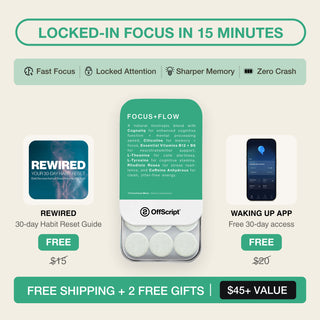
What we will claim is narrow + defensible. FOCUS+FLOW contains eight ingredients at printed doses. It is a fast-dissolving mint built to work in about 15 minutes. It is designed for people who want a real tool for demanding work without a prescription. That is the product. Everything past that is someone else's copywriting.
FOCUS WITHOUT THE SCRIPT
Eight ingredients, every dose printed. No prescription required.
SHOP FOCUS+FLOWHow To Actually Decide
Start with the question underneath. If focus has been a persistent problem across years, settings + tasks, that is worth a proper evaluation with a clinician. No supplement answers that question, + spending a year experimenting with tins instead of getting assessed is a poor use of your time.
If focus is situationally hard, meaning some days and some tasks, look at inputs first. Sleep, daylight, food + how fragmented your calendar is will explain most of it. Fix what you can there before you buy anything, because a supplement layered on four hours of sleep is a rounding error.
Then, if you want a tool for the demanding sessions, choose on transparency. Printed doses, no proprietary blends, amounts that match published research + a brand willing to say what its product does not do. If you are already taking any medication, ask your doctor before adding a supplement. Interactions are real, individual, + a label cannot know your chart.
Key Takeaways
- Prescription options are medical treatments for diagnosed conditions. Supplements are not, + should not be sold as replacements.
- Prescriptions act more powerfully + are held to a stricter regulatory standard. That is worth saying plainly.
- For most people without a diagnosis, the real comparison is against a third coffee, not against medication.
- Caffeine builds tolerance. That is a mild adjustment cost, not zero, + brands claiming zero are overselling.
- Persistent focus problems deserve a clinician. Situational ones usually start with sleep, light + food.
References
- Haskell CF, et al. The effects of L-theanine, caffeine and their combination on cognition and mood. Biological Psychology. 2008. PMID 18006208
- Kelly SP, et al. L-theanine and caffeine in combination affect human cognition as evidenced by oscillatory alpha-band activity and attention task performance. Journal of Nutrition. 2008. PMID 18641209
- Fredholm BB, et al. Actions of caffeine in the brain with special reference to factors that contribute to its widespread use. Pharmacological Reviews. 1999. PMID 10049999
- Jongkees BJ, et al. Effect of tyrosine supplementation on clinical and healthy populations under stress or cognitive demands. Journal of Psychiatric Research. 2015. PMID 26424423
- Darbinyan V, et al. Rhodiola rosea in stress induced fatigue: a double blind cross-over study on the mental performance of healthy physicians during night duty. Phytomedicine. 2000. PMID 11081987
FAQ
Can natural nootropics replace prescription treatment?
No, + we are not going to suggest otherwise. Prescription options are medical treatments prescribed after evaluation and monitored by a clinician, which is a fundamentally different thing from a supplement you buy off a shelf. If you are currently prescribed something, any change is a conversation with your doctor. A supplement brand has no standing in that decision.
Are natural nootropics safer than prescription options?
They generally act more gently, which is not the same as being safe for everyone in every situation. Supplements are less tightly regulated for identity, potency + purity, so quality varies more between brands than most people expect. They can also interact with medication. The useful question is not which category is safer in the abstract, but what is appropriate for you specifically.
Do natural focus supplements cause dependency?
Caffeine builds tolerance with regular use, so the same dose gradually does less, + stopping abruptly after daily use can bring a headache and a flat day or two. That is a real adjustment effect, though a mild and well-understood one, and it is not comparable to the dependency profile of a controlled medication. Using it for sessions that need it rather than by routine keeps it working.
What is in FOCUS+FLOW?
Eight ingredients, all printed: CognatiQ 100mg, L-Theanine 150mg, caffeine (anhydrous) 100mg, L-Tyrosine 100mg, Rhodiola Rosea 100mg, Citicoline 18mg, Vitamin B12 60mcg + Vitamin B6 5.1mg. No proprietary blends. The Citicoline sits below the range used in most published research and we print it anyway, because the alternative is hiding it inside a blend.
Should I talk to a doctor before taking a focus supplement?
Yes, if you take any medication, are pregnant or nursing, or are managing a diagnosed condition. Interactions are individual + no label can account for your situation. It is also worth a conversation if focus has been a persistent difficulty across years and settings rather than something situational, because that pattern deserves a proper evaluation rather than an experiment with supplements.
