




You are running a full course load, probably a job, and a social life you are not willing to give up. Your focus problem is not laziness. It is that your sleep is irregular, your energy comes from whatever is cheapest, and the material you have to get through is genuinely boring for hours at a stretch. There is also a thing nobody says out loud in the library at 1am: borrowed study pills are everywhere on campus, and plenty of people are taking something a doctor prescribed to someone else. If your instinct is that you would rather not do that, this page is for you. That instinct is correct, and you do not have to trade it for worse grades.
What This Work Demands
- Long reading + study marathons without losing the thread
- Memory recall under exam conditions
- Focus through material that is genuinely dull
- Stamina near deadlines when the schedule collapses
Where It Breaks Down
- Late nights wrecking early lectures
- Energy-drink crashes landing mid-class
- Cramming with no real focus, rereading the same page
- Pressure to use borrowed prescription pills to keep up
A Protocol That Fits Your Day
One FOCUS+FLOW before you sit down, not after. It dissolves under the tongue so it lands in roughly 10 to 20 minutes. Use that window on the hardest subject on your list, not on organizing your notes.
This is the honest use case. It will not replace sleep, and nothing will. What it does is take the edge off the fog so the lecture is not a total write-off. Treat it as damage control, not a strategy.
If it is before your caffeine cutoff, a second mint is fine. Count what you have already had, energy drinks and coffee included. Most crashes students blame on studying are just a 300mg caffeine morning coming due.
Half-life is roughly 5 to 6 hours. A 4pm dose is still with you at midnight. If finals week has already destroyed your sleep, adding late caffeine makes tomorrow worse, not better.
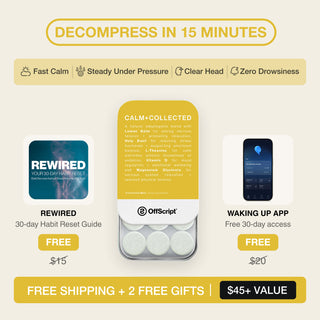
CALM+COLLECTED is caffeine-free, with Lemon Balm 200mg, L-Theanine 200mg, Holy Basil 100mg, Magnesium Glycinate 120mg + Vitamin D 20mcg. It promotes calm without dulling the edge, so you are settled but still sharp enough to think.
Why FOCUS+FLOW Fits
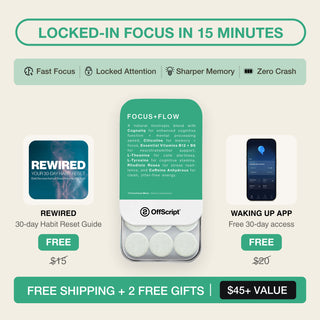
Studying needs sustained attention through material your brain would rather avoid, without the spike-and-crash pattern that energy drinks produce. FOCUS+FLOW pairs 100mg caffeine, about a cup of coffee, with 150mg L-Theanine to smooth it out, and adds Citicoline 18mg and L-Tyrosine 100mg on the cognitive side. It is a mint rather than a capsule, so it works in 10 to 20 minutes instead of the better part of an hour, which matters when your study block is two hours long. Full formula, printed doses: CognatiQ 100mg, L-Theanine 150mg, Caffeine (Anhydrous) 100mg, L-Tyrosine 100mg, Rhodiola Rosea 100mg, Vitamin B12 60mcg, Vitamin B6 5.1mg, Citicoline 18mg.
STUDY SHARP. BORROW NOTHING.
100mg caffeine + 150mg L-Theanine, printed on the tin. 12 mints per tin, 2 tins per order.
SHOP NOWStraight Answers
It is probably too expensive for a student budget.
It is a tin of 12 mints, 2 tins per order. Price it against a daily energy drink habit before you decide. Most people find the comparison is closer than they expected, and you are not buying it every single day if you use it strategically.
Will this work as well as what my roommate takes?
No, and we are not going to pretend otherwise. A prescription stimulant is a different category of intervention with a different risk profile, and taking one prescribed to someone else is both a health risk and a disciplinary one. What this does is give you clean, sustained focus without dependency. That is a real thing, honestly described.
Can I just pull an all-nighter instead?
You can, and your recall will be worse for it. Sleep is when memory consolidates, so an all-nighter trades the encoding you did for retrieval you will not have. Nothing on this page fixes that. Use it to make your daytime study time count so you need fewer all-nighters.
Is this safe to take before an exam?
For most healthy adults, 100mg of caffeine is a normal amount, roughly a cup of coffee, well inside the mainstream 400mg daily guidance. Do not try it for the first time on exam morning. Test it on a normal study day first so you know how you respond. If you are on medication or managing a health condition, check with a doctor.
Key Takeaways
- You do not have to borrow pills to keep up. That instinct is right.
- Caffeine plus L-Theanine gives study focus without the energy-drink crash.
- Take it 20 minutes before the block, on the hardest subject first.
- Nothing replaces sleep. Memory consolidates while you are unconscious.
- Count total caffeine. Most study crashes are a 300mg morning coming due.
- Never test something new on exam morning. Trial it on a normal day.
References
- Haskell CF, et al. The effects of L-theanine, caffeine and their combination on cognition and mood. Biological Psychology. 2008. PMID 18006208
- Kahathuduwa CN, et al. Acute effects of theanine, caffeine and theanine-caffeine combination on attention. Nutritional Neuroscience. 2017. PMID 26869148
- Kelly SP, et al. L-theanine and caffeine in combination affect human cognition as evidenced by oscillatory alpha-band activity and attention task performance. Journal of Nutrition. 2008. PMID 18641209
- Kamimori GH, et al. The rate of absorption and relative bioavailability of caffeine administered in chewing gum versus capsules. International Journal of Pharmaceutics. 2002. PMID 11839447
- Jongkees BJ, et al. Effect of tyrosine supplementation on clinical and healthy populations under stress or cognitive demands. Journal of Psychiatric Research. 2015. PMID 26424423
- Fredholm BB, et al. Actions of caffeine in the brain with special reference to factors that contribute to its widespread use. Pharmacological Reviews. 1999. PMID 10049999
FAQ
What are the best nootropics for studying?
The most evidence-backed combination for sustained study focus is caffeine paired with L-Theanine, which gives alertness without the jitter and crash that energy drinks produce. FOCUS+FLOW carries 100mg caffeine and 150mg L-Theanine, plus Citicoline 18mg and L-Tyrosine 100mg. For exam nerves specifically, a caffeine-free calming blend is the better tool.
Are natural nootropics as effective as borrowed study pills?
No, and anyone claiming otherwise is selling you something. A prescription stimulant is a different category with a different risk profile, and taking one prescribed to someone else carries real health and disciplinary risk. What natural options offer is clean, sustained focus without building dependency, which is a genuine benefit described honestly.
Will nootropics help me remember what I studied?
Indirectly. Better attention during a study session means better encoding, and you cannot recall what you never properly encoded. But consolidation happens during sleep, which is why all-nighters produce such poor retention. Use focus support to make your waking study time count, then protect your sleep, because that is where the memory actually sticks.
How much do they cost compared to energy drinks?
An order is 2 tins of 12 mints each. Compare that against a daily energy drink habit over the same period and the gap is usually smaller than students expect. The bigger saving comes from using it strategically on real study days rather than as a daily reflex, which is also better for keeping caffeine effective.
