


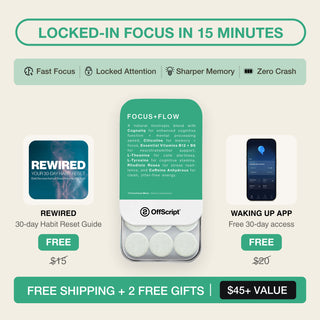


How fast a supplement works comes down to one thing most labels ignore: how it gets into you. Swallow a pill + you wait. Let it dissolve under your tongue + it moves. That difference has a name, sublingual delivery, + it is the reason a fast-dissolving mint can outrun a capsule that lists the exact same ingredients. This guide breaks down the science: what sublingual actually means, why it is faster, where it wins + where it does not, and why FOCUS+FLOW is built as a fast-dissolving mint instead of a pill you swallow.
What Sublingual Actually Means
Sublingual means under the tongue. It is not marketing language. It describes a real route into your bloodstream.
The tissue on the floor of your mouth is thin + packed with blood vessels sitting close to the surface. When a substance dissolves against it, part of the dose can pass straight through that tissue into circulation. No swallowing, no stomach, no waiting on digestion to unlock it.
This is why some of the fastest-acting compounds in medicine are designed to dissolve under the tongue rather than be swallowed. The mouth is a shortcut, + biology built it in.
A fast-dissolving mint uses that same route. As it melts, the active ingredients start absorbing immediately, + you feel the effect while a swallowed version would still be working through your gut. The format is not a gimmick or a flavor choice. It is a delivery decision, + delivery is half of what makes any supplement actually do something. An ingredient that never reaches your bloodstream in a meaningful amount is just an ingredient on a label. Sublingual is one of the cleanest ways to make sure it gets there.
It is the reason a lozenge that dissolves under the tongue can take hold faster than the identical dose in a pill you wash down with water. Same compound, same milligrams, different door in.
Why It Is Faster Than A Pill
A swallowed capsule takes the long road. Down the esophagus, into the stomach, through digestion, into the liver, then finally out into your blood. Every step costs time, + the liver step costs dose. That process is called first-pass metabolism: your liver breaks down a chunk of the compound before it ever reaches circulation.
Two things suffer. Speed + yield. A pill can sit for 30 to 45 minutes before you feel anything, + some of what you paid for gets dismantled on the way.
Dissolving under the tongue sidesteps part of that route entirely. The dose that absorbs sublingually enters the blood directly, skipping the stomach + the liver's first pass. Onset drops from half an hour to minutes, + less of the dose is lost.
For focus, that timing is the whole point. You do not want alertness in 40 minutes. You want it for the block of work starting now.
So the same ingredient, at the same dose, can feel like two different products depending on nothing more than whether you swallow it or let it dissolve. That is how much the route matters.
Bioavailability: Getting What You Paid For
Bioavailability is the share of a dose that actually reaches your bloodstream in a usable form. It is the number that matters, + it is the number proprietary blends never show you.
A 100mg ingredient is not a 100mg effect. If digestion + first-pass metabolism strip away a large fraction, the real delivered dose is far smaller than the label suggests. Two products can print identical numbers + deliver very different results, purely on format.
Sublingual absorption raises bioavailability for compounds that take that route well, because it bypasses the losses of digestion. You get more of the stated dose doing its job, sooner.
This is also why we are careful about honesty on doses. Printing 100mg only means something if a real amount lands where it needs to. Format + dose work together: the right ingredient, at a stated amount, in a delivery that actually gets it in. A big number on a slow, poorly-absorbed format is theater. A sensible dose in a fast-dissolving mint is a product. That combination, printed doses plus sublingual delivery, is the standard we build FOCUS+FLOW to.
This is why we treat delivery as part of the dose, not an afterthought. Milligrams on a label only count if they survive the trip in, + a fast, direct route protects more of what you paid for.
Fast Mint Vs Capsule Vs Powder
Every format is a set of trade-offs. Here is how the common ones stack up for on-demand focus.
| Feature | Fast-Dissolving Mint | Capsule | Powder |
|---|---|---|---|
| Onset | Fast | Slower | Medium |
| Needs water | No | Yes | Yes |
| Portable | Pocket tin | Bottle | Tub + scoop |
| Dose precision | Fixed per mint | Fixed per cap | Scoop variance |
| Taste control | Built in | N/A | Varies |
Capsules are fine for ingredients you take daily on a schedule + do not need fast. Powders let you customize a big dose, but you are mixing, measuring, + carrying a tub. Both make you wait on digestion.
A fast-dissolving mint trades away high-dose customization for speed, portability, + a fixed dose you can trust every time. For focus you want on demand, in a pocket, that trade is the right one. You are not building a stack at your kitchen counter. You are locking in before a meeting.
There is also the friction question. A format you actually use every day beats a better one you skip because it needs water, a scoop, or a flat surface. For on-demand focus, the moment you need it is rarely standing at your kitchen counter, + a pocket tin is always ready.
Pick the format you will actually reach for without thinking about it. The best delivery on paper is worthless if it stays in the drawer, + the one in your pocket wins by simply being there.
Where Sublingual Wins, And Where It Doesn't
Sublingual is powerful, not universal. Being honest about the limits is part of trusting the wins.
It shines for compounds that absorb well through oral tissue + that you want fast: think focus ingredients you take before a task. L-Theanine + caffeine, the engine of FOCUS+FLOW, are a good fit for quick onset.
It is a weaker choice when you need a very large dose that simply will not dissolve in a small mint, or when an ingredient is meant to release slowly over many hours. A time-release capsule is purpose-built for that drip. Some nutrients are also absorbed perfectly well through normal digestion + gain little from the sublingual route.
So the honest framing is this: sublingual delivery is the best tool for fast, on-demand effects from ingredients suited to it. It is not a magic upgrade you bolt onto everything. FOCUS+FLOW uses it where it earns its place, on a focus formula built to work in minutes, + prints the doses so you can judge the rest. Matching the format to the goal is the point. A focus mint should be fast. A daily multivitamin does not need to be.
Matching the format to the goal is the honest way to build a product, not bolting the trendiest delivery onto everything + calling it an upgrade.
How FOCUS+FLOW Uses It
FOCUS+FLOW is a fast-dissolving mint by design, not by accident. The formula is built around ingredients that suit quick onset, led by 150mg L-Theanine + 100mg of naturally sourced caffeine, so the focus arrives while a capsule would still be dissolving in your stomach.
The practical payoff is simple. No pill to swallow. No water to find. No 40-minute lag between deciding to focus + actually focusing. You let one dissolve under your tongue + get to work.
It also travels. A tin fits in a pocket or bag, so the same fast focus works at your desk, in the car, before a workout, or between back-to-back meetings. One tin holds 12 mints, + every order ships two, so you start with 24 servings to find your rhythm.
You are never left waiting on a pill to catch up with your day. That is the practical promise of the format, + it is why we chose it over a capsule that would look identical on an ingredient panel yet behave nothing alike in real use.
FOCUS THAT KEEPS UP
Fast-dissolving focus in a pocket tin. 12 per tin, 2 tins per order.
SHOP FOCUS+FLOWWant the ingredient side of the story? Read the L-Theanine + caffeine deep dive.
Key Takeaways
- Sublingual means absorbing under the tongue, bypassing part of digestion.
- It delivers faster onset + higher bioavailability for suitable ingredients.
- Bioavailability, not the label number, decides the real delivered dose.
- It is not universal: capsules still win for large or time-release doses.
- FOCUS+FLOW uses the sublingual route because focus should work in minutes.
Explore The Series
- The complete guide to nootropic mints
- Best energy mints
- Caffeine gum benefits
- L-Theanine + caffeine: the focus stack
FAQ
What does sublingual mean?
Sublingual means under the tongue. The tissue there is thin + rich with blood vessels, so ingredients that dissolve against it can absorb directly into your bloodstream, skipping the stomach. It is a genuine route into circulation, not just a way to take something without water.
Is sublingual really faster than swallowing a pill?
For suitable ingredients, yes. A swallowed capsule takes 30 to 45 minutes because it has to pass through digestion + the liver first. Sublingual absorption bypasses part of that, so onset drops to minutes + less of the dose is broken down on the way.
What is bioavailability?
Bioavailability is the share of a dose that actually reaches your bloodstream in a usable form. It is why a big number on a label does not guarantee a big effect: if digestion strips most of it, the delivered dose is small. Faster, more direct delivery like sublingual can raise it.
Does FOCUS+FLOW need water?
No. It is a fast-dissolving mint. You let one dissolve under your tongue, with no water + no pill to swallow. That is the whole point of the format: focus on demand, anywhere, without a glass of water or a 40-minute wait.
Is sublingual always better than a capsule?
No, + we will not pretend otherwise. Sublingual wins for fast, on-demand effects from ingredients suited to it. Capsules are better for very large doses or slow, time-release delivery. FOCUS+FLOW uses the sublingual route because a focus formula should work in minutes, not in an hour.
References
- "Sublingual and Buccal Delivery: A Historical and Scientific Prescriptive." Pharmaceutics, 2025. MDPI
- Herman TF, Santos C. "First-Pass Effect." StatPearls, NCBI Bookshelf, National Library of Medicine. NCBI
- Bassi da Silva J, et al. "Oral Mucosa Models to Evaluate Drug Permeability." Pharmaceutics, 2023. PMC
- Kamimori GH, et al. "The rate of absorption and relative bioavailability of caffeine administered in chewing gum versus capsules to normal healthy volunteers." International Journal of Pharmaceutics, 2002. PubMed
- Wickham KA, Spriet LL. "Administration of Caffeine in Alternate Forms." Sports Medicine, 2018. PMC