




You are asking your body to be alert when every internal signal says sleep, then to sleep when the sun is up and the neighbours are mowing. That is not a willpower problem. It is a circadian one, and it is genuinely harder than what day workers deal with. Nurses, first responders, drivers, factory and hospitality staff all run into the same wall around 3am to 4am, because that is when core body temperature bottoms out and alertness goes with it. The two problems are separate and most advice only addresses one. Staying sharp through the night is problem one. Coming down afterward so you can actually sleep is problem two, and it is usually the one that ruins the following week.
What This Work Demands
- Alertness through the body's physiological low point
- Focus + safety on long, repetitive tasks
- Fast, clear response in emergencies
- Beating the 3am to 4am circadian dip
Where It Breaks Down
- Fighting biology to stay awake through the night
- Cannot wind down when the shift ends
- Chronic fatigue + fog that never fully clears
- Escalating caffeine just to stay upright
A Protocol That Fits Your Day
One FOCUS+FLOW about 20 minutes before you clock in. 100mg caffeine, roughly a cup of coffee, with 150mg L-Theanine to keep it steady rather than sharp. Starting controlled beats catching up later.
This is the hardest hour and the one worth planning for. If it is far enough from your sleep window, a second mint is reasonable. Pair it with bright light and movement, both of which do real work on alertness that no supplement replicates.
Stop caffeine here. This is the discipline that decides whether you sleep. Half-life is 5 to 6 hours, so a 5am dose is still substantially with you at 10am when you are trying to go down. Push through the last stretch on light and movement instead.
Sunglasses on the way home genuinely help. You are trying to tell your body the day is over, and morning light does the opposite. This is not a supplement tip but it is one of the highest-leverage things on this page.
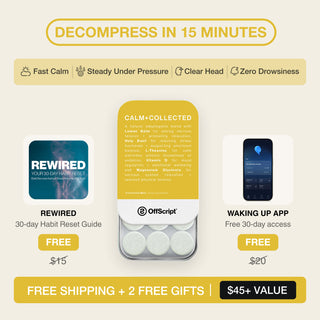
CALM+COLLECTED is caffeine-free: Lemon Balm 200mg, L-Theanine 200mg, Holy Basil 100mg, Magnesium Glycinate 120mg + Vitamin D 20mcg. It promotes calm for the transition from a high-alert shift to sleep, without knocking you out.
Why FOCUS+FLOW Fits
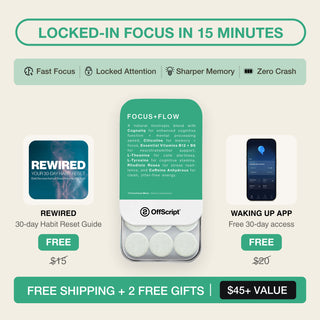
Shift work punishes the pattern most people default to, which is escalating caffeine across the night and then lying awake at 10am. FOCUS+FLOW is 100mg caffeine paired with 150mg L-Theanine, which gives cleaner alertness with less jitter, so you tend to use less of it overall. Rhodiola Rosea 100mg is aimed at exactly the mental fatigue that accumulates across consecutive nights, and the classic study on it was run on physicians during night duty. It works cumulatively over 1 to 4 weeks rather than dose by dose. It is a mint, so onset is 10 to 20 minutes, which matters when the dip arrives faster than a capsule would. Full formula, printed doses: CognatiQ 100mg, L-Theanine 150mg, Caffeine (Anhydrous) 100mg, L-Tyrosine 100mg, Rhodiola Rosea 100mg, Vitamin B12 60mcg, Vitamin B6 5.1mg, Citicoline 18mg. CALM+COLLECTED is the other half: caffeine-free, for the wind-down.
SHARP THROUGH THE DIP.
100mg caffeine + 150mg L-Theanine for cleaner alertness with less jitter. 12 mints per tin, 2 tins per order.
SHOP NOWStraight Answers
I already drink caffeine all night.
And you crash anyway, then cannot sleep when you get home. That is the loop worth breaking. Cleaner alertness with less jitter usually means using less total caffeine, and using it earlier in the shift. The change that matters most is not the product, it is the cutoff.
Nothing helps me wind down after nights.
CALM+COLLECTED is built for that transition specifically. Caffeine-free, so it is not fighting whatever you took at 2am, and it promotes calm without knocking you out. Pair it with sunglasses on the commute and a properly dark room. The behavioural side does a lot of the work here.
Is it safe to take this on consecutive night shifts?
For most healthy adults, 100mg of caffeine is well inside the mainstream 400mg daily guidance. The thing to watch across a run of nights is total intake, since it tends to creep. If you are on medication, pregnant, or managing a heart or blood pressure condition, check with a doctor first. Shift work already puts load on the system.
My schedule rotates, so nothing is consistent.
Then anchor the rule to the shift rather than the clock. Take it near the start, stop caffeine for the final third, wind down after. That works whether your shift starts at 7pm or 11pm. The cumulative ingredients like Rhodiola do not care what time you take them, only that you are consistent day to day.
Key Takeaways
- Two separate problems: staying sharp at night, and sleeping afterward.
- The 3am to 4am dip is physiological. Plan for it, do not fight it blind.
- Stop caffeine for the last third of the shift. This decides whether you sleep.
- Sunglasses on the commute home. Morning light tells your body the day started.
- Cleaner alertness usually means using less total caffeine, not more.
- Rhodiola Rosea builds over 1 to 4 weeks. Consistency matters more than timing.
References
- Darbinyan V, et al. Rhodiola rosea in stress induced fatigue: a double blind cross-over study of a standardized extract on the mental performance of healthy physicians during night duty. Phytomedicine. 2000. PMID 11081987
- Haskell CF, et al. The effects of L-theanine, caffeine and their combination on cognition and mood. Biological Psychology. 2008. PMID 18006208
- Kahathuduwa CN, et al. Acute effects of theanine, caffeine and theanine-caffeine combination on attention. Nutritional Neuroscience. 2017. PMID 26869148
- Fredholm BB, et al. Actions of caffeine in the brain with special reference to factors that contribute to its widespread use. Pharmacological Reviews. 1999. PMID 10049999
- Kamimori GH, et al. The rate of absorption and relative bioavailability of caffeine administered in chewing gum versus capsules. International Journal of Pharmaceutics. 2002. PMID 11839447
FAQ
What supplements help you stay awake on a night shift?
Caffeine is the ingredient with the strongest evidence for alertness, and pairing it with L-Theanine reduces the jitter that makes long shifts unpleasant. FOCUS+FLOW carries 100mg caffeine with 150mg L-Theanine, plus Rhodiola Rosea 100mg for the fatigue that accumulates across consecutive nights. Bright light and movement do real work too and cost nothing.
How do I sleep after a night shift?
The single biggest lever is stopping caffeine for the last third of your shift, because a 5am dose is still substantially present at 10am. After that, sunglasses on the commute home, a genuinely dark room, and a caffeine-free wind-down. CALM+COLLECTED promotes calm for that transition without knocking you out.
What helps with the 3am to 4am dip?
That window is when core body temperature bottoms out, so the dip is physiological rather than motivational. Plan for it instead of being surprised. If it is far enough from your sleep window, a dose of caffeine is reasonable, and pairing it with bright light and a few minutes of movement addresses alertness through a different mechanism than any supplement does.
Is it safe to use these across several night shifts in a row?
For most healthy adults, 100mg of caffeine per dose sits well inside the mainstream guidance of around 400mg a day. The thing to watch across a run of nights is total intake, which tends to creep upward. If you are pregnant, on medication, or managing a heart or blood pressure condition, check with a doctor first.
