




"Cortisol belly" promises something appealing: that the weight you cannot shift is not about food or training, it is hormonal, + the right supplement unlocks it. There is a real mechanism buried in that claim, which is why it spreads. There is also a large amount of nonsense stacked on top. Here is what cortisol genuinely does to fat storage, how much it actually explains, + what moves the needle. We will say up front that the answer is not a mint. For the wider picture, start with how to lower cortisol naturally.
The Part That Is Real
Cortisol is a metabolic hormone, not just a stress signal. It mobilises glucose, influences appetite + interacts with insulin. Visceral fat, the deeper abdominal fat packed around the organs rather than sitting under the skin, is more metabolically active + more responsive to those signals than fat elsewhere.
So the directional claim holds: sustained cortisol elevation is associated with a preference for abdominal storage. That is why the phrase exists at all + why doctors take central weight gain seriously as a clinical sign.
The more useful frame is the daily curve rather than the total. Cortisol should rise sharply after waking then fall across the day. Under chronic pressure that slope flattens, and it is the flattened pattern, not one high reading, that tracks with metabolic consequences. A systematic review of human trials on the hypothalamic-pituitary-adrenal axis maps where this regulation genuinely responds to intervention (Lopresti, 2022).
The Part That Is Oversold
It is one input, not the input. Total energy intake, activity, sleep, age, genetics + medication all shape body composition, and for most people they dominate. Cortisol nudges distribution. It does not override the rest.
"Cortisol belly" is not a distinct type of fat. You cannot look at a waistline + diagnose a hormone. Abdominal fat looks the same whether stress, calories, genetics or menopause put it there, which means anyone offering to identify "cortisol belly" from a photo is guessing.
There is no spot reduction. This is settled, and it applies here too. No intervention removes fat from one region on demand, hormonal or otherwise.
No supplement is shown to reduce abdominal fat via cortisol. This is the load-bearing claim of the entire category + it is not supported. Ashwagandha has the best cortisol data of any adaptogen, roughly a 28% serum reduction over 60 days in a randomised placebo-controlled trial of chronically stressed adults (Chandrasekhar et al., 2012). That is a hormone measurement. It is not a body-composition result, + presenting it as one is the sleight of hand this market runs on.
The Indirect Route That Actually Matters More
Here is where stress genuinely earns its reputation, + it has little to do with hormones acting on fat cells directly.
Chronic stress reliably shortens + fragments sleep. Short sleep increases appetite, degrades food choices + reduces spontaneous movement. It also makes training harder to sustain. Stress independently pushes people toward calorie-dense convenience food + evening drinking, and it removes the time + attention that cooking + exercise require.
That chain is well-supported + it is almost certainly doing more work than any direct cortisol-to-adipose effect. It is also better news, because every link in it is something you can act on.
What Actually Helps
Roughly in order of leverage:
- Sleep, protected + regular. The highest-yield change available, and it addresses both the hormonal route + the behavioural one at once.
- Strength training. Preserves lean mass, improves insulin sensitivity + changes body composition even when scale weight moves slowly.
- Eat regularly. Skipped meals are themselves a stressor, + they reliably set up worse choices later in the day.
- Walk daily, outdoors + early where possible. Morning light anchors the daily rhythm, which is the thing that flattens under pressure.
- Move the last coffee earlier. Controlled work found habitual drinkers keep a partial cortisol response to afternoon doses even after tolerance develops to the morning one (Lovallo et al., 2005). It is a small, cheap change aimed at the exact hours the curve should be falling.
- Reduce the actual load, or your control over it. The uncomfortable lever, + often the only one that works long-term.
Where A Supplement Honestly Sits
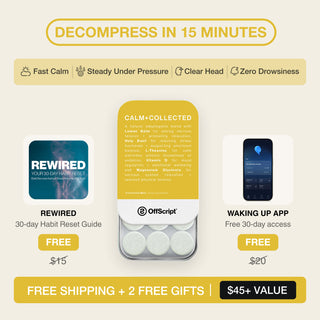
Not as a fat-loss tool. We are not going to claim CALM+COLLECTED changes body composition, because there is no evidence it does + we would be inventing it.
Where it fits is upstream: supporting a stress response that is keeping you wired at night. If that improves sleep, the sleep does the downstream work. L-Theanine has the best acute evidence, reducing the response to a stressor from a single dose in a triple-blind crossover trial (Evans et al., 2021). Holy basil has randomised placebo-controlled evidence on stress outcomes across weeks (Lopresti et al., 2022). Magnesium sits underneath as a cofactor, with the key review calling the anxiety evidence suggestive but limited by study quality (Boyle et al., 2017).
Promotes calm, focused attention without drowsiness.
A traditional herb long used to promote a settled mood.
The adaptogen layer, judged over weeks rather than afternoons.
A gentle, well-absorbed form, easier on the stomach than oxide.
Commonly low in people who work indoors.
CALM+COLLECTED is caffeine-free + contains no stimulant, no diuretic + nothing marketed for weight. That is deliberate.
When Central Weight Gain Is Medical
CALM UNDER PRESSURE
For the stress response underneath the broken sleep. Not a weight-loss product.
SHOP CALM+COLLECTEDKey Takeaways
- The mechanism is real: cortisol influences fat distribution, + visceral fat is particularly responsive. It is one input among many, not the dominant one.
- "Cortisol belly" is not a distinct type of fat + cannot be identified by looking. There is no spot reduction.
- The indirect route matters more: stress wrecks sleep, and short sleep drives appetite, food choices + activity.
- No supplement is shown to reduce abdominal fat through cortisol. A hormone-reduction trial is not a body-composition result.
- Rapid central weight gain with muscle weakness, purple stretch marks or new high blood pressure is a doctor visit, not a purchase.
Explore The Series
- Signs of High Cortisol: What Is Real + What Is Not
- Cortisol Detox: What It Means + What Actually Works
- How To Lower Cortisol Naturally: The Complete Guide
- Cortisol Supplements: What Actually Works + What Is Marketing
- Supplements for Burnout: What Actually Helps
References
- Lopresti AL. Modulation of the hypothalamic-pituitary-adrenal (HPA) axis by plants and phytonutrients: a systematic review of human trials. Nutr Neurosci. 2022;25(8):1704-1730. PubMed
- Chandrasekhar K, Kapoor J, Anishetty S. A prospective, randomized double-blind, placebo-controlled study of safety and efficacy of a high-concentration full-spectrum extract of ashwagandha root in reducing stress and anxiety in adults. Indian J Psychol Med. 2012;34(3):255-262. PubMed
- Lovallo WR, et al. Caffeine stimulation of cortisol secretion across the waking hours in relation to caffeine intake levels. Psychosomatic Medicine. 2005. PMC
- Evans M, et al. A Randomized, Triple-Blind, Placebo-Controlled, Crossover Study to Investigate the Efficacy of a Single Dose of AlphaWave L-Theanine on Stress in a Healthy Adult Population. Neurol Ther. 2021;10(2):1061-1078. PubMed
- Lopresti AL, Smith SJ, Metse AP, Drummond PD. A randomized, double-blind, placebo-controlled trial investigating the effects of an Ocimum tenuiflorum (holy basil) extract on stress. Front Nutr. 2022;9:965130. PubMed
- Boyle NB, Lawton C, Dye L. The effects of magnesium supplementation on subjective anxiety and stress: a systematic review. Nutrients. 2017;9(5):429. PubMed
FAQ
Is cortisol belly a real thing?
The mechanism behind it is real but smaller than advertised. Cortisol influences where the body stores fat, and visceral abdominal fat is particularly responsive to those signals. It is one input among energy intake, activity, sleep, age, genetics and medication, and it is not the dominant one for most people. Abdominal fat also looks identical regardless of what caused it, so no one can identify a hormonal cause by looking.
How do I get rid of cortisol belly?
Not by targeting the area, because spot reduction does not work. The changes that genuinely help are protecting sleep, strength training, eating at regular intervals, walking daily in morning light, moving your last coffee earlier and reducing the underlying load. Sleep is the highest-leverage item, because it addresses both the hormonal route and the appetite and activity changes that follow stress.
Do cortisol supplements reduce belly fat?
There is no good evidence that they do. Some ingredients, ashwagandha most notably, have controlled trials showing reduced serum cortisol. That is a hormone measurement, not a body-composition outcome, and products routinely present the first as though it proves the second. We do not claim our formula changes body composition, because it has not been shown to.
Does stress make you gain weight?
Mostly through indirect routes that are well supported. Chronic stress shortens and fragments sleep, and short sleep increases appetite, worsens food choices and reduces spontaneous movement. Stress also pushes people toward calorie-dense convenience food and evening drinking. Those effects are likely larger than any direct action of cortisol on fat cells.
When should I see a doctor about abdominal weight gain?
When it is rapid or unexplained and concentrated across the trunk and face, especially alongside muscle weakness, new wide purple stretch marks, easy bruising or new high blood pressure. Thyroid conditions, PCOS, medication side effects and Cushing's syndrome all cause central weight change and all have real treatments, so getting it assessed properly matters more than any supplement decision.
These statements have not been evaluated by the Food and Drug Administration. This product is not intended to diagnose, treat, cure, or prevent any disease. It is not a weight-loss product. This article is educational and is not medical advice.