




Every frequent flyer has done the gate-side supplement audit: the powder that looks suspicious, the gummies fused into one brick, the capsules rattling loose in a sandwich bag. Traveling with supplements is mostly easy, but the rules + the practical failures are worth knowing before the trip, not at the checkpoint. Here is the whole picture in one place.
The rules in one paragraph: in the United States, TSA allows supplements in both carry-on + checked bags, pills + solids in any quantity, with no requirement to keep them in original containers. Liquid or gel supplements fall under the standard 3.4oz (100ml) carry-on limit. Solid forms, tablets, capsules, gummies + mints, face no such cap. International trips add one wrinkle: a few countries regulate specific ingredients, so check your destination for anything unusual.
What TSA Actually Cares About
Almost nothing, when it comes to solid supplements. Pills + solids are unlimited in carry-on + checked luggage. You do not need original bottles for domestic flights, though labeled containers make any conversation shorter. Officers can ask about anything, so the practical rule is simple: carry supplements that are identifiable, ideally in labeled packaging, + keep them accessible rather than buried.
Liquids are the exception. A liquid vitamin, a tincture, or a gel-based supplement counts toward the liquids bag in carry-on, 3.4oz or less per container. Larger bottles go in checked luggage.
Powders get a soft rule of their own: containers over 12oz may need separate screening. A tub of powdered anything is legal, it just slows you down.
Why A Tin Of Mints Is The Easy Case
A pressed mint is a solid in a labeled tin, which means it clears every rule above without a thought. No liquids bag, no quantity math, no water needed to take one mid-flight, + the label prints every ingredient + dose, so the what-is-this conversation answers itself.
The format also solves the in-flight problem the checkpoint never sees: actually taking the thing. Capsules want water; the beverage cart is forty minutes away. A sublingual mint dissolves on its own, whenever you want it, in seat 23F with the tray table up. How to take one properly is covered in How to Take Sublingual Mints Correctly.
Packing Supplements Like An Adult
Carry-on, not checked. Anything you actually need on the trip goes with you. Checked bags miss connections; your magnesium should not.
Keep the labels. For international trips especially, original packaging is the difference between a wave-through + a lecture. A pill organizer is fine domestically; abroad, keep at least one labeled container per product.
Check your destination for the weird ones. Most common supplements travel fine anywhere. A handful of ingredients, some stimulants, melatonin in a few countries, CBD in many, are regulated abroad. Two minutes of checking beats an airport seizure of your supply.
Mind the heat. A car trunk in August or a checked bag on a tarmac cooks formulas. Cabin temperature is fine; that is another quiet argument for the carry-on.
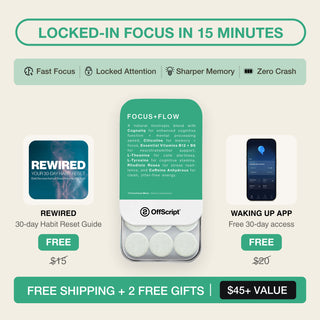
Pack for the timezone, not just the flight. If you use a caffeinated mint like FOCUS+FLOW, remember the six-hour rule still applies in the new timezone: caffeine within six hours of your new bedtime disrupts the sleep you need to beat jet lag (Drake et al., 2013). Use it on landing-day mornings, not overnight flights.
The Travel Stack That Earns Its Space
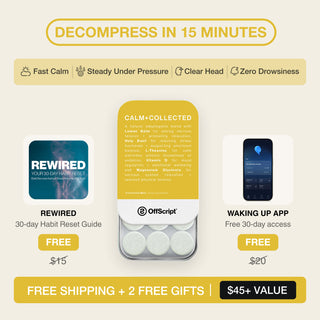
Travel strips your routine to what fits in a pocket, which is clarifying. The honest short list: FOCUS+FLOW for landing-day mornings + the work you flew there to do. CALM+COLLECTED for the parts of flying that spike your pulse, boarding, turbulence, tight connections, since it is caffeine-free + works in about fifteen minutes; the full pre-flight protocol is in our guide to natural stress relief. Magnesium for the hotel nights. Everything else can usually stay home for a week.
BUILT FOR THE CARRY-ON
Printed doses in a pocket tin. The easiest thing in your bag to explain.
SHOP FOCUS+FLOWKey Takeaways
- TSA allows solid supplements in any quantity, carry-on or checked, no original bottles required domestically.
- Liquid supplements obey the 3.4oz carry-on rule; powders over 12oz may get extra screening.
- Mints in a labeled tin are the easiest case: solid, identifiable, no water needed in-flight.
- Go carry-on, keep labels for international trips, + check destination rules for regulated ingredients.
- In a new timezone, keep caffeine six hours clear of the new bedtime to protect jet-lag recovery.
Explore The Series
- How to Take Sublingual Mints Correctly
- The Complete Guide to Natural Calm + Stress Relief
- Caffeine Mints: The Practical Guide
References
- Drake C, Roehrs T, Shambroom J, Roth T. Caffeine effects on sleep taken 0, 3, or 6 hours before going to bed. J Clin Sleep Med. 2013;9(11):1195-1200. PubMed
FAQ
Can I bring supplements on a plane?
Yes. TSA allows pills + solid supplements in unlimited quantities in both carry-on + checked bags, + original containers are not required for domestic flights. Liquid supplements follow the standard 3.4oz carry-on limit, + powders over 12oz may need separate screening.
Do supplements need to be in original bottles to fly?
Not for domestic US flights; a pill organizer is fine. For international travel, keep original labeled packaging, because customs officers in other countries may want to identify what you are carrying, + a printed label settles it instantly.
Can I take supplement mints through TSA?
Yes, they are the easiest case there is: a solid supplement in a labeled tin. No liquids rule applies, no quantity cap, + the ingredient panel on the tin answers any question. They also need no water in-flight, which is the real advantage at 35,000 feet.
Are supplements allowed on international flights?
Almost always, but the destination country's rules matter more than the airline's. Most vitamins + minerals travel anywhere; a few ingredients, melatonin in some countries, certain stimulants + CBD in many, are regulated. Check your specific destination for anything beyond the basics.
What supplements should I take when flying?
Keep it minimal: something for calm if flying winds you up (caffeine-free, so it will not fight your sleep), something for alertness on landing-day mornings, + magnesium for hotel-room sleep. Skip anything caffeinated within six hours of your destination bedtime.
These statements have not been evaluated by the Food and Drug Administration. This product is not intended to diagnose, treat, cure, or prevent any disease. Travel rules summarized here reflect published TSA guidance + can change; check current TSA + destination-country rules before you fly.
