




In India, tulsi is planted in courtyards + treated as sacred. In a supplement facts panel, it's Ocimum sanctum, 100mg. Somewhere between those two framings sits the actual question: does holy basil do anything measurable to how your body handles stress, or is it just a very old habit with good branding? How that gets measured is explained in how to lower cortisol, + holy basil is ranked against its alternatives in cortisol supplements.
The research is more interesting than either camp would like.
What "Adaptogen" Actually Means
The word gets thrown around so loosely it's nearly meaningless. The original pharmacological definition is narrower + more useful: a substance that helps the body maintain balance under stress, works non-specifically rather than targeting one symptom, and doesn't significantly disturb normal function when you're not stressed.
That last clause is the interesting one. A sedative makes you calmer whether or not you needed calming. A true adaptogen is supposed to do more when your system is dysregulated + less when it isn't. Whether any plant fully meets that bar is genuinely debated — but it's the right frame for reading the tulsi literature.
The Stress Axis, In Plain Terms
When your brain registers a threat — a deadline, a difficult conversation, an inbox — it triggers a chain called the HPA axis: hypothalamus, pituitary, adrenal glands. The output is cortisol.
Cortisol isn't the villain it's marketed as. It mobilises glucose, sharpens attention + gets you through the thing. The problem is chronic activation. When the stressor never fully ends, the axis stays switched on, and that sustained signalling is what's associated with the downstream effects people actually complain about: broken sleep, a wired-but-tired baseline, difficulty concentrating.
A systematic review of human trials examined how various plants + phytonutrients modulate the HPA axis, cataloguing where the evidence is real + where it's thin (Lopresti, 2022). Holy basil sits in the "promising, more trials needed" tier — which is exactly where honest marketing should place it.
What The Human Trials Show
Holy basil has better human data than most herbs in its category, though the trials remain small.
The most rigorous recent entry is a randomised, double-blind, placebo-controlled trial of an Ocimum tenuiflorum extract in adults reporting stress, which found improvements in stress-related outcomes versus placebo (Lopresti et al., 2022). Placebo-controlled + double-blind is the standard that matters here, because stress measures are self-reported + notoriously responsive to expectation.
On the cognitive side, a placebo-controlled study in healthy adult volunteers reported improvements in specific cognitive parameters — reaction time + error rates on attention tasks — after holy basil supplementation (Sampath et al., 2015). That's a useful signal because it suggests the effect isn't purely sedative: something is improving under load, not just dampening arousal.
What the research does not support: claims that holy basil treats anxiety disorders, replaces medication, or produces dramatic cortisol reductions in everyone. The effect sizes in these trials are modest. Anyone promising a transformation is going past the evidence.
Why It's Paired, Not Solo
Single-ingredient thinking is how most supplement marketing works + it's usually the weakest version of the argument. The more defensible position is that stress has multiple levers + hitting several gently beats hitting one hard.
Holy basil works on the stress-response axis over days + weeks. L-theanine works within an hour on your immediate state, associated with increased alpha-wave activity — the relaxed-but-alert signature (Nobre et al., 2008). Magnesium sits underneath both as a cofactor in hundreds of enzymatic reactions, with a systematic review finding suggestive but methodologically limited evidence for subjective anxiety (Boyle et al., 2017).
Different timescales, different mechanisms. That's the case for a formula rather than a single capsule.
The CALM+COLLECTED Label
Everything, at its real dose. No proprietary blend hiding the amounts:
Promotes calm, focused attention without drowsiness.
Traditional herb used to promote a settled mood.
Adaptogen traditionally used to support resilience under stress.
A gentle, well-absorbed form of magnesium.
Supports normal mood + immune function.
Our holy basil dose is 100mg, which is lower than some standalone tulsi products. That's deliberate — it's formulated as one lever among several rather than the entire argument.
CALM UNDER PRESSURE
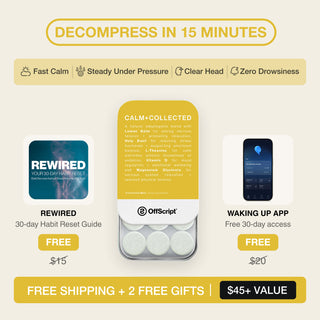
Holy basil, lemon balm + L-Theanine in a mint that dissolves in 60 seconds. 12 mints per tin, 2 tins per order.
SHOP CALM+COLLECTEDHow To Use It — And What To Expect
Adaptogens are not acute-relief tools. The trials that show effects on stress measures generally run six to eight weeks of daily use. If you take holy basil once before a stressful meeting + feel nothing, that's the expected result, not a failure.
Set the expectation correctly: a slightly lower baseline, a slightly faster return to normal after something stressful, over weeks. Undramatic. Which is roughly what the effect sizes in the literature would predict.
Safety notes worth stating: holy basil may affect blood sugar + has some evidence of anti-fertility effects in animal studies at high doses, so if you're managing diabetes, trying to conceive, pregnant, or on blood thinners, talk to a doctor first.
Key Takeaways
- Holy basil works on the HPA axis — the stress-response chain that ends in cortisol — rather than sedating you directly.
- It has better human evidence than most herbs in its category, including a recent randomised, double-blind, placebo-controlled trial, but the effect sizes are modest.
- A placebo-controlled study in healthy volunteers also found improvements in attention measures, suggesting it isn't purely a dampener.
- It's a weeks-long tool, not an acute one. Judge it over four to six weeks of daily use.
- CALM+COLLECTED uses 100mg as one lever among several, alongside L-theanine's faster, different mechanism.
Explore The Series
- The science of adaptogens + the stress response
- The complete guide to natural calm + stress relief
- Does caffeine raise cortisol?
References
- Lopresti AL, Smith SJ, Metse AP, Drummond PD. A randomized, double-blind, placebo-controlled trial investigating the effects of an Ocimum tenuiflorum (holy basil) extract on stress. Front Nutr. 2022;9:965130. PubMed
- Sampath S, Mahapatra SC, Padhi MM, et al. Holy basil (Ocimum sanctum Linn.) leaf extract enhances specific cognitive parameters in healthy adult volunteers: A placebo controlled study. Indian J Physiol Pharmacol. 2015;59(1):69-77. PubMed
- Lopresti AL. Modulation of the hypothalamic-pituitary-adrenal (HPA) axis by plants and phytonutrients: a systematic review of human trials. Nutr Neurosci. 2022;25(8):1704-1730. PubMed
- Nobre AC, Rao A, Owen GN. L-theanine, a natural constituent in tea, and its effect on mental state. Asia Pac J Clin Nutr. 2008;17 Suppl 1:167-168. PubMed
- Boyle NB, Lawton C, Dye L. The effects of magnesium supplementation on subjective anxiety and stress — a systematic review. Nutrients. 2017;9(5):429. PubMed
- Savage K, Firth J, Stough C, Sarris J. GABA-modulating phytomedicines for anxiety: A systematic review of preclinical and clinical evidence. Phytother Res. 2018;32(1):3-18. PubMed
FAQ
Does holy basil lower cortisol?
Some human trials report improvements in stress-related measures, and a systematic review places it among plants with plausible HPA-axis effects. But "lowers cortisol" oversimplifies it — cortisol fluctuates hour to hour, the effect sizes in these trials are modest, and no supplement reliably produces a dramatic drop. Support for the stress response is a fairer description than suppression of a hormone.
How long before holy basil works?
The trials showing effects on stress measures generally run six to eight weeks of daily use. It isn't an acute-relief tool — if you take it once before a stressful event and feel nothing, that's expected. Judge it over four to six weeks.
Is holy basil the same as regular basil?
No. Culinary basil is Ocimum basilicum. Holy basil is Ocimum sanctum (also called Ocimum tenuiflorum, or tulsi) — a different species with a different compound profile. Eating pesto is not a substitute.
Why is your dose only 100mg when other products use more?
Because it's formulated as one lever among several rather than the whole argument. CALM+COLLECTED pairs it with 200mg of L-theanine and 200mg of lemon balm, which work on different mechanisms and different timescales. Chasing the largest single number tends to make a better label, not a better formula.
Who should avoid holy basil?
It may affect blood sugar, and animal studies at high doses have raised anti-fertility questions. If you're managing diabetes, trying to conceive, pregnant, breastfeeding, or taking blood thinners, check with a doctor first.