




Focus is not a personality trait you are born with or without. It is a system you can build. Get the environment, the habits, + the fuel right, and flow state stops being luck + starts being repeatable. This guide is the practical version: what flow actually is, how to cut the inputs that shatter it, how to build a trigger that gets you in fast, how to fuel it cleanly, the focus killers nobody warns you about, + a simple daily protocol you can start tomorrow. No hacks. Just the levers that move.
What Flow State Actually Is
Flow is the state where the work pulls you along + time disappears. You stop watching yourself do the task + just do it. Output climbs, effort feels lower, + you look up an hour later surprised at how much got done.
It shows up under specific conditions: the challenge roughly matches your skill, the goal is clear, feedback is immediate, + distractions have fallen away. Too easy + you drift. Too hard + you stall. In the pocket between, flow appears.
You cannot force flow by gritting your teeth. But you can set the table for it, + that is the entire game. Most people treat focus as a willpower problem: try harder, feel guilty when it fails. It is usually a setup problem. Your phone is in reach. Six tabs are open. You never defined what done looks like. Fix the setup + focus mostly takes care of itself.
That reframing matters because it is fixable. You do not need more discipline than everyone else. You need fewer things fighting for your attention + a clear runway into the work. The rest of this guide is how to build that runway, step by step.
That is good news, because a setup is fixable + willpower is not something you can simply decide to have more of. You change the room, not your character.
Cut The Inputs First
Before you add anything, remove. Attention is subtractive. Every input competing for it is a crack flow leaks out of.
Start with the phone. Not face-down on the desk, in another room. The mere presence of a phone within reach measurably drags on focus, even switched off, because part of your mind is holding the door open for it. Distance beats willpower.
Then the screen in front of you. Close every tab that is not the task. Kill notifications, or better, put the machine in a focus mode that silences them at the system level. One task, one window. If you need the internet for the work, keep only what the work needs open.
Then the ambient stuff. Noise-cancelling or a single track on repeat gives your brain a wall against the room. Tell people, or a shared calendar, that this block is protected.
None of this is glamorous, + that is the point. The biggest focus gains are not clever techniques. They are the boring removal of the six things quietly pulling at you. Make the environment boring in every direction except the work, + the work becomes the most interesting thing left.
Subtraction is unglamorous, which is exactly why it is underrated. The biggest focus gains hide in the boring work of removing what was quietly pulling at you.
Build The Trigger
Flow rewards a runway. The brain drops into deep work faster when a consistent cue tells it the session is starting. You are training a pattern, + patterns beat motivation.
Pick a trigger + repeat it until it is automatic. Same time of day if you can. Same first action: open the one document, start the timer, put on the same track. A small physical cue helps: a specific drink, or a mint you take as the session opens. The cue itself does not have to be powerful. It has to be consistent. Over a week or two, the cue + the state fuse, + starting gets easier.
Work in blocks, not marathons. Ninety minutes of protected focus followed by a real break beats four hours of grinding with a leaking tank. Focus is a sprint-recover cycle. The break is not a failure of discipline; it is what makes the next block possible.
And define done before you start. "Work on the report" is a swamp. "Draft the three-paragraph summary" is a target. A clear finish line gives the immediate feedback flow needs + stops the task from sprawling into the whole day.
Motivation is unreliable + shows up when it pleases. A trained pattern shows up whether you feel like it or not, which is the entire reason to build one.
Fuel It Cleanly
Environment + habit set the table. Fuel decides how sharp you are once you sit down.
Caffeine genuinely helps focus. It blocks adenosine, the tiredness signal, so alertness + drive rise. The problem is what usually rides with it: the jitters that make you scattered instead of sharp, + the crash a few hours later. A wired brain is not a focused brain.
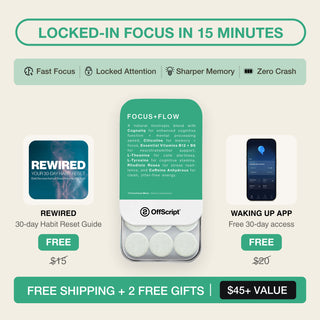
The fix is pairing. L-Theanine, an amino acid from tea, promotes calm by supporting alpha brain-wave activity, the state tied to relaxed attention. Run it alongside caffeine + it takes the edge off without dulling the alertness. You get steady focus instead of a buzz. This is the single best-studied fuel combination for cognitive work, + it is the engine of FOCUS+FLOW: 100mg of naturally sourced caffeine with 150mg L-Theanine, in a fast-dissolving mint that works in minutes.
Do not forget the basics fuel sits on top of. Sleep is the real nootropic; nothing rescues a badly slept brain. Water + a bit of protein beat a sugar spike that spikes + then sinks. Fuel amplifies a rested system. It does not replace one.
SET THE TABLE FOR FLOW
Clean focus fuel in a fast mint. 12 per tin, 2 tins per order.
SHOP FOCUS+FLOWThe Focus Killers Nobody Talks About
Some focus leaks are obvious. Others hide in plain sight, + they quietly cap your best days.
Context-switching is the big one. Every time you flick to a message + back, there is a switching cost: your brain leaves residue on the last task + takes minutes to fully re-engage. Do that thirty times an hour + you are never actually deep. Batch your inputs. Check messages on purpose, at set times, not on reflex.
The second is the afternoon crash, + it is often self-inflicted. A big lunch or a mid-morning caffeine spike sets up a 2pm dip. A steadier fuel curve + a lighter lunch keeps the afternoon usable.
The third is ambiguity. An undefined task drains focus because part of your mind is still deciding what to do instead of doing it. Decide first, execute second.
The fourth is chronic under-recovery. Skipped sleep, no breaks, permanent low-grade stress: a frazzled nervous system cannot focus no matter how many tabs you close. If you are running on empty, the fix is not another technique. It is rest. Knowing which killer is hitting you is half the battle, because the fix for each is different.
Name the one that is hitting you + the fix usually becomes obvious, because the remedy for each is different. Diagnosis first, then the tool.
A Simple Daily Protocol
Put it together + it is not complicated. Here is a protocol you can run tomorrow.
Morning: protect your first 90 minutes for the hardest thinking, when your mind is freshest + the day has not filled with other people's priorities. Phone in another room. One task defined. Take your focus fuel as the block opens, so it is working by the time you are in.
Midday: eat lighter than you want to, get a few minutes of daylight + movement, + reset. This is what keeps the afternoon from collapsing.
Afternoon: use a second block for focused-but-lighter work. If the 2pm dip hits, a clean caffeine + L-Theanine mint beats a third coffee that will wreck your sleep. Mind the timing: keep caffeine out of the eight hours before bed.
Evening: stop chasing focus + start protecting sleep, because tomorrow's focus is built tonight. Screens down early, wind down on purpose.
None of these steps is heroic. Run them consistently for two weeks + your baseline focus rises on its own. Consistency is the hack. For the fuel side in detail, see the best nootropic stack guide.
None of it is heroic. The advantage compounds because you run it every single day, not because any one step is clever. Boring + repeated beats brilliant + occasional.
Key Takeaways
- Focus is a setup problem more than a willpower problem.
- Cut inputs first: phone away, one task, notifications off.
- Build a consistent trigger + work in 90-minute sprint-recover blocks.
- Fuel cleanly: caffeine + L-Theanine for steady focus, on top of real sleep.
- Beat the hidden killers: context-switching, the afternoon crash, ambiguity, under-recovery.
Explore The Series
- The best nootropic stack for all-day focus
- L-Theanine + caffeine: the focus stack
- Best energy mints
- The complete guide to nootropic mints
FAQ
How can I improve my focus fast?
Cut inputs before adding anything: phone in another room, notifications off, one task, one window. Then define what done looks like + protect a set block of time. Clean caffeine paired with L-Theanine can sharpen the block, but the environment does most of the work.
How do I get into flow state?
Match a challenging task to your skill, make the goal clear, remove distractions, + give yourself an uninterrupted block of at least an hour. Flow appears in the pocket where the work is hard enough to absorb you but not so hard you stall. You set the table; you cannot force it.
Does caffeine actually help focus?
Yes. Caffeine blocks adenosine, the molecule that builds up + makes you tired, so alertness + drive rise. On its own it can tip into jitters + a crash, which is why pairing it with L-Theanine, the way FOCUS+FLOW does, keeps the focus steady instead of wired.
Why do I lose focus in the afternoon?
The 2pm dip is often self-inflicted: a big lunch or a morning caffeine spike sets up the crash. A lighter lunch, a few minutes of daylight + movement, + a steadier fuel curve keep the afternoon usable. A clean caffeine + L-Theanine mint beats a third coffee that wrecks your sleep.
What is the biggest hidden focus killer?
Context-switching. Every flick to a message + back carries a switching cost, leaving mental residue that takes minutes to clear, so checking messages thirty times an hour means you are never truly deep. Batch your inputs: check on purpose at set times, not on reflex.
References
- Owen GN, et al. "The combined effects of L-theanine and caffeine on cognitive performance and mood." Nutritional Neuroscience, 2008. PubMed
- Kelly SP, et al. "L-theanine and caffeine in combination affect human cognition as evidenced by oscillatory alpha-band activity and attention task performance." Journal of Nutrition, 2008. PubMed
- Dodd FL, et al. "A double-blind, placebo-controlled study evaluating the effects of caffeine and L-theanine both alone and in combination on cerebral blood flow, cognition and mood." Psychopharmacology, 2015. PMC
- Deijen JB, et al. "Tyrosine improves cognitive performance and reduces blood pressure in cadets after one week of a combat training course." Brain Research Bulletin, 1999. ScienceDirect
- Olsson EM, von Schéele B, Panossian AG. "A randomised, double-blind, placebo-controlled, parallel-group study of the standardised extract SHR-5 of the roots of Rhodiola rosea in the treatment of subjects with stress-related fatigue." Planta Medica, 2009. PubMed
- Reyes-Izquierdo T, et al. "Modulatory effect of coffee fruit extract on plasma levels of brain-derived neurotrophic factor in healthy subjects." British Journal of Nutrition, 2013. PubMed