




You know the caffeine curve because you live it. The first cup is clean + sharp. By the second, your leg is bouncing, your inbox feels louder, and your attention keeps slipping off the thing you actually need to do. Then, an hour later, the floor drops out. That isn't a discipline problem. It's a chemistry problem—and it's the exact problem the L-theanine caffeine focus stack was built to solve.
Here's the reframe that matters: the answer to a rough stimulant isn't a stronger stimulant, and it isn't a prescription. It's a smarter pairing. L-theanine, an amino acid found almost exclusively in tea, doesn't blunt caffeine's edge—it reshapes it. Used correctly, the two turn "wired + scattered" into "calm + locked in." This is a practical guide to building that stack the right way: the mechanism, the ratio, the timing, and where it fits.
Why caffeine alone works against you
Caffeine is a genuinely good molecule. It blocks adenosine, the neurotransmitter that accumulates through your day and makes you feel tired, so you feel more awake + alert. That part is real and worth keeping.
The trouble is that caffeine doesn't stop at wakefulness. It also drives up sympathetic "fight or flight" activity—raising heart rate, nudging blood pressure, and spiking the physical arousal you experience as jitters, a racing mind, and that thin layer of anxiety over everything. For focused work, arousal is a curve, not a straight line. A little sharpens you. Too much fragments you: you feel busy + stimulated, but you can't hold a single thread. That's why a big coffee often makes you feel more productive while you actually get less done.
Most people respond by drinking more, which pushes them further up the wrong side of the curve. What you actually want is caffeine's alertness with the physical over-arousal filed off. That's the specific job L-theanine does.
What L-theanine actually does in your brain
L-theanine is worth understanding on its own terms, because "it makes caffeine smoother" undersells the mechanism. Within roughly 30 to 40 minutes of an oral dose, L-theanine increases alpha-band brain wave activity—the same electrical rhythm your brain produces during relaxed, alert focus, like the settled state of an experienced meditator. Critically, alpha activity is the signature of calm attention, not sedation. You get quieter, not sleepier.
Underneath that, L-theanine modulates several systems at once. It raises inhibitory GABA tone, partially dampens over-excitatory NMDA glutamate signaling, and gently influences dopamine + serotonin. In plain terms: it turns down the neural noise that stimulants turn up. That's the opposite of how a benzodiazepine works—there's no sedation, no fog, no dependency profile. It's a natural counterweight, which is exactly why it pairs so cleanly with caffeine instead of cancelling it out.
Why the L-theanine caffeine focus stack beats either one alone
This is where the research gets specific, and it's the reason this pairing has become a staple in serious cognitive-performance circles rather than just another supplement trend.
In a double-blind, placebo-controlled study, researchers found that combining L-theanine and caffeine improved both the speed and accuracy of attention-switching and reduced how easily people were distracted during a demanding memory task—effects that showed up in the combination specifically. A separate placebo-controlled crossover trial using 97 mg of L-theanine with 40 mg of caffeine likewise found the pair significantly improved accuracy on a task-switching challenge. Attention-switching is a fair proxy for real knowledge work: bouncing between a document, a spreadsheet, and a conversation without losing the plot.
The "without the jitters" half of the promise has a mechanism too. Caffeine on its own constricts blood vessels and can push blood pressure up under mental load. In a controlled trial measuring cerebral blood flow, adding L-theanine offset caffeine's vasoconstrictive effect. And in a study on stress reactivity, L-theanine blunted the rise in blood pressure triggered by mentally stressful tasks, most noticeably in the people who normally spike the hardest. That physiological calming is what you feel as steadiness: alert, but not vibrating.
The honest caveat—because you deserve one—is that not every study shows a dramatic synergy, and effects are clearest for attention + task-switching rather than every cognitive measure. But the direction is consistent: caffeine brings the alertness, L-theanine keeps it civil.
How to actually build and use the stack
Mechanism is nice; execution is what changes your afternoon. Here's how to run the L-theanine caffeine focus stack well.
- Ratio: aim for roughly 2:1, L-theanine to caffeine. A common, well-tolerated starting point is 200 mg L-theanine to 100 mg caffeine. If you're caffeine-sensitive, keep the L-theanine and drop the caffeine toward 50 mg. The theanine should meet or exceed the caffeine—that's what keeps the edge off.
- Dose caffeine to your tolerance, not the label. 50 to 100 mg is plenty for most focused-work sessions. More caffeine doesn't buy more focus; past a point it just buys arousal, which is the thing you're trying to manage.
- Timing: take it about 30 to 45 minutes before you need to lock in. That lines up with when both compounds are ramping—alpha activity rising, adenosine blockade kicking in—so you arrive at your desk already dialed rather than climbing.
- Front-load your day. Caffeine has a long half-life (often 5 to 6 hours). Running the stack in the morning or early afternoon protects your sleep, which is the real foundation of next-day focus. Wrecking tonight's sleep to power through today is a bad trade.
- Don't stack it on top of three coffees. Count your total caffeine. The point is a clean, single, well-shaped dose—not adding theanine as an apology for overdoing it.
Run it this way for a week and the difference is obvious: fewer jitters, no cliff-edge crash, and longer stretches where the work just flows instead of fighting you.
The ingredient science: where FOCUS+FLOW fits
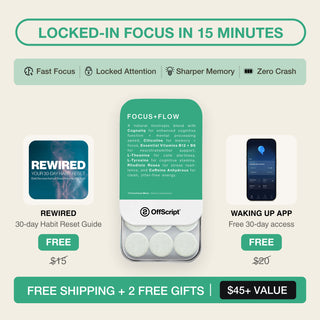
You can assemble this by hand from separate powders + a kitchen scale. Or you can use a formula that already respects the ratio and builds on top of it. That's the logic behind FOCUS+FLOW: it pairs L-theanine with caffeine anhydrous in a sensible ratio, then adds the ingredients that address what the base stack doesn't.
Calm, focused attention without the jitters.
Clean, measured energy—smoothed by L-Theanine.
Dopamine precursor for drive + focus under pressure.
Patented coffee-fruit extract, clinically studied to support BDNF.
Adaptogen that supports mental stamina under stress.
Raw material for acetylcholine, the memory + learning neurotransmitter.
Supports neurotransmitter production.
Supports cellular energy.
Caffeine + L-theanine handle the moment-to-moment "calm alertness." The rest of the formula supports the machinery underneath it. L-Tyrosine is a precursor your brain uses to synthesize dopamine—the motivation + drive neurotransmitter—which tends to get depleted under stress and heavy cognitive load. Choline is the raw material your body uses to make acetylcholine, a neurotransmitter central to memory + attention. CognatiQ, a patented, clinically studied coffee-fruit extract, is included for its research-backed ability to support BDNF (brain-derived neurotrophic factor)—a protein that supports the growth + resilience of neurons, essentially the substrate your focus is built on. Rhodiola Rosea adds adaptogenic support for mental stamina under stress, and vitamins B6 + B12 round it out, supporting neurotransmitter production + cellular energy metabolism.
The philosophy is the same at every layer: work with the body's own systems—give it the raw materials it already knows how to use—rather than overriding them with something synthetic. That's calm, sustainable focus by design, not a borrowed high you pay back later.
FOCUS ON COMMAND
The 2:1 stack, already dialed—plus the ingredients that support what caffeine can't.
SHOP FOCUS+FLOWThe bottom line
Caffeine isn't the problem. Unpaired caffeine is. The L-theanine caffeine focus stack is one of the most reliable, best-studied moves in natural cognitive performance precisely because it's not a hack—it's two molecules doing complementary jobs, exactly the way tea has delivered them for centuries. Alertness without the wired edge. Focus without the crash.
If you'd rather not weigh powders every morning, try FOCUS+FLOW for yourself and feel what a properly built stack does to a working afternoon. Your focus was never broken—it was just running on the wrong chemistry.
Key Takeaways
- Caffeine's problem isn't alertness—it's over-arousal. The jitters, the racing mind, and the crash come from sympathetic activation, not from the wakefulness you actually want.
- L-theanine reshapes the curve. It raises calm-focus alpha brain waves + turns down neural noise, giving you caffeine's edge without the vibration.
- The research is specific. The pairing improves attention-switching + accuracy and offsets caffeine's blood-pressure + vasoconstrictive effects in controlled trials.
- Ratio + timing matter. Aim for roughly 2:1 L-theanine to caffeine, 50–100 mg caffeine, taken 30–45 minutes before you lock in, front-loaded early in the day.
- FOCUS+FLOW builds on the base stack with L-Tyrosine, CognatiQ, Rhodiola, Choline + B-vitamins—supporting the machinery underneath calm alertness.
Explore The Series
- Why L-Theanine + Caffeine Is the Smartest Stack in Nootropics
- Natural Energy vs. the Caffeine Crash: What's Actually Happening
- CognatiQ Coffee-Fruit Extract + Why Your Brain Needs BDNF
References
- Nobre AC, Rao A, Owen GN. L-theanine, a natural constituent in tea, and its effect on mental state. Asia Pacific Journal of Clinical Nutrition. 2008. https://pubmed.ncbi.nlm.nih.gov/18296328/
- Owen GN, Parnell H, De Bruin EA, Rycroft JA. The combined effects of L-theanine and caffeine on cognitive performance and mood. Nutritional Neuroscience. 2008. https://pubmed.ncbi.nlm.nih.gov/18681988/
- Einöther SJ, Martens VE, Rycroft JA, De Bruin EA. L-theanine and caffeine improve task switching but not intersensory attention or subjective alertness. Appetite. 2010. https://pubmed.ncbi.nlm.nih.gov/20079692/
- Dodd FL, Kennedy DO, Riby LM, Haskell-Ramsay CF. A double-blind, placebo-controlled study evaluating the effects of caffeine and L-theanine both alone and in combination on cerebral blood flow, cognition and mood. Psychopharmacology. 2015. https://pmc.ncbi.nlm.nih.gov/articles/PMC4480845/
- Yoto A, Motoki M, Murao S, Yokogoshi H. Effects of L-theanine or caffeine intake on changes in blood pressure under physical and psychological stresses. Journal of Physiological Anthropology. 2012. https://pmc.ncbi.nlm.nih.gov/articles/PMC3518171/
FAQ
What is the best L-theanine to caffeine ratio?
Roughly 2:1 L-theanine to caffeine is the well-tolerated starting point most people land on—for example, 200 mg L-theanine to 100 mg caffeine. The key principle is that the L-theanine should meet or exceed the caffeine, because that's the balance that keeps caffeine's physical over-arousal in check while preserving its alertness.
Will L-theanine cancel out caffeine or make me drowsy?
No. L-theanine isn't a sedative—it raises alpha brain-wave activity, the signature of calm, alert focus, not sleep. It dampens caffeine's jittery over-arousal without touching the adenosine-blocking alertness that makes caffeine useful. You end up quieter, not sleepier.
When should I take the stack for focused work?
About 30 to 45 minutes before you need to lock in. That lines up with when both compounds are ramping—alpha activity rising, adenosine blockade kicking in—so you arrive at your desk already dialed. Keep it to the morning or early afternoon, since caffeine's 5-to-6-hour half-life can reach into your sleep.
How is this different from taking Adderall or a prescription stimulant?
It's a different approach entirely. The stack works with your body's own systems—supporting calm-focus brain rhythms and supplying raw materials your brain already uses—rather than forcing a synthetic override. It's framed as natural performance support, not a treatment for any medical condition, and it carries no dependency profile.
Does FOCUS+FLOW contain the right amount of L-theanine and caffeine?
FOCUS+FLOW pairs 150 mg L-theanine with 100 mg caffeine anhydrous—theanine meeting the caffeine, in line with the ratio the research supports. On top of that base it layers L-Tyrosine, CognatiQ, Rhodiola Rosea, Choline, and B-vitamins to support the dopamine, acetylcholine, and BDNF machinery underneath calm alertness.