




There's a specific kind of betrayal that happens around 2 p.m. You had the coffee. You had the energy drink, or the second coffee, or the pre-workout you keep at your desk. For an hour you felt sharp. Then the floor dropped out — foggy, irritable, reaching for more of the same thing that just failed you. The wellness aisle sells this as a fuel problem you can out-caffeinate. It isn't. It's a design problem, and clean energy without the crash is something you engineer, not something you buy in a taller can.
The good news for a skeptic who reads ingredient labels: the mechanics of a crash are well understood, which means the fixes are specific + testable. This isn't about willpower or "clean living" in the abstract. It's about three levers — your fuel supply, your stimulant, and the cofactors your cells need to turn food into usable energy. Get those right and steady output stops being a lucky day and starts being the default.
The Crash Is a Design Flaw, Not a Willpower Problem
A crash is your physiology doing exactly what you set it up to do. When you flood your system with fast sugar or a big isolated dose of caffeine, you get a sharp peak followed by an equally sharp correction. The most rigorous look at the sugar side of this came from the PREDICT study, which tracked postprandial glucose in over 1,000 people eating more than 8,600 standardized meals. Researchers found that the dip below baseline two to three hours after eating — not the peak — was the strongest predictor of returning hunger, shorter time to the next meal, and greater energy intake across the day (Wyatt et al., Nature Metabolism, 2021). People with bigger dips reported measurably more fatigue + hunger, independent of how high their glucose had spiked.
That's the whole crash story in one sentence: it's the trough, not the summit, that wrecks your afternoon. And glucose variability itself — the size and frequency of those swings — tracks with fatigue + mood more tightly than your average blood sugar does. So the goal isn't to chase a bigger high. It's to flatten the curve so there's no cliff on the other side. Every practical tactic below is a version of that same move.
Stabilize the Fuel: Steady Glucose Is the Foundation
If your blood sugar is on a rollercoaster, no supplement will save your energy — you'll just be alert on the way up + worse on the way down. Stable glucose is the non-negotiable base layer, and it's the cheapest lever you have.
- Lead with protein and fiber, not carbs alone. A bagel or a bowl of cereal is a glucose spike waiting to happen. The PREDICT data showed that meals higher in sugar and lower in protein + fiber produced the deepest post-meal dips. Anchoring a meal with 25–30g of protein and some fiber blunts both the spike and the crash that follows it.
- Don't drink caffeine on an empty stomach and call it breakfast. Caffeine with nothing to buffer it hits fast and leaves fast. Pairing it with real food changes the shape of the curve.
- Eat before you're starving. Letting glucose bottom out and then eating a big fast-carb meal is how you manufacture the exact swing you're trying to avoid.
- Move after you eat. A ten-minute walk pulls glucose into muscle instead of letting it spike + crash. It's unglamorous and it works.
None of this is a diet. It's a set of small, verifiable adjustments to the shape of your energy curve — and if you track your own biometrics, you can watch the afternoon slump shrink within a week.
Buffer the Stimulant: The L-Theanine Move
Caffeine isn't the enemy. Caffeine alone, in a big isolated dose, is the enemy — that's what delivers the jitter-then-crumble arc. The most elegant fix comes from an amino acid found in green tea: L-theanine.
Paired with caffeine, L-theanine keeps the alertness + reaction-time benefits while smoothing out the sharp edges. In a double-blind, placebo-controlled study on cerebral blood flow, cognition, and mood, the combination produced better cognitive performance and steadier subjective alertness than caffeine on its own (Dodd et al., Nutritional Neuroscience, 2015). More recent work backs this up: a high-dose L-theanine–caffeine combination significantly improved selective attention and reaction time versus placebo, even in sleep-deprived adults (British Journal of Nutrition, 2024).
Mechanistically, L-theanine promotes a calm-alert state without sedation, tempering the over-stimulation that caffeine alone can cause. Most of the research uses roughly a 2:1 ratio — around 200mg of L-theanine to 100mg of caffeine. The practical takeaway: if your energy source is pure stimulant, you're getting half the tool. The buffer is what turns a spike into sustained focus.
Fill the Cofactor Gaps: B Vitamins Run the Machinery
Here's the part the energy-drink category ignores because it doesn't sell excitement: your cells can't turn food into ATP without the right cofactors, and the B vitamins are central to that machinery. They don't contain energy themselves — they're the enzymes' tools for releasing it. Thiamine helps convert carbohydrates to fuel, riboflavin feeds the mitochondrial respiratory chain, and B6 sits in the middle of amino acid + carbohydrate metabolism in the citric acid cycle (Huskisson et al., Journal of International Medical Research, 2007).
Run low on these inputs and the whole conversion process gets less efficient — which shows up as exactly the kind of diffuse, stimulant-resistant fatigue no amount of coffee fixes. A randomized, double-blind trial found that B-complex supplementation (B1, B2, B6, B12) improved anti-fatigue markers + exercise performance in healthy adults (International Journal of Medical Sciences, 2023). B12 in particular supports the cellular energy production that keeps output steady rather than spiky. This is foundational, not flashy — and that's the point of clean energy: it's built on inputs, not on the next jolt.
FOCUS ON COMMAND
Steady, buffered, cofactor-backed energy — engineered so the floor doesn't drop out at 2 p.m.
SHOP FOCUS+FLOWWhat a Clean-Energy Stack Actually Looks Like
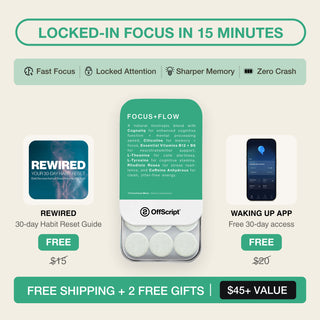
Put the levers together and you get a formula philosophy rather than a single hero ingredient. This is the logic behind Focus+Flow, which was built to deliver energy + focus without the peak-and-crash pattern most stimulants create. Two pieces are worth understanding before you look at the label.
The first is the coffee cherry. Cognatiq is a patented extract drawn from the whole coffee fruit — not the bean — and its polyphenols are clinically studied to raise brain-derived neurotrophic factor (BDNF), a protein tied to neuron health + cognitive performance. A single 100mg dose increased plasma BDNF by roughly 143% over baseline in healthy subjects (Reyes-Izquierdo et al., British Journal of Nutrition, 2013). Notably, the polyphenols drive the effect — not caffeine.
The second is choline, the raw material your body uses to build acetylcholine, the neurotransmitter behind memory + learning. Focus+Flow lists it as Choline (as Citicoline), 18mg — the nutrient followed by its source form, standard supplement-facts labeling — so the citicoline research applies to this formula directly. Using phosphorus MRI, researchers showed citicoline raised ATP + phosphocreatine in the frontal lobe, and a separate randomized trial found it improved attention in healthy adults (Nakazaki et al., Journal of Nutrition, 2021). That ATP finding matters for a piece about energy: citicoline isn't only feeding the memory pathway, it's supporting the frontal-lobe fuel supply too. Here's the full stack:
Patented coffee-fruit extract, clinically studied to support BDNF.
Calm, focused attention without the jitters.
Dopamine precursor for drive + focus under pressure.
Adaptogen that supports mental stamina under stress.
Clean, measured energy — smoothed by L-Theanine.
Raw material for acetylcholine, the memory + learning neurotransmitter.
Supports neurotransmitter production.
Supports cellular energy.
That's the difference between a stimulant and a system. One borrows energy from tomorrow. The other supports the inputs your body already uses to make its own.
The Real Takeaway
Clean energy without the crash isn't a product you stumble onto — it's a set of decisions. Flatten your glucose curve with protein + fiber. Buffer your stimulant so it lifts you without dropping you. Give your cells the cofactors they need to actually make energy. Do those three things and the 2 p.m. betrayal stops being a daily event.
If you'd rather not assemble all of that yourself, Focus+Flow was formulated around exactly this logic — steady, buffered, cofactor-backed energy instead of a spike you'll pay for later. Try it for yourself and see what your afternoons feel like when the floor stops dropping out.
Key Takeaways
- The crash lives in the trough, not the peak — the post-meal dip below baseline predicts fatigue + hunger better than how high your glucose spiked.
- Stable glucose is the base layer. Lead with protein + fiber, don't caffeinate on an empty stomach, and walk after meals to flatten the curve.
- Buffer the stimulant. Pairing caffeine with L-theanine (roughly 2:1) keeps the alertness while smoothing the jitter-then-crash arc.
- B vitamins run the machinery. They don't contain energy — they're the cofactors your cells need to release it, and running low shows up as stimulant-resistant fatigue.
- A system beats a jolt. Focus+Flow stacks Cognatiq, L-theanine, citicoline-sourced choline, and B vitamins to support steady output instead of borrowing energy from tomorrow.
Explore The Series
- Best Energy Mints: A Faster Way to Stay Focused
- Natural Energy vs. the Caffeine Crash: What's Really Going On
- The 2PM Crash Isn't a Willpower Problem
- Does Caffeine Raise Cortisol? What the Research Actually Says
- Why L-Theanine + Caffeine Is the Smartest Stack You Can Make
References
- Wyatt P, et al. "Postprandial glycaemic dips predict appetite and energy intake in healthy individuals." Nature Metabolism, 2021. https://www.nature.com/articles/s42255-021-00383-x
- Dodd FL, et al. "A double-blind, placebo-controlled study evaluating the effects of caffeine and L-theanine both alone and in combination on cerebral blood flow, cognition and mood." Nutritional Neuroscience, 2015. https://pmc.ncbi.nlm.nih.gov/articles/PMC4480845/
- "High-dose L-theanine–caffeine combination improves neurobehavioural and neurophysiological measures of selective attention in acutely sleep-deprived young adults." British Journal of Nutrition, 2024. https://pmc.ncbi.nlm.nih.gov/articles/PMC12491391/
- Huskisson E, et al. "The Role of Vitamins and Minerals in Energy Metabolism and Well-Being." Journal of International Medical Research, 2007. https://journals.sagepub.com/doi/pdf/10.1177/147323000703500301
- "A functional evaluation of anti-fatigue and exercise performance improvement following vitamin B complex supplementation in healthy humans." International Journal of Medical Sciences, 2023. https://www.ncbi.nlm.nih.gov/pmc/articles/PMC10542023/
- Reyes-Izquierdo T, et al. "Modulatory effect of coffee fruit extract on plasma levels of brain-derived neurotrophic factor in healthy subjects." British Journal of Nutrition, 2013. https://pubmed.ncbi.nlm.nih.gov/23312069/
- Nakazaki E, et al. "Citicoline and Memory Function in Healthy Older Adults: A Randomized, Double-Blind, Placebo-Controlled Clinical Trial." Journal of Nutrition, 2021. https://www.ncbi.nlm.nih.gov/pmc/articles/PMC8349115/
FAQ
Why do I crash a few hours after coffee or an energy drink?
A big isolated dose of caffeine or fast sugar produces a sharp peak followed by an equally sharp correction. Research on postprandial glucose found that the dip below baseline two to three hours after eating — the trough, not the peak — is the strongest predictor of returning fatigue and hunger. Your crash is your physiology correcting the spike you created.
Does L-theanine cancel out caffeine?
No. L-theanine doesn't blunt the alertness — it smooths the edges. In placebo-controlled studies the caffeine–L-theanine combination preserved the reaction-time and attention benefits while producing steadier subjective alertness than caffeine alone. It promotes a calm-alert state without sedation, which is why the pairing feels focused rather than wired.
Do B vitamins actually give you energy?
Not directly — they don't contain energy. B vitamins are cofactors your cells use to convert food into ATP: thiamine helps process carbohydrates, riboflavin feeds the mitochondrial respiratory chain, and B6 and B12 support the metabolism that keeps output steady. If you're running low, that conversion gets less efficient, which shows up as diffuse fatigue no amount of coffee fixes.
Is Focus+Flow just caffeine in a nicer package?
No. Caffeine is one measured input (100mg), buffered by 150mg of L-theanine. The rest of the formula does different jobs — Cognatiq for BDNF support, choline (as citicoline) as raw material for acetylcholine, L-tyrosine as a dopamine precursor, rhodiola for stamina under stress, and B6 and B12 as energy-metabolism cofactors. It's built as a system for steady output, not a bigger jolt.
How fast will I notice a difference?
The glucose habits — protein and fiber first, walking after meals, not caffeinating on empty — are testable within about a week if you track your own biometrics. The buffered-stimulant effect is noticeable the same day: caffeine paired with L-theanine feels steadier than caffeine alone almost immediately.
Is there an energy drink without a crash?
The honest answer: the crash is built into the standard energy-drink design — sugar plus a large unbuffered caffeine dose. Your best crash-free options change the design instead: a zero-sugar drink with a moderate dose, or better, a format that pairs caffeine with L-theanine at a printed dose, like a clean energy mint. No sugar to dip, and a counterweight on the stimulant.