





You know the pattern because you live it. The 8am coffee lands like a green light. By 10am you are unstoppable. By 2pm you are staring at your screen wondering why the words stopped making sense, reaching for a second cup that never quite works as well as the first. That afternoon collapse has a name, a mechanism, + a fix. The real story of natural energy vs the caffeine crash is not that caffeine is bad. It is that caffeine on its own is only half of a stimulant. The other half is what you use to land the plane.
This is not an anti-coffee sermon. Caffeine is one of the most studied + effective cognitive tools on earth. The problem is that most people are running the engine with no suspension, no steering, + no brakes, then blaming the fuel when the ride gets rough. Understanding why the crash happens is the first step to building energy that actually lasts.
What the caffeine crash actually is
Your brain runs on a quiet accounting system. As your neurons fire through the day, they produce a molecule called adenosine, which builds up + binds to receptors that tell your brain, in effect, "you are getting tired, start winding down." Adenosine is your fatigue signal. It is supposed to accumulate. That is how your body knows when to rest.
Caffeine works by impersonation. Structurally, it is similar enough to adenosine that it slots into the same receptors, acting as an antagonist that blocks adenosine from binding. The fatigue signal is still being sent, but the phone is off the hook. Researchers have specifically implicated antagonism of the adenosine A2A receptor in caffeine's wakefulness-promoting effect. You do not feel more energetic in a metabolic sense. You feel less tired, because the tiredness message is being intercepted.
Here is the part nobody warns you about. While caffeine sits on those receptors, adenosine does not stop being produced. It keeps piling up in the background, unheard. Caffeine has a half-life of roughly five to six hours, meaning that hours after your cup, half of it is still circulating. But eventually it clears. And when it does, every receptor opens at once to a backlog of adenosine that has been accumulating for hours. The fatigue signal that was on hold gets delivered all at the same time. That wall of tiredness is the crash, + it can feel heavier than if you had never had the coffee at all.
Why more coffee is the wrong answer
The instinctive fix is another cup. It works, briefly, because you are re-blocking the receptors. But you are also deepening the debt. More adenosine keeps building behind a higher wall, so the eventual crash gets bigger, not smaller. Stack that habit over weeks + your brain adapts by growing more adenosine receptors, a process called upregulation. Now your baseline caffeine dose does less, you need more to feel normal, + the crashes on the days you skip it get brutal. That is the dependency treadmill in miniature, + it is the exact pattern OffScript exists to help people step off.
There is a second problem with caffeine flying solo: the jitters. A big, unbuffered dose does not just block fatigue. It ramps up the sympathetic nervous system, which is why a strong coffee can leave you wired, anxious, heart racing, + unable to sit still long enough to actually do focused work. Alertness without control is not the same thing as clean energy. It is just noise with better marketing.
Natural energy vs caffeine crash: what clean energy really means
When people say they want "clean" energy, they usually cannot define it, but they know the feeling: sharp but calm, alert without the buzz, + no cliff at the end. In physiological terms, clean energy is caffeine that has been buffered + directed. You keep the receptor-blocking benefit, but you smooth the edges + slow the descent so there is no single moment where everything crashes down at once.
This is the heart of the natural energy vs caffeine crash distinction. A crash is not an unavoidable tax on being productive. It is a design flaw of taking one ingredient in isolation. The body is not asking for more stimulation. It is asking for balance, the right supporting compounds alongside the caffeine so the whole system rises + settles gently instead of spiking + collapsing.
The most researched tool for doing exactly that is an amino acid found in green tea: L-theanine.
The science of smoothing the crash: L-theanine and balanced caffeine
L-theanine is the reason a cup of green tea feels calmer than a cup of coffee even when both contain caffeine. It crosses the blood-brain barrier + influences your calming neurotransmitter systems, promoting a state often described as relaxed alertness. On its own it can make you calm. Paired with caffeine, it does something more interesting: it keeps the focus + reaction-time gains while stripping out the jitteriness + the jagged comedown.
This is not folklore. It is one of the best-documented combinations in cognitive science. In a placebo-controlled study, researchers found that L-theanine combined with caffeine improved both speed and accuracy on demanding attention-switching tasks and reduced susceptibility to distraction. A separate randomized, double-blind crossover trial published in Biological Psychology found that the combination produced faster reaction times, better working memory, and blunted the rise in self-reported mental fatigue. A systematic review of the research reached the same conclusion: the pairing consistently supports attention + alertness while taming caffeine's rough edges. Most clinical work uses roughly a 2:1 ratio of L-theanine to caffeine, which is why the combination, not the caffeine alone, is what actually delivers steady, usable focus.
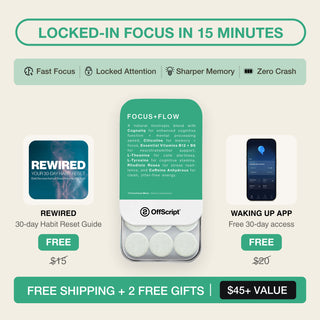
Theanine handles the smoothing. But truly clean energy also means giving your brain the raw materials to sustain output instead of just borrowing against it. That is where a formula built for the whole curve matters. Focus+Flow is built on exactly this logic. It pairs a measured 100mg dose of caffeine with 150mg of L-theanine for that relaxed-alertness balance, then layers in the supporting cast your brain actually runs on:
Patented coffee-fruit extract, clinically studied to support BDNF — the protein behind neuron growth + resilience.
Calm, focused attention without the jitters — the ingredient that smooths caffeine's edges.
Dopamine precursor for drive + focus that holds up under pressure.
Adaptogen that supports mental stamina when the workload drags on.
Clean, measured energy — deliberately buffered by L-theanine.
Raw material for acetylcholine, the memory + learning neurotransmitter.
Supports the production of neurotransmitters.
Supports cellular energy — the metabolic groundwork beneath everything above.
A quick note on the acetylcholine side of the story. Choline is the raw material your body uses to make acetylcholine, the neurotransmitter tied to memory + learning. The Focus+Flow label reads "Choline (as Citicoline), 18mg" — standard supplement-facts phrasing that names the nutrient first + its source form in parentheses. In other words, the choline here is delivered as citicoline, the well-studied form used in the cognitive research, doing the upstream job of keeping that system supplied.
The difference in design is the whole point. Caffeine alone gives you a spike + a cliff. A balanced formula gives you a rise you can actually stand on, because the crash has been engineered out rather than left as an afterthought.
FOCUS ON COMMAND
Clean, crash-free focus built on the L-theanine + caffeine science above — 12 mints per tin.
SHOP FOCUS+FLOWHow to build energy that lasts
You do not have to overhaul your life to get off the spike-and-crash cycle. A few informed choices go a long way. Do not drink caffeine on a completely empty stomach, where it hits fastest + hardest. Hydrate, since mild dehydration masquerades as fatigue. Get real sunlight early, which sets your natural alertness rhythm so you rely less on the cup. And when you do reach for caffeine, reach for it buffered rather than raw, so you are working with your biology instead of whipping it.
The takeaway on natural energy vs the caffeine crash is simple: the crash was never the price of focus. It was the price of taking caffeine alone. Give your brain the supporting cast it has been missing, + the same alertness arrives without the 2pm collapse waiting on the other side.
If you are tired of trading a great morning for a wrecked afternoon, that is exactly the problem Focus+Flow was formulated to solve. Try it for yourself + feel the difference between being wired + being genuinely clear.
Key Takeaways
- The crash is not caffeine "wearing off" — it is the backlog of adenosine that piled up behind blocked receptors, delivered all at once.
- More coffee deepens the debt + drives receptor upregulation, which is how tolerance + dependency build.
- Clean energy means caffeine that is buffered + directed, not simply more of it.
- L-theanine paired with caffeine (roughly 2:1) preserves focus + reaction time while removing the jitters + the comedown, per multiple controlled trials.
- Focus+Flow buffers 100mg caffeine with 150mg L-theanine, then adds tyrosine, rhodiola, CognatiQ, citicoline-sourced choline + B-vitamins to support the whole curve.
Explore The Series
- Clean Energy Without the Crash
- The 2pm Crash Isn't a Willpower Problem
- Does Caffeine Raise Cortisol?
References
- Institute of Medicine (US). Pharmacology of Caffeine. In: Caffeine for the Sustainment of Mental Task Performance. National Academies Press.
- Jacobson KA, et al. Adenosine A2A receptor antagonists: from caffeine to selective non-xanthines. British Journal of Pharmacology. 2022.
- Giesbrecht T, Rycroft JA, Rowson MJ, De Bruin EA. The combination of L-theanine and caffeine improves cognitive performance and increases subjective alertness. Nutritional Neuroscience. 2010;13(6):283-290.
- Haskell CF, Kennedy DO, Milne AL, Wesnes KA, Scholey AB. The effects of L-theanine, caffeine and their combination on cognition and mood. Biological Psychology. 2008;77(2):113-122.
- Kahathuduwa CN, et al. The cognitive-enhancing outcomes of caffeine and L-theanine: a systematic review. 2022.
FAQ
Why do I crash in the afternoon after my morning coffee?
While caffeine blocks your adenosine receptors, your brain keeps producing adenosine in the background. When the caffeine finally clears — its half-life is roughly five to six hours — all that accumulated adenosine binds at once, delivering the fatigue signal that was on hold. That sudden wall of tiredness is the crash.
Does adding more caffeine stop the crash?
Only briefly, and it makes the underlying problem worse. A second dose re-blocks the receptors while even more adenosine builds behind a higher wall, so the eventual crash is larger. Repeated over weeks, your brain grows more adenosine receptors (upregulation), which is how tolerance + dependency take hold.
What is L-theanine and why is it paired with caffeine?
L-theanine is an amino acid found in green tea that promotes a state of relaxed alertness. Paired with caffeine, controlled trials show it preserves the gains in focus + reaction time while reducing jitteriness + the harsh comedown. Most research uses roughly a 2:1 ratio of L-theanine to caffeine.
Does Focus+Flow contain citicoline?
Yes. The label reads "Choline (as Citicoline), 18mg" — that is standard supplement-facts labeling, naming the nutrient followed by its source form. The 18mg figure is the elemental choline delivered, and citicoline is the form it comes in.
Is caffeine bad for you?
No. Caffeine is one of the most studied + effective cognitive tools available. The issue is taking it in isolation, unbuffered, which produces the spike-and-crash pattern. Buffering it with supporting compounds like L-theanine keeps the benefit while smoothing the descent.