




Two of the most-studied compounds in nootropics aren't rare, patented, or exotic. One grows in a tea leaf. The other is in your morning coffee. Apart, each has an obvious flaw — caffeine wires you up and then drops you, and l-theanine on its own is so subtle most people can't feel it. Put them together and something strange happens: the flaws cancel, and what's left is the cleanest focus most people have ever experienced. The pairing of l-theanine and caffeine isn't a trend. It's arguably the most reliable cognitive stack ever discovered, and it's been hiding in a cup of green tea the whole time.
This is the part of the nootropics world that doesn't get enough credit. Everyone chases the next novel molecule. Meanwhile the highest-evidence, lowest-risk combination available has been sitting in the research literature for over fifteen years, quietly outperforming caffeine alone in trial after trial. Here's why it works so well together — and why "together" is the entire point.
Caffeine's problem is the crash and the jitters
Caffeine works by blocking adenosine, the molecule that builds up through the day + makes you feel tired. Block it, and alertness surges. That part is great. The problem is that caffeine doesn't discriminate. It raises alertness, but it also raises heart rate, tightens blood vessels, and pushes the nervous system toward a slightly anxious, over-clocked state. For a lot of high-performers, the sweet spot between "sharp" + "wired" is narrow — one cup too many and focus curdles into restlessness.
Then there's the drop. Caffeine's alertness comes on fast and leaves fast, and the exit is what people describe as the crash: a slump in energy + mood as adenosine floods back in. So caffeine gives you a real cognitive lift with two liabilities attached — edginess on the way up, and a hole on the way down. That's the gap l-theanine was made to fill.
L-theanine's job is calm without sedation
L-theanine is an amino acid found almost exclusively in tea. It crosses the blood-brain barrier + nudges the brain toward a state researchers describe as relaxed alertness. The mechanism is specific: l-theanine increases activity in alpha brain waves — the frequency band associated with a calm, wakeful, focused mind, the same state you see in experienced meditators. In a well-known EEG study, oral l-theanine reliably raised alpha-band activity in healthy adults without making them drowsy (Kelly et al., 2008, Journal of Nutrition).
That's the key distinction. Most things that calm you down also dull you — antihistamines, alcohol, a heavy lunch. L-theanine does the opposite. It modulates GABA + other calming neurotransmitters enough to take the edge off, but not so much that it sedates. On its own, that effect is real but understated — which is exactly why l-theanine has always been a supporting actor rather than a star. It's not built to carry the show alone. It's built to make caffeine behave.
Why l-theanine and caffeine are better together than apart
Here's the elegant part. Caffeine pushes the nervous system up + slightly toward anxiety. L-theanine pulls it toward calm without pulling down alertness. Stack them and you get caffeine's clean cognitive drive with l-theanine smoothing off the jitters + steadying the ride. You keep the focus and lose the edge.
This isn't hand-waving — it's one of the better-replicated findings in the field. A double-blind, placebo-controlled trial found that the combination of l-theanine and caffeine improved accuracy on demanding attention-switching tasks and boosted self-reported alertness more than would be expected from either compound on its own (Giesbrecht et al., 2010, Nutritional Neuroscience). Notably, the doses used were modest — roughly the amount of caffeine in a small coffee paired with the theanine of a few cups of tea.
The alpha-wave study went further and looked directly at the brain. When participants took l-theanine and caffeine together, researchers saw measurable changes in alpha-band activity and better performance on attention tasks — faster, more accurate target detection than placebo — with the combination outperforming either compound taken alone (Kelly et al., 2008). The behavioral improvement and the brainwave signature showed up together, which is exactly what you'd want to see if the synergy is real rather than a placebo story.
More recent work has stress-tested the pairing under harder conditions. In a 2025 double-blind crossover study, a higher-dose l-theanine and caffeine combination improved selective attention in acutely sleep-deprived adults — sharpening reaction time to targets and producing faster neural resource allocation, measured directly by event-related brain potentials (Nawarathna et al., 2025, British Journal of Nutrition). When you're running on no sleep, that's precisely when caffeine alone tends to make you twitchy + error-prone. The addition of l-theanine is what keeps the attention sharp instead of scattered.
The jitters aren't just a feeling — and l-theanine touches that too
The "smoothing" effect isn't only subjective. Caffeine measurably raises blood pressure, and that physiological arousal is part of what edginess actually is. In a controlled study, l-theanine intake blunted the blood-pressure increases that came with stress, while caffeine on its own tended to amplify them (Yoto et al., 2012, Journal of Physiological Anthropology). So when people say the stack feels "cleaner," there's a physical correlate underneath it: l-theanine is quietly countering some of caffeine's cardiovascular push while the alertness stays intact. Calm energy isn't a marketing phrase here. It's two mechanisms pointing in opposite directions + meeting in a better middle.
How to build the stack well
Getting the pairing right comes down to a few details that the research points toward:
- Ratio matters more than raw dose. A lot of the positive trials landed somewhere around a 1:1 to 2:1 ratio of l-theanine to caffeine — for example, roughly 100 mg of l-theanine with 50 mg of caffeine. Enough theanine to counterbalance the caffeine is the whole game.
- Consistency beats megadosing. The benefit is a steadier, cleaner focus, not a bigger high. Piling on caffeine past your tolerance re-introduces the exact jitters l-theanine is there to suppress.
- Pair it with the rest of the machinery. L-theanine and caffeine handle the calm-alertness axis, but sustained focus also depends on the neurotransmitters behind motivation + mental clarity — which is why the strongest formulas don't stop at two ingredients.
How Focus+Flow builds on the l-theanine and caffeine core
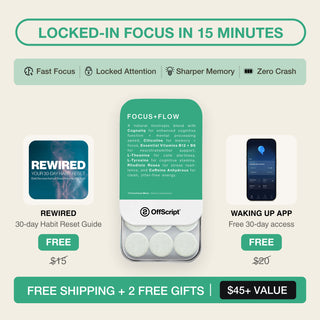
This is the logic behind Focus+Flow. It pairs 150mg of l-theanine with a measured 100mg dose of caffeine anhydrous to deliver that jitter-free lift, then builds around it: L-tyrosine as a dopamine precursor for drive, choline as the raw material for acetylcholine — the neurotransmitter behind memory + learning — Rhodiola Rosea to support mental stamina under stress, and CognatiQ, a patented, clinically studied coffee-fruit extract shown to support levels of BDNF, a protein tied to the growth + maintenance of neurons. The l-theanine and caffeine core is doing the classic job. The rest is there so the focus has somewhere to go.
Patented coffee-fruit extract, clinically studied to support BDNF.
Calm, focused attention without the jitters.
Dopamine precursor for drive + focus under pressure.
Adaptogen that supports mental stamina under stress.
Clean, measured energy — smoothed by L-Theanine.
Raw material for acetylcholine, the memory + learning neurotransmitter.
Supports neurotransmitter production.
Supports cellular energy.
FOCUS ON COMMAND
The l-theanine + caffeine synergy, built out with the neurotransmitters focus actually runs on.
SHOP FOCUS+FLOWThe smartest stack, because it respects how the brain actually works
The reason l-theanine and caffeine deserves the title isn't hype. It's that the combination reflects something true about physiology: you don't get your best thinking by flooring the accelerator. You get it by pairing drive with control. Caffeine supplies the drive. L-theanine supplies the control. Neither is remarkable alone, and that's the point — the intelligence is in the pairing, not the parts.
If you've been drinking coffee + wondering why focus keeps slipping into restlessness, the missing half was never a stronger stimulant. It was the amino acid that keeps the stimulant honest. See how Focus+Flow builds on the l-theanine and caffeine synergy — and feel the difference between wired + genuinely dialed in. Try it for yourself.
Key Takeaways
- Caffeine delivers real alertness but comes with two liabilities: jitters on the way up + a crash on the way down.
- L-theanine raises alpha-wave activity, producing calm without sedation — the rare compound that relaxes you without dulling you.
- Stacked together, the two cancel each other's downsides: you keep caffeine's drive + lose the edginess, a synergy replicated across multiple controlled trials.
- Ratio matters more than dose — roughly 1:1 to 2:1 l-theanine to caffeine — and consistency beats megadosing.
- Focus+Flow pairs 150mg l-theanine with 100mg caffeine, then adds L-tyrosine, choline, Rhodiola + CognatiQ so the focus has somewhere to go.
Explore The Series
- The L-Theanine + Caffeine Focus Stack: A How-To
- Natural Energy vs. the Caffeine Crash
- What Are Nootropics? A Beginner's Guide
References
- Kelly SP, Gomez-Ramirez M, Montesi JL, Foxe JJ. L-Theanine and Caffeine in Combination Affect Human Cognition as Evidenced by Oscillatory Alpha-Band Activity and Attention Task Performance. Journal of Nutrition. 2008;138(8):1572S–1577S.
- Giesbrecht T, Rycroft JA, Rowson MJ, De Bruin EA. The combination of L-theanine and caffeine improves cognitive performance and increases subjective alertness. Nutritional Neuroscience. 2010;13(6):283–290.
- Nawarathna S, Ariyasinghe D, Dassanayake T. High-dose L-theanine–caffeine combination improves neurobehavioural and neurophysiological measures of selective attention in acutely sleep-deprived young adults. British Journal of Nutrition. 2025.
- Yoto A, Motoki M, Murao S, Yokogoshi H. Effects of L-theanine or caffeine intake on changes in blood pressure under physical and psychological stresses. Journal of Physiological Anthropology. 2012;31(1):28.
FAQ
What is the best ratio of l-theanine to caffeine?
Most of the positive research landed around a 1:1 to 2:1 ratio of l-theanine to caffeine — for example, roughly 100–200 mg of l-theanine paired with 100 mg of caffeine. The goal is enough theanine to counterbalance the caffeine's arousal without fully damping the alertness you want.
Will l-theanine make me sleepy?
No. L-theanine promotes calm by raising alpha-brain-wave activity, the state linked to relaxed alertness rather than drowsiness. In EEG studies it took the edge off without sedating participants, which is exactly why it pairs so well with a stimulant instead of canceling it out.
Does l-theanine cancel out caffeine's benefits?
It doesn't. Controlled trials show the combination improves attention and alertness more than caffeine alone. L-theanine smooths the jittery, over-aroused edge of caffeine while leaving the cognitive drive intact — you keep the focus and lose the restlessness.
Can I just drink green tea instead of taking a supplement?
Green tea naturally contains both compounds, which is where the discovery came from, but the amounts vary a lot cup to cup and the theanine content is often lower than the doses used in studies. A measured formula lets you hit a consistent ratio every time rather than guessing.
What else is in Focus+Flow besides l-theanine and caffeine?
Focus+Flow pairs 150mg of l-theanine with 100mg of caffeine anhydrous, then adds L-tyrosine (a dopamine precursor), choline (raw material for the memory neurotransmitter acetylcholine), Rhodiola Rosea (an adaptogen for mental stamina), and CognatiQ, a patented coffee-fruit extract studied for supporting BDNF. The l-theanine + caffeine core handles calm alertness; the rest supports the motivation + clarity behind sustained focus.