





Walk into any conversation about focus these days and someone will mention nootropics. Podcasters swear by their stacks. Your most disciplined coworker takes something before deep work. The word gets thrown around like everyone already agreed on what it means. Most people haven't. So let's fix that first, because the term is more precise than the marketing suggests — and understanding it is the difference between buying real cognitive support + buying expensive caffeine with a clever label.
The honest answer to what are nootropics is this: they're compounds studied to support how your brain works — memory, focus, mental clarity, resistance to stress — without the sledgehammer trade-offs of prescription stimulants. Some are synthetic. Many are natural. The good ones share one thing: a real, describable mechanism. Not vibes. A reason they work.
What Are Nootropics, Actually? A Definition Worth Knowing
The term isn't a wellness-industry invention. It was coined in 1972 by Romanian psychologist + chemist Dr. Corneliu Giurgea, who had synthesized the compound piracetam a decade earlier. He built the word from the Greek nous (mind) and trepein (to bend) — literally, to bend the mind. And he didn't hand out the label loosely. Giurgea proposed that a true nootropic should enhance learning + memory, protect the brain under stress, and — critically — do so with very low toxicity + few side effects, unlike traditional stimulants that sedate or over-rev the nervous system (Giurgea, via Corneliu E. Giurgea, Wikipedia).
That last part matters more than anything the supplement aisle will tell you. Giurgea's original bar was safety alongside benefit. A substance that improves focus by burning you out isn't a nootropic by his definition — it's just a stimulant. Keep that standard in your back pocket. It's the single best filter for cutting through hype.
How Nootropics Actually Work in the Brain
Nootropics don't share one universal mechanism, which is exactly why the category gets muddy. Instead, different compounds support cognition through a few distinct pathways. Understanding these four buckets tells you more than any product label:
- Neurotransmitter support. Your brain runs on chemical messengers — dopamine for motivation + drive, acetylcholine for memory + learning, norepinephrine for alertness. Some nootropics supply the raw precursors your brain uses to build these, or support the machinery that keeps them firing.
- Cerebral energy and blood flow. Neurons are metabolically expensive. Compounds that support mitochondrial energy production or healthy circulation help the brain sustain effort instead of fading after an hour.
- Neuroprotection and growth. This is the frontier. Certain compounds influence brain-derived neurotrophic factor (BDNF), a protein that supports the survival of existing neurons + the formation of new connections — the biological basis of learning itself.
- Stress modulation. The best nootropics don't just push you faster; they help you stay calm + clear under load, smoothing out the jittery edge that pure stimulants leave behind.
A well-built formula doesn't rely on one of these. It combines them, so the pathways reinforce each other. That's the whole idea behind a "stack."
The Ingredients That Earn the Name: A Science Deep-Dive
Here's where most brands get vague and where you should get skeptical. An ingredient belongs in a serious nootropic only if there's a mechanism behind it. Below are the ones that clear that bar — each maps to what we put in our Focus+Flow formula — with the actual reason each works.
Patented coffee-fruit extract, clinically studied to support BDNF.
Calm, focused attention without the jitters.
Dopamine precursor for drive + focus under pressure.
Adaptogen that supports mental stamina under stress.
Clean, measured energy — smoothed by L-Theanine.
Raw material for acetylcholine, the memory + learning neurotransmitter.
Supports neurotransmitter production.
Supports cellular energy.
Whole Coffee Fruit Extract (CognatiQ) — the BDNF play
This is the ingredient that gets nootropics genuinely interesting. CognatiQ is a patented extract made from the whole coffee cherry — the fruit around the bean that most coffee production discards. In a double-blind, placebo-controlled trial, a single 100 mg dose raised plasma BDNF by an average of 143% compared to baseline (Reyes-Izquierdo et al., British Journal of Nutrition, 2013). BDNF is essentially fertilizer for neurons — it supports the connections underlying memory + learning. Notably, when researchers compared whole coffee fruit against green coffee bean extract and caffeine powder, only the whole-fruit extract produced the significant BDNF effect. It's not the caffeine doing the work.
Citicoline — memory and attention infrastructure
Choline is the raw material your brain uses to build acetylcholine — the neurotransmitter behind memory + learning — and the phospholipids that make up cell membranes. Focus+Flow's label reads Choline (as Citicoline), 18 mg: standard supplement-facts format, meaning the choline is delivered as citicoline (CDP-choline). That matters, because citicoline is the form with the human trial data. In a randomized, double-blind, placebo-controlled trial, healthy older adults taking 500 mg of citicoline daily for 12 weeks showed significant improvements in memory — especially episodic memory — + in selective attention versus placebo (Nakazaki et al., The Journal of Nutrition, 2021). The mechanism is the same either way: supporting the brain's bioenergetics + membrane turnover — the hardware, not just the signal.
L-Theanine + Caffeine — the calm-focus pairing
Caffeine alone is a blunt instrument: alert, but often jittery. L-theanine, an amino acid from tea, changes that. Studied together, the two improve attention + accuracy on demanding tasks more than either does alone. One trial found the combination increased both hit rate + target discrimination on a visual attention task, while L-theanine on its own did nothing and caffeine alone only partly delivered (Owen et al., 2008, and related work in The Journal of Nutrition). A systematic review concluded the pairing reliably enhances attention while smoothing the rough edges of caffeine (Baba et al., systematic review, 2021). This is the mechanism behind "calm alertness" — focus without the crash.
L-Tyrosine — cognition under pressure
L-tyrosine is the amino acid your brain converts into dopamine + norepinephrine — the neurotransmitters behind motivation + alertness. Its usefulness is specific and honest: research suggests tyrosine helps most in stressful or cognitively demanding situations, replenishing catecholamines when stress depletes them (Young, 2007). In other words, it's a support for the exact moments when you need to think clearly + everything is working against you.
FOCUS ON COMMAND
Every mechanism above, at a dose you can actually read on the label. Clean, crash-free focus.
SHOP FOCUS+FLOWNatural vs. Synthetic — and Why It's Not Just Marketing
Giurgea's original nootropics were synthetic. Plenty of effective ones still are. So why does OffScript lean natural? Not out of purity theater — because of his own criterion: benefit with low side-effect burden. Compounds like choline, L-theanine, + coffee fruit extract have mechanisms your body already knows how to use, and they tend to support your brain's own regulation rather than override it. That's the point. The goal isn't to force your brain into a state it can't sustain. It's to give it what it needs to do what it already does — better, + for longer.
This is also the honest line between nootropics + prescription stimulants. A drug like Adderall works. It also comes with tolerance, dependency risk, + a body that increasingly expects the outside input. Natural nootropics aim at the opposite: support, not substitution. Informed choice, not a treadmill.
How to Start: A Beginner's Filter
Now that you can answer what are nootropics for yourself, here's how to shop like someone who reads ingredient labels:
- Demand a mechanism. If a product can't tell you why an ingredient works, assume it doesn't.
- Check the dose. Real studies use real amounts. "Proprietary blends" that hide doses are hiding something.
- Look for synergy. The strongest formulas combine pathways — energy, neurotransmitters, neuroprotection, stress — rather than betting on one hero ingredient.
- Respect the safety bar. Focus you can't sustain isn't focus. It's a loan.
The Bottom Line
So, what are nootropics? They're not magic pills, + they're not just caffeine in a nicer bottle. They're a real, decades-old category of compounds studied to support memory, focus, + mental clarity — ideally with the safety Giurgea insisted on from the start. The difference between a gimmick + genuine support comes down to one question you can now ask with confidence: does this work by a real mechanism, at a real dose?
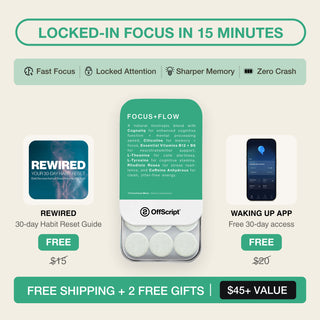
That's the standard we built Focus+Flow around — coffee fruit extract for BDNF, citicoline for memory infrastructure, L-theanine + caffeine for calm alertness, L-tyrosine for pressure, rhodiola for stamina under stress. If you've been curious whether natural cognitive support can actually deliver, the most honest thing we can say is: read the mechanisms above, then try it for yourself + judge by how you think + feel.
Key Takeaways
- A nootropic, by its original 1972 definition, must deliver a cognitive benefit and a low side-effect burden — safety is built into the word, not a bonus.
- There's no single mechanism. Real nootropics work through neurotransmitter support, cerebral energy, neuroprotection (BDNF), or stress modulation — the best formulas combine several.
- Mechanism + dose are your two-question filter. If a product can't name why an ingredient works or hides the amount, treat it as marketing.
- Focus+Flow pairs CognatiQ (BDNF), citicoline (acetylcholine), L-theanine + caffeine (calm alertness), L-tyrosine (pressure), + rhodiola (stamina) — each at a disclosed dose.
- Natural nootropics aim at support, not substitution — the opposite of the tolerance-and-dependency cycle of prescription stimulants.
Explore The Series
- CognatiQ + BDNF: the coffee-fruit extract that grows your brain
- Why L-Theanine + Caffeine Is the Smartest Stack You Can Take
- L-Tyrosine: The Dopamine Precursor That Keeps You Sharp Under Pressure
References
- Giurgea, C. E. — biography and nootropic concept. Corneliu E. Giurgea, Wikipedia.
- Reyes-Izquierdo T, et al. Modulatory effect of coffee fruit extract on plasma levels of brain-derived neurotrophic factor in healthy subjects. British Journal of Nutrition, 2013. PubMed.
- Nakazaki E, et al. Citicoline and Memory Function in Healthy Older Adults: A Randomized, Double-Blind, Placebo-Controlled Clinical Trial. The Journal of Nutrition, 2021. PMC.
- Owen GN, et al. L-theanine and caffeine in combination affect human cognition. The Journal of Nutrition / Nutritional Neuroscience, 2008. PubMed.
- Baba Y, et al. The Cognitive-Enhancing Outcomes of Caffeine and L-theanine: A Systematic Review. 2021. PMC.
- Young SN. L-Tyrosine to alleviate the effects of stress? Journal of Psychiatry & Neuroscience, 2007. PMC.
FAQ
What are nootropics in simple terms?
Nootropics are compounds studied to support how your brain works — memory, focus, mental clarity, + resistance to stress — without the heavy trade-offs of prescription stimulants. The term was coined in 1972 and, by its original definition, a true nootropic must pair a cognitive benefit with a low side-effect burden.
Are natural nootropics as effective as prescription stimulants?
They work differently. Prescription stimulants force a state through strong dopamine + norepinephrine action, which brings tolerance + dependency risk. Natural nootropics aim to support your brain's own regulation — feeding precursors, supporting BDNF, smoothing caffeine — so the goal is sustainable support rather than substitution. They are not a treatment for any medical condition.
How do I know if a nootropic actually works?
Use two filters: mechanism + dose. A credible product can tell you why each ingredient works — the pathway it supports — and it discloses the amount so you can compare it to what studies actually used. Proprietary blends that hide doses fail both tests.
Does Focus+Flow contain citicoline?
Yes. The label reads Choline (as Citicoline), 18 mg — the standard supplement-facts way of listing a nutrient followed by its source form. That's 18 mg of elemental choline delivered as citicoline (CDP-choline), the form studied in the memory and attention trials cited above.
Does Focus+Flow contain caffeine?
Yes — 100 mg of caffeine anhydrous per serving, paired with 150 mg of L-theanine. That pairing is deliberate: L-theanine smooths the rough, jittery edge of caffeine while the two together support attention more than either alone, which is the mechanism behind "calm alertness."
What does BDNF have to do with focus and learning?
BDNF (brain-derived neurotrophic factor) is a protein that supports the survival of existing neurons + the formation of new connections — the biological basis of learning itself. CognatiQ, the patented coffee-fruit extract in Focus+Flow, has been clinically studied to support plasma BDNF levels.