





Here's something the pharmaceutical model rarely tells you: your brain does not run out of focus because you're weak or undisciplined. Under real pressure — a deadline, a hard conversation, a cold morning, three hours of sleep debt — your brain runs low on the raw material it needs to make the chemicals that keep you sharp. Chief among them is dopamine. And your body cannot manufacture dopamine out of nothing. It needs a specific building block, delivered on demand. That building block is L-tyrosine, and the relationship between l-tyrosine and dopamine is one of the most well-characterized nutrient-to-neurotransmitter pathways in human physiology.
This is not a story about a mysterious "brain booster." It's a story about supply + demand at the molecular level — and why giving your brain more of the precursor it depends on tends to matter most exactly when you're under the gun.
What L-Tyrosine Actually Is (And Why Dopamine Depends On It)
L-tyrosine is a non-essential amino acid, meaning your body can make some of it from another amino acid, phenylalanine, and you also get it from protein-rich foods. But "non-essential" is misleading. Tyrosine is the direct starting material for an entire family of neurotransmitters called catecholamines: dopamine, norepinephrine, + epinephrine (adrenaline).
The conversion runs in a specific order. An enzyme called tyrosine hydroxylase converts L-tyrosine into L-DOPA. L-DOPA becomes dopamine. Dopamine, in turn, is the precursor for norepinephrine, which becomes epinephrine. Every one of these signaling molecules — the ones responsible for motivation, drive, alertness, + the "locked-in" feeling of deep work — traces back to that first tyrosine molecule.
Here's the part that matters most. Tyrosine hydroxylase is what biochemists call the rate-limiting step in catecholamine synthesis — the narrowest point in the entire assembly line. When your brain is firing hard and burning through dopamine and norepinephrine faster than usual, the availability of tyrosine can become the bottleneck that determines how much of these neurotransmitters you can actually produce. Give the enzyme more substrate to work with, and under the right conditions, it can keep production up. That is the whole logic behind supplementing with tyrosine.
Why Stress Is When L-Tyrosine Earns Its Keep
Under normal, low-stakes conditions, your brain makes plenty of dopamine + norepinephrine without any help. This is important to be honest about: tyrosine is not a stimulant, and it won't make a well-rested person on an easy task noticeably sharper. Several studies find no benefit at baseline.
The picture changes under acute stress. Demanding, taxing situations accelerate the release + turnover of catecholamines. When neurons fire rapidly and dump dopamine and norepinephrine faster than they can be replenished, the raw tyrosine supply gets stretched — and cognitive performance can slip. This is the exact scenario where supplemental tyrosine has repeatedly shown an effect: not by adding a jolt, but by protecting the performance you'd otherwise lose.
The military figured this out first, because soldiers routinely operate in precisely these conditions. In a foundational study, researchers found that tyrosine reduced the mood and performance decrements caused by acute exposure to cold and altitude stress. A later trial gave cadets 2 grams of tyrosine per day during a demanding week-long combat training course and reported that tyrosine improved cognitive performance and even reduced blood pressure compared with placebo. In a controlled cold-exposure study, tyrosine supplementation mitigated the working-memory decrements that cold normally produces.
A 2015 review in Military Medicine pulled this literature together and concluded, across randomized and non-randomized trials, that the evidence favors tyrosine for mitigating cognitive decline under acute stressors. The reviewers were appropriately measured — the effect is about defending function under load, not enhancing a relaxed baseline — but the direction of the evidence is consistent.
There's one context where this precursor logic comes up constantly: people who have come off a prescription stimulant with their doctor and are rebuilding focus from their own baseline. We wrote about that transition in detail — life after Adderall — including where tyrosine genuinely helps + where it doesn't.
The Cognitive-Control Research: Working Memory and Flexibility
Stress isn't the only demand that drains catecholamines. Cognitively taxing work does it too. A line of research from cognitive neuroscientists has tested tyrosine specifically on the mentally hardest tasks — the ones that lean heavily on dopamine-dependent "cognitive control."
In one well-designed study, participants took tyrosine and then performed an N-back task, a standard working-memory challenge. The result was telling: tyrosine improved performance on the demanding 2-back condition but not the easy 1-back condition. In other words, the benefit showed up only when the task actually taxed the system — exactly what you'd predict if tyrosine works by replenishing a depletable resource.
A related study found that tyrosine promoted cognitive flexibility during task-switching, another function that depends on dopamine signaling. The pattern across this body of work is consistent + mechanistically coherent: when the demand on your catecholamine system is high, more precursor helps; when demand is low, it doesn't do much. That's not a weakness of the compound. It's the signature of something that works by addressing a genuine supply constraint rather than artificially forcing the system.
Why L-Tyrosine Belongs In a Stack, Not On Its Own
If tyrosine is the raw material for dopamine, why not just take tyrosine and call it a day? Because raw material is only one part of sustained mental performance. Real focus is a system — production, signaling, calm, + staying power all have to line up. This is precisely why L-tyrosine works better as one instrument in a well-built formula than as a soloist.
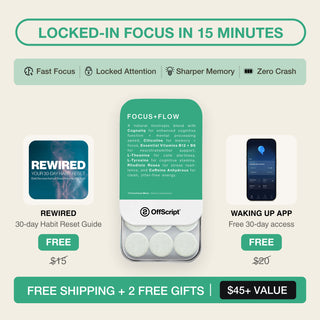
That's the thinking behind Focus+Flow, where L-tyrosine sits alongside ingredients that cover the other links in the chain:
Dopamine precursor for drive + focus under pressure.
Patented coffee-fruit extract, clinically studied to support BDNF.
Calm, focused attention without the jitters.
Adaptogen that supports mental stamina under stress.
Clean, measured energy — smoothed by L-Theanine.
Raw material for acetylcholine, the memory + learning neurotransmitter.
Supports neurotransmitter production.
Supports cellular energy.
Each ingredient covers a different link in the focus chain:
- L-tyrosine supplies the dopamine + norepinephrine precursor, so production can keep pace when you're under pressure.
- Vitamin B6 is a required cofactor in the enzymatic conversion of L-DOPA into dopamine — the pathway literally cannot run efficiently without it, which is why the two belong together.
- L-theanine smooths the edges, promoting calm alertness so the drive from elevated catecholamines feels like clean focus rather than jitter.
- Choline supports the acetylcholine side of attention — the memory + learning neurotransmitter — complementing the dopamine story rather than duplicating it.
- CognatiQ, a patented, clinically studied coffee-fruit extract, is included for its research-backed ability to support levels of BDNF — brain-derived neurotrophic factor — the protein that supports the health + adaptability of neurons over the long run.
The point of a stack like this is that dopamine precursors matter most inside a supported system. Feed the pathway, supply its cofactors, keep the experience calm, + support the underlying brain cells. That's a fuller answer to focus than any single molecule — including tyrosine — can give on its own.
FOCUS ON COMMAND
L-tyrosine, its B6 cofactor, calm from L-theanine, and CognatiQ for the long game — built into one clean, crash-free mint.
SHOP FOCUS+FLOWHow To Think About Using It
A few honest, practical notes. Tyrosine is best understood as insurance for high-demand moments, not a daily stimulant you'll feel kick in. Doses used in the research vary widely, from a couple of grams per day up to weight-based amounts in extreme-stress studies. It's generally well tolerated, but it is not a substitute for sleep, and if you take medication that affects catecholamines or thyroid function — or you're pregnant or nursing — talk to a clinician first. Informed choice means reading the mechanism + deciding for yourself, which is exactly the standard OffScript is built on.
The Bottom Line
The connection between l-tyrosine and dopamine isn't marketing — it's biochemistry with a clear bottleneck + a clear fix. When pressure spikes and your brain burns through its catecholamines, tyrosine gives the rate-limiting enzyme more to work with, helping you hold your edge instead of losing it. That's a fundamentally different promise than a synthetic stimulant makes: not borrowing sharpness you'll pay back later, but supporting the machinery you already have.
If you want that mechanism working for you inside a formula built to support the whole focus system — precursor, cofactor, calm, + cellular health — take a closer look at Focus+Flow and decide for yourself. Try it under real pressure. That's when you'll notice the difference.
Key Takeaways
- L-tyrosine is the direct precursor to dopamine + norepinephrine, feeding the rate-limiting enzyme tyrosine hydroxylase at the narrowest point in catecholamine production.
- It's not a stimulant. The research consistently shows benefit under acute stress or heavy cognitive load — and little to nothing at an easy, well-rested baseline.
- Military + cognitive-control studies point the same direction: tyrosine defends performance you'd otherwise lose, rather than boosting a relaxed system.
- It works best in a stack, where its B6 cofactor, L-theanine's calm, choline, + CognatiQ cover the other links in the focus chain.
- Treat it as insurance for high-demand moments — not a replacement for sleep, and worth a clinician conversation if you take catecholamine- or thyroid-affecting medication.
Explore The Series
- Life after Adderall: rebuilding focus without the prescription
- The Prescription Cycle: Why Stimulants Aren't the Answer
- Why L-Theanine + Caffeine Is the Smartest Stack
- CognatiQ, Coffee Fruit Extract, + BDNF
References
- Daubner SC, Le T, Wang S. Tyrosine hydroxylase and regulation of dopamine synthesis. Archives of Biochemistry and Biophysics. 2011. https://pmc.ncbi.nlm.nih.gov/articles/PMC3065393/
- Banderet LE, Lieberman HR. Treatment with tyrosine, a neurotransmitter precursor, reduces environmental stress in humans. Brain Research Bulletin. 1989. https://www.sciencedirect.com/science/article/abs/pii/0361923089900968
- Deijen JB, et al. Tyrosine improves cognitive performance and reduces blood pressure in cadets after one week of a combat training course. Brain Research Bulletin. 1999. https://www.sciencedirect.com/science/article/abs/pii/S0361923098001634
- Mahoney CR, et al. Tyrosine supplementation mitigates working memory decrements during cold exposure. Physiology & Behavior. 2007. https://pubmed.ncbi.nlm.nih.gov/17585971/
- Colzato LS, Jongkees BJ, et al. Working memory reloaded: tyrosine repletes updating in the N-back task. Frontiers in Behavioral Neuroscience. 2013. https://www.frontiersin.org/journals/behavioral-neuroscience/articles/10.3389/fnbeh.2013.00200/full
- Steenbergen L, Sellaro R, Hommel B, Colzato LS. Tyrosine promotes cognitive flexibility: evidence from proactive vs. reactive control during task switching. Neuropsychologia. 2015. https://pubmed.ncbi.nlm.nih.gov/25598314/
- Attipoe S, et al. Tyrosine for mitigating stress and enhancing performance in healthy adult humans: a rapid evidence assessment. Military Medicine. 2015. https://academic.oup.com/milmed/article/180/7/754/4160625
FAQ
Does L-tyrosine actually raise dopamine?
Indirectly, yes — but only when your system needs it. Tyrosine is the raw substrate for the enzyme tyrosine hydroxylase, the rate-limiting step in making dopamine. When your brain is burning through catecholamines under stress or heavy cognitive load, more available tyrosine lets that enzyme keep production up. At an easy, well-rested baseline, extra tyrosine tends to do little, because supply isn't the bottleneck.
Is L-tyrosine a stimulant like caffeine or Adderall?
No. It doesn't push your nervous system harder or add a jolt you'll feel come on. It's a precursor — raw material that supports your brain's own dopamine + norepinephrine production. The research pattern reflects this: benefit shows up under demand, not as an across-the-board buzz. That's a fundamentally different mechanism than a synthetic stimulant.
When should I take L-tyrosine for the best effect?
The evidence points to high-demand windows — before a cognitively taxing task, a stressful performance situation, or exposure to physical stressors like cold or sleep deprivation. Think of it as insurance for the moments that would otherwise drain you, rather than a daily lift you'll notice on an ordinary calm day.
How much L-tyrosine is in Focus+Flow, and is that enough?
Focus+Flow contains 100mg of L-tyrosine per serving, positioned as one part of a complete focus stack rather than a standalone tyrosine dose. It sits alongside its Vitamin B6 cofactor, L-theanine for calm, CognatiQ, + measured caffeine — so the precursor is supported by the cofactors + partners that help the whole pathway run, instead of being taken in isolation.
Can I take L-tyrosine with coffee or other nootropics?
Generally it pairs well, and in Focus+Flow it's formulated to sit beside caffeine + L-theanine. That said, tyrosine can interact with medications affecting catecholamines or thyroid function, so if you take those — or you're pregnant or nursing — check with a clinician first. And no supplement offsets missed sleep; tyrosine supports the machinery, it doesn't replace recovery.