




Between 2016 and 2021, the share of commercially insured Americans filling at least one prescription stimulant climbed from 3.6% to 4.1% — with the sharpest jumps among adults in their twenties, thirties, and forties, according to the CDC's Morbidity and Mortality Weekly Report. That's millions more people reaching for a pill to think clearly. Some of them genuinely need it. But a lot of them are simply high-functioning adults who felt scattered, asked for help, and walked out with amphetamine.
This isn't an argument against medicine. If a clinician has diagnosed you and a stimulant is working, that's between you + your doctor. This is an argument against the autopilot — the assumption that a controlled substance is the default first move for anyone who can't focus. Because the way stimulants work sets up a cycle that's worth understanding before you're three refills deep. And the good news is that stimulant alternatives have gotten genuinely good, backed by real mechanisms rather than marketing.
How the Prescription Cycle Actually Works
Prescription stimulants like amphetamine (Adderall) and methylphenidate (Ritalin) work by flooding the synapse with dopamine + norepinephrine — increasing their release and blocking their reuptake. More of these neurotransmitters hanging around means sharper focus + drive. In the short term, it's effective. That's not in dispute.
The complication is what the brain does in response. Your nervous system is built to defend equilibrium. When it's repeatedly bathed in extra dopamine, it adapts — often by dialing down its own receptor sensitivity. A 2022 literature review in Brain Sciences documented this pattern, noting that in one clinical sample roughly a quarter of patients developed tolerance to stimulants within days to weeks, and that the usual clinical responses are dose increases or scheduled "drug holidays." The review is careful — tolerance is not universal, and many people stay stable for years — but the mechanism is real + well described.
Here's why that matters for the ordinary user. The same dose that felt like a revelation in month one can feel like baseline by month six. The obvious fix is more. And a higher dose is also a bigger dose of the side effects that ride along with these drugs. A review in Brain and Behavior catalogs the familiar list: appetite suppression, insomnia, elevated heart rate + blood pressure, irritability, and the flat, wrung-out feeling of the afternoon crash. None of that is exotic. It's the standard tax on borrowing tomorrow's dopamine to spend today.
If you have already had the conversation with your prescriber about stepping away from stimulants, the practical question becomes what the other side looks like. We wrote that up separately: life after Adderall, and how focus actually rebuilds — including an honest withdrawal timeline.
The Question Nobody Asks at the Pharmacy
The Health-Conscious Skeptic reads ingredient labels + checks the citations. So apply that same scrutiny here: is the goal to feel switched-on, or to build a brain that focuses well on its own?
Stimulants are a lever, not a foundation. They push existing neurotransmitters harder; they don't give your brain more raw material to work with, and they don't do anything to protect the neurons doing the work. That's the structural reason the cycle exists — you can lean on a lever indefinitely, but you can't build on it. A more durable approach asks a different question: what does the brain actually need to produce focus, motivation, + clarity on its own terms?
That's the entire premise behind the best stimulant alternatives. Instead of forcing a spike and paying it back later, they supply the precursors, cofactors, + signaling support the brain uses to run well — so the improvement is something you own, not something you rent.
The Science Behind Natural Stimulant Alternatives
"Natural" only means something if the mechanism holds up. Here's what a serious formulation targets, and why each piece earns its place.
Cognatiq (whole coffee fruit extract) — feeding BDNF
Brain-derived neurotrophic factor, or BDNF, is essentially fertilizer for neurons — it supports the growth, maintenance, + survival of the brain cells involved in learning + memory. CognatiQ is a patented whole coffee fruit extract studied specifically for its effect on BDNF. In a study published in the British Journal of Nutrition, a single 100 mg dose of whole coffee fruit concentrate raised plasma BDNF by roughly 143% within two hours. That's a fundamentally different play than a stimulant: rather than draining the dopamine account, it supports the cellular infrastructure that thinking depends on.
Choline (as Citicoline) — raw material for the focus neurotransmitter
Choline is the raw material your body uses to make acetylcholine, the neurotransmitter central to attention + memory, and to build the phospholipids that form healthy neuron membranes. Focus+Flow delivers it as citicoline — the label reads "Choline (as Citicoline), 18mg," standard supplement-facts phrasing that names the nutrient first + its source form in parentheses. That form is the one the research was run on: in a randomized, double-blind, placebo-controlled trial, citicoline improved memory performance versus placebo in healthy older adults. It's the supply-side approach in action: give the brain the ingredients, let it make what it needs.
L-Theanine + Caffeine — alert without the jitter
Caffeine sharpens alertness but can tip into jitter + a crash. L-theanine, an amino acid from tea, smooths that edge. Studied together, the pair does more than either alone: a controlled study in The Journal of Nutrition found the combination improved accuracy on demanding attention-switching tasks + reduced susceptibility to distraction, tracked alongside changes in alpha-band brain activity linked to relaxed focus. Calm alertness, not wired-and-tired.
L-Tyrosine — restocking dopamine under pressure
L-tyrosine is the amino acid your body converts into dopamine + norepinephrine — the same messengers stimulants exploit, approached from the supply side. Under stress or heavy cognitive load, the brain burns through these catecholamines faster than it replaces them. A review in Neuroscience & Biobehavioral Reviews found tyrosine supplementation can support cognitive performance specifically in demanding or stressful situations, apparently by replenishing what stress depletes. It doesn't force a spike; it refills the tank so your own system keeps running.
Rhodiola Rosea — stamina when the pressure is on
Rhodiola is an adaptogen with a long track record for supporting mental stamina under stress — the kind of sustained output that a hard afternoon of thinking actually demands. It rounds out the profile alongside B6 + B12, which act as cofactors in neurotransmitter synthesis + cellular energy metabolism: the unglamorous machinery that turns precursors into usable brain chemistry.
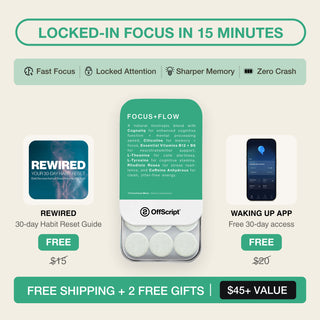
Here's the full stack inside OffScript's Focus+Flow — not a stimulant knockoff, but a set of stimulant alternatives chosen to support the brain's own production line:
Patented coffee-fruit extract, clinically studied to support BDNF.
Calm, focused attention without the jitters.
Dopamine precursor for drive + focus under pressure.
Adaptogen that supports mental stamina under stress.
Clean, measured energy — smoothed by L-Theanine.
Raw material for acetylcholine, the memory + learning neurotransmitter.
Supports neurotransmitter production.
Supports cellular energy.
FOCUS ON COMMAND
Clean, crash-free focus built on ingredients that support your brain instead of taxing it.
SHOP FOCUS+FLOWChoosing the Approach That Compounds Instead of Depletes
The honest framing is this. Prescription stimulants deliver a strong, fast effect and, for some people with a genuine diagnosis, they're the right tool. But they operate by pushing your existing neurochemistry harder, and biology tends to adapt — which is how the tolerance-and-dose-increase cycle gets started in the first place.
Ingredient-driven stimulant alternatives work along a slower, steadier axis. They won't feel like flipping a switch on day one, and any brand that promises they will is lying to you. What they offer instead is support that builds: more BDNF, more raw material for acetylcholine + dopamine, steadier energy, calmer focus — with a side-effect profile that doesn't compound against you over time.
None of this treats or cures any condition, and it's not medical advice. It's a description of how these compounds work in the body, so you can make an informed choice instead of a default one. That choice is the entire point — your brain, your call, made with eyes open.
If you'd rather support your focus than borrow against it, try Focus+Flow for yourself and see how a clear head feels when it's built to last, not rented by the dose.
Key Takeaways
- Prescription stimulant fills are rising fastest among working-age adults — many of them high-functioning people, not clinically severe cases.
- Stimulants work by pushing your existing dopamine + norepinephrine harder; the brain adapts by dialing down sensitivity, which is how tolerance + dose creep begin.
- Higher doses mean a bigger dose of side effects: poor sleep, appetite loss, elevated heart rate, + the afternoon crash.
- Stimulant alternatives take the supply side — feeding BDNF, citicoline-sourced choline, + tyrosine so the brain makes its own focus chemistry.
- The trade-off is honest: slower to feel, but it builds instead of depleting, with no rebound to pay back.
Explore The Series
- Life after Adderall: rebuilding focus without the prescription
- L-Tyrosine: The Dopamine Precursor That Keeps You Sharp Under Pressure
- CognatiQ Coffee Fruit Extract and the BDNF Connection
- What Are Nootropics? A Beginner's Guide
References
- Danielson ML, et al. Trends in Stimulant Prescription Fills Among Commercially Insured Children and Adults — United States, 2016–2021. MMWR, CDC, 2023.
- Handelman K, Sumiya F. Tolerance to Stimulant Medication for Attention Deficit Hyperactivity Disorder: Literature Review and Case Report. Brain Sciences, 2022.
- Lakhan SE, Kirchgessner A. Prescription stimulants in individuals with and without ADHD: misuse, cognitive impact, and adverse effects. Brain and Behavior, 2012.
- Reyes-Izquierdo T, et al. Modulatory effect of coffee fruit extract on plasma levels of brain-derived neurotrophic factor in healthy subjects. British Journal of Nutrition, 2013.
- Nakazaki E, et al. Citicoline and Memory Function in Healthy Older Adults: A Randomized, Double-Blind, Placebo-Controlled Clinical Trial. The Journal of Nutrition, 2021.
- Owen GN, et al. L-Theanine and caffeine in combination affect human cognition as evidenced by oscillatory alpha-band activity and attention task performance. The Journal of Nutrition, 2008.
- Jongkees BJ, et al. Effect of tyrosine supplementation on clinical and healthy populations under stress or cognitive demands—A review. Neuroscience & Biobehavioral Reviews, 2015.
FAQ
Are natural stimulant alternatives as strong as Adderall?
No, and no honest brand should claim otherwise. Prescription stimulants produce a strong, immediate effect by forcing your existing dopamine + norepinephrine to work harder. Ingredient-driven alternatives work differently — they supply the raw materials + cofactors your brain uses to produce focus on its own. The effect is subtler and builds over time, but it doesn't come with the tolerance cycle or the rebound crash.
What actually causes stimulant tolerance?
Your nervous system defends its equilibrium. When it's repeatedly exposed to extra dopamine, it often adapts by reducing its own receptor sensitivity, so the same dose delivers less effect over time. A 2022 review in Brain Sciences documented this pattern and noted that the common clinical responses are dose increases or scheduled breaks. Tolerance isn't universal, but the mechanism is well described.
Does Focus+Flow contain citicoline?
Yes. The label reads "Choline (as Citicoline), 18mg" — standard supplement-facts labeling, where the nutrient is named first and its source form follows in parentheses. So the 18mg is elemental choline, delivered as citicoline, the same well-studied form used in the memory research cited above.
How does Cognatiq differ from caffeine?
Caffeine is a stimulant that raises short-term alertness. CognatiQ is a patented whole coffee fruit extract studied for something entirely different: raising BDNF, a protein that supports the growth + survival of the neurons involved in learning + memory. Focus+Flow includes both — caffeine for measured energy, CognatiQ for the longer-term cellular support.
Can I take a natural nootropic if I'm already on a prescription stimulant?
That's a conversation for you + your prescribing clinician, not something to decide from a blog post. Nothing here is medical advice, and we don't make disease-treatment claims. If a stimulant is working under a doctor's care, keep that dialogue open before changing anything.