




The clearest sentence first: this decision belongs to you + your prescriber, not to a supplement company. If you have diagnosed ADHD, stimulant medication is an evidence-based treatment that works well for a lot of people, and coming off it is a medical decision with real consequences. This article isn't an argument for quitting.
It's for the people who have already had that conversation — or who are preparing to have it — and want to know what the other side actually looks like. Because that's the part nobody prepares you for.
Why People Reach This Point
The pattern comes up often enough to be worth naming. Someone starts a stimulant in their twenties or thirties, often after years of struggling. It works — genuinely, dramatically. Then somewhere down the line the calculus shifts.
Sometimes it's tolerance: the dose that transformed your workday now just makes you normal. Sometimes it's the side effects accumulating — appetite suppression, sleep quality slipping, a flatness in the evenings, a heart rate you're aware of. Sometimes it's the dependency itself: the realisation that you can't reliably work without it, and disliking what that means.
None of those make the medication bad. They're just reasons a reasonable person might want a different relationship with it. Worth noting the backdrop, too: starting a stimulant through telehealth became far more common across the COVID-19 period, at least among Medicaid + CHIP enrollees (Creedon et al., 2025). A lot of people are having this conversation right now.
What Actually Happens When You Stop
Here's the honest timeline, because the vague optimism most wellness content offers helps nobody.
Days 1–5: the rebound. Stimulants increase dopamine + norepinephrine signalling. Remove them and your baseline feels dramatically worse than it did before you ever started — not because you've damaged anything, but because you're comparing an unmedicated brain against a recent memory of a medicated one. Expect fatigue, low motivation + brain fog. This is the part where most people conclude they can't function without it.
Weeks 1–3: the flat stretch. The acute rebound eases. What replaces it is dullness — work feels effortful in a way you'd forgotten, and initiating tasks is harder than sustaining them.
Weeks 4–12: actual baseline. This is where you find out what your unmedicated focus genuinely looks like — which is neither the crash of week one nor the peak of a medicated afternoon. For some people this is workable with the right structure. For others, it confirms the medication was doing something necessary. Both outcomes are legitimate information.
If you go back on medication after trying this, that isn't failure. It's a decision made with better data.
The Things That Actually Move The Needle
In rough order of impact — and note that nothing you can buy appears until fourth.
1. Sleep, protected seriously
Stimulants mask sleep debt. Take them away and the debt is fully visible. This is the highest-leverage variable, and it's also the one most affected by the medication itself — which is why sleep often improves in the weeks after stopping.
2. Exercise, especially in the morning
Aerobic exercise acutely increases dopamine + norepinephrine — the same neurotransmitter systems stimulants target, through a mechanism your body regulates itself. It's the closest free substitute that exists.
3. Structure that doesn't rely on willpower
Medication lets you brute-force a badly designed day. Without it, design matters: hardest cognitive work in your best window, single-tasking, phone in another room, deliberate breaks. Unglamorous, and it's most of the win.
4. Targeted support — the honest version
This is where supplements fit, and the scope is narrower than most brands admit. Nothing natural replicates a stimulant. What some ingredients do have evidence for is supporting the systems under load.
L-Tyrosine is the amino acid precursor to dopamine. It doesn't flood the system the way a stimulant does — it supplies raw material. A review found tyrosine supplementation most useful specifically under stress or high cognitive demand, when neurotransmitter turnover is elevated (Jongkees et al., 2015). That's a precise, limited claim, and it's the right one.
Rhodiola Rosea has been studied for stress-induced fatigue, with a controlled trial reporting improvements in mental fatigue measures (Darbinyan et al., 2000).
L-Theanine + caffeine is the most replicated cognitive pairing in the natural literature — improved attention + reduced tiredness, with the theanine smoothing caffeine's edge (Haskell et al., 2008). For someone leaving a stimulant, that "alert without wired" quality matters more than raw stimulation.
CognatiQ — a patented coffee fruit extract — was studied for its effect on plasma BDNF, a protein involved in neuronal growth + plasticity (Reyes-Izquierdo et al., 2013). Different timescale entirely from a stimulant: infrastructure, not performance.
What FOCUS+FLOW Is — And Isn't
Full label, real doses:
Patented coffee-fruit extract, clinically studied to support BDNF.
Calm, focused attention without the jitters.
Dopamine precursor for drive + focus under pressure.
Adaptogen that supports mental stamina under stress.
Clean, measured energy — smoothed by L-Theanine.
Citicoline-sourced choline; raw material for acetylcholine, the memory + learning neurotransmitter.
Supports neurotransmitter production.
Supports cellular energy.
What it is not: a replacement for stimulant medication, a treatment for ADHD, or something that will make week one of a taper comfortable. Anyone marketing a supplement that way is preying on people in a genuinely difficult moment.
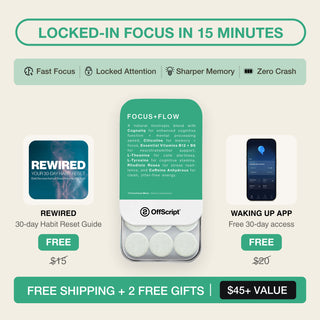
What it is: a formula built around what has evidence — dopamine raw material, an adaptogen for mental stamina, the theanine-caffeine pairing for alertness without the wired edge, and BDNF support on a longer timescale.
FOCUS ON COMMAND
Built for clean focus, not chemical override. 12 mints per tin, 2 tins per order.
SHOP FOCUS+FLOWReset Your Definition Of Focus
This is the part that decides how the transition goes, and it isn't pharmacological.
Stimulants can produce a very particular state — hours of uninterrupted, effortless absorption. It's genuinely remarkable, and it is not the human baseline. Unmedicated focus is different: it comes in waves, it requires deliberate initiation, and it degrades with fatigue.
If you measure your unmedicated brain against your medicated peak, you'll conclude you're broken. You're not. You're comparing against a state most people never experience.
One practical note: if you're using caffeine as part of the transition, keep it out of the back half of your day. Research measuring sleep after caffeine found that a dose taken even six hours before bed measurably disrupted it (Drake et al., 2013) — and sleep is the variable you can least afford to compromise here.
Key Takeaways
- Coming off stimulants is a medical decision. Never taper on your own — rebound symptoms can be severe, and unmanaged ADHD carries real risks.
- Expect a rough first week, a flat few weeks, and a genuine baseline somewhere around weeks four to twelve. Judging yourself in week one is judging the withdrawal, not your brain.
- Sleep, morning exercise + structural changes to your day outrank anything you can buy.
- No natural ingredient replicates a stimulant. Tyrosine supplies dopamine raw material, rhodiola supports mental stamina, theanine + caffeine improve alertness without the wired edge — all real, all smaller in magnitude.
- Going back on medication after an honest trial isn't failure. It's a decision made with better information.
Explore The Series
- The prescription cycle: why stimulants aren't the answer
- L-Tyrosine: the dopamine precursor that keeps you sharp under pressure
- The high-performance guide to focus + flow state
References
- Jongkees BJ, Hommel B, Kühn S, Colzato LS. Effect of tyrosine supplementation on clinical and healthy populations under stress or cognitive demands—A review. J Psychiatr Res. 2015;70:50-57. PubMed
- Darbinyan V, Kteyan A, Panossian A, et al. Rhodiola rosea in stress induced fatigue. Phytomedicine. 2000;7(5):365-371. PubMed
- Haskell CF, Kennedy DO, Milne AL, Wesnes KA, Scholey AB. The effects of L-theanine, caffeine and their combination on cognition and mood. Biol Psychol. 2008;77(2):113-122. PubMed
- Reyes-Izquierdo T, Nemzer B, Shu C, et al. Modulatory effect of coffee fruit extract on plasma levels of brain-derived neurotrophic factor in healthy subjects. Br J Nutr. 2013;110(3):420-425. PubMed
- Drake C, Roehrs T, Shambroom J, Roth T. Caffeine effects on sleep taken 0, 3, or 6 hours before going to bed. J Clin Sleep Med. 2013;9(11):1195-1200. PubMed
- Creedon TB, Wen H, Ali MM, Haffajee RL. Trends in telehealth initiation of prescription stimulants for child and adult enrollees in Medicaid and CHIP during COVID-19. Health Aff (Millwood). 2025;44(8):996-1004. PubMed
FAQ
How do I get off Adderall naturally?
You don't do it alone. Any change to stimulant medication goes through the prescriber who manages it — they'll structure a taper if one is appropriate. What you can control is everything around it: protecting sleep, adding morning exercise, restructuring your day so focus doesn't depend on brute force, and setting realistic expectations for the first few weeks.
How long does it take to feel normal after stopping stimulants?
Roughly: a hard first week as the rebound peaks, a flat stretch through weeks one to three, and something like a genuine baseline between weeks four and twelve. Individual variation is large. The key point is that week one is not representative — judging your unmedicated brain then is judging the withdrawal.
Can a supplement replace Adderall?
No. Nothing natural replicates a prescription stimulant, and we won't pretend otherwise. Some ingredients have evidence for supporting the systems involved — L-tyrosine as a dopamine precursor under cognitive load, rhodiola for mental fatigue, L-theanine with caffeine for alertness without jitteriness — but the magnitude is different by an order of magnitude.
Does FOCUS+FLOW contain citicoline?
Yes. The label reads "Choline (as Citicoline)" at 18mg — that's 18mg of elemental choline sourced from citicoline, written the standard way supplement facts panels list a nutrient with its source form.
Is it a failure if I go back on medication?
No. If you tried it properly, with medical support and enough time to get past the rebound, and concluded the medication was doing something necessary — that's a decision made with better data than you had before. For many people with diagnosed ADHD, stimulant medication is the right treatment.