




Lemon balm has been prescribed for anxiety since the 1600s, which is either a great endorsement or a red flag depending on how much you trust the 1600s. The honest answer is that traditional use tells you where to look — it doesn't tell you whether something works. What makes lemon balm worth a second look in 2026 isn't the folklore. It's that researchers went looking for a mechanism + actually found one.
What Lemon Balm Actually Is
Lemon balm (Melissa officinalis) is a member of the mint family with a faint citrus smell — hence the name. It has been used in European herbal medicine for centuries, usually for restlessness, nervous tension + trouble sleeping.
That history matters less than what came after. Over the past two decades, lemon balm moved from the herbal-tradition column into the pharmacology column, because researchers identified specific compounds — chiefly rosmarinic acid + related phenolics — that interact with a well-understood system in your brain.
The GABA Mechanism, Explained Properly
GABA is your brain's primary inhibitory neurotransmitter. If glutamate is the accelerator, GABA is the brake. When you feel wired, ruminating, unable to downshift, that is — very roughly — an accelerator/brake imbalance.
Most pharmaceutical anti-anxiety drugs work on this system. Benzodiazepines like Xanax bind to the GABA-A receptor + amplify GABA's braking signal directly. It works fast, and it works powerfully, which is precisely why tolerance + dependency are such well-documented problems with that class.
Lemon balm approaches the same system from a different angle. Rather than binding the receptor and forcing the brake down, its constituents appear to inhibit GABA transaminase — the enzyme that breaks GABA down. Less breakdown means more of your own GABA stays available for longer. A systematic review of GABA-modulating plant medicines catalogued this mechanism across the preclinical + clinical literature (Savage et al., 2018).
The distinction is the whole point. One approach overrides your regulation. The other supports the regulation you already have. That difference is why one carries a dependency profile + the other doesn't.
What The Human Research Shows
Here is where we have to be careful, because the evidence base for lemon balm is genuinely promising + genuinely smaller than the evidence base for something like L-theanine. Anyone telling you otherwise is selling something.
The strongest signals so far:
A randomised, double-blind, placebo-controlled trial gave lemon balm extract to patients over eight weeks + reported reductions in self-rated anxiety, depression + sleep disturbance compared to placebo (Haybar et al., 2018). Worth knowing: that trial ran in patients with chronic stable angina, so it isn't a clean read-across to healthy adults under work stress.
More recently, a placebo-controlled trial examined the acute effects of a standardised lemon balm extract on mood + cognitive performance during a demanding task battery, finding measurable effects within hours rather than weeks (Mathews et al., 2026). That matters practically — it suggests lemon balm is useful before a stressor, not only as a slow-building daily herb.
Animal work fills in the mechanism, showing reduced anxiety-like behaviour with chronic administration (Ibarra et al., 2010). Preclinical evidence never proves a human effect, but it tells you the mechanism isn't imaginary.
The honest summary: lemon balm has a plausible, identified mechanism + a handful of decent human trials pointing in a consistent direction. It is not a settled question, and the trials are small.
Calm Without Sedation — Why That Distinction Matters
Plenty of things will make you less anxious by making you less everything. Alcohol does it. Sedating antihistamines do it. Higher-dose benzodiazepines certainly do it.
That's a bad trade for anyone who has to think for a living. The goal isn't to be numb at 2pm — it's to have the physical symptoms of stress stop hijacking your attention while your attention still works.
This is why lemon balm tends to be formulated alongside L-theanine rather than alone. L-theanine has the deeper human evidence base for a relaxed-but-alert state, associated with increased alpha-wave activity (Nobre et al., 2008). Lemon balm approaches calm through the GABA-breakdown route. Two different mechanisms, one direction of travel.
How It Shows Up In CALM+COLLECTED
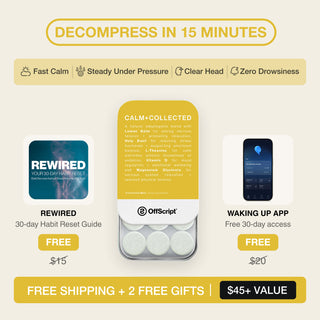
We use lemon balm at 200mg, paired with the other actives below. Full label, no proprietary blend:
Promotes calm, focused attention without drowsiness.
Traditional herb used to promote a settled mood.
Adaptogen traditionally used to support resilience under stress.
A gentle, well-absorbed form of magnesium.
Supports normal mood + immune function.
It's a mint, so it dissolves in your mouth rather than going through your stomach — which is a delivery decision, not a magic one. We wrote about why that route is faster in our guide to sublingual delivery.
CALM UNDER PRESSURE
Lemon balm, L-Theanine + holy basil in a mint that dissolves in 60 seconds. 12 mints per tin, 2 tins per order.
SHOP CALM+COLLECTEDDosing, Timing + Honest Caveats
Human trials have used a wide range, commonly 300–600mg of extract daily, though standardisation differs so much between products that cross-study dose comparisons are shaky. Ours sits at 200mg alongside a 200mg dose of L-theanine, which is where the combined evidence is strongest rather than where the biggest number lives.
Timing: because the acute trial found effects within hours, taking it ahead of a known stressor is reasonable. It is not sedating at these doses, so it doesn't need to be an evening-only thing.
Two more caveats worth stating plainly. Lemon balm may interact with sedatives + thyroid medication, so check with a pharmacist if you take either. And if you're pregnant or breastfeeding, the safety data isn't there — skip it.
Key Takeaways
- Lemon balm works on the GABA system, but by slowing GABA's breakdown rather than forcing the receptor open — a fundamentally different relationship than a benzodiazepine has with the same system.
- Human evidence is promising but modest: an eight-week RCT in a specific patient population, plus a recent acute-effects trial showing changes within hours.
- It's usually paired with L-theanine because they reach calm by different routes, and L-theanine has the deeper evidence base.
- CALM+COLLECTED uses 200mg of lemon balm — a dose chosen for the combination, not for the label.
- It is not a treatment for an anxiety disorder. For everyday stress load, it's a reasonable, low-risk tool.
Explore The Series
- The complete guide to natural calm + stress relief
- GABA supplements: can they really calm your mind?
- The science of adaptogens + the stress response
References
- Savage K, Firth J, Stough C, Sarris J. GABA-modulating phytomedicines for anxiety: A systematic review of preclinical and clinical evidence. Phytother Res. 2018;32(1):3-18. PubMed
- Haybar H, Javid AZ, Haghighizadeh MH, et al. The effects of Melissa officinalis supplementation on depression, anxiety, stress, and sleep disorder in patients with chronic stable angina. Clin Nutr ESPEN. 2018;26:47-52. PubMed
- Mathews I, et al. The acute effects of Zensera (Melissa officinalis L.) extract on mood and cognitive performance during cognitively demanding tasks. Ther Adv Psychopharmacol. 2026;16:20451253261415706. PubMed
- Ibarra A, Feuillere N, Roller M, et al. Effects of chronic administration of Melissa officinalis L. extract on anxiety-like reactivity and on circadian and exploratory activities in mice. Phytomedicine. 2010;17(6):397-403. PubMed
- Nobre AC, Rao A, Owen GN. L-theanine, a natural constituent in tea, and its effect on mental state. Asia Pac J Clin Nutr. 2008;17 Suppl 1:167-168. PubMed
- Lopresti AL. Modulation of the hypothalamic-pituitary-adrenal (HPA) axis by plants and phytonutrients: a systematic review of human trials. Nutr Neurosci. 2022;25(8):1704-1730. PubMed
FAQ
Does lemon balm actually work for anxiety, or is it just tradition?
There's a real mechanism behind it — its compounds appear to inhibit the enzyme that breaks down GABA, your brain's main calming neurotransmitter. Human trials are positive but small, and one of the better ones ran in a specific patient population. So: plausible mechanism, promising evidence, not a settled question.
Will lemon balm make me drowsy?
At the doses used in supplements like ours, it's not intended to sedate — the goal is a settled baseline, not drowsiness. Very high doses of any calming herb can feel sedating for some people, and it may add to the effect of sedative medications, so check with a pharmacist if you take those.
How is this different from taking Xanax?
Both touch the GABA system, but differently. A benzodiazepine binds the GABA-A receptor and amplifies the signal directly, which is powerful and fast — and why tolerance and dependency are documented risks. Lemon balm appears to slow GABA's breakdown so more of your own stays available. Different mechanism, different risk profile. They are not interchangeable, and lemon balm is not a substitute for prescribed medication.
How much lemon balm should I take?
Human trials commonly use 300–600mg of extract daily, but standardisation varies so much between products that comparing doses across studies is unreliable. CALM+COLLECTED uses 200mg alongside 200mg of L-theanine — chosen for how the combination performs rather than for the biggest number on a label.
Can I take lemon balm with my prescribed anxiety medication?
Ask your prescriber or pharmacist first. Lemon balm may add to the effects of sedatives, and never adjust or stop a prescription on your own — some anxiety medications require medically supervised tapering.