




Nobody searches "natural alternative to Xanax" casually. Either you've been offered a prescription + you'd rather not start, or you're already on one + you don't like where it's heading. Both are good reasons to be reading this. What follows is the honest version, which means starting with what most supplement pages skip: benzodiazepines work extremely well. That is precisely why the way they work matters so much.
What Xanax Actually Does At The Receptor
Alprazolam doesn't manufacture calm out of nothing. It borrows yours + turns up the volume.
GABA is your brain's primary inhibitory neurotransmitter — the brake pedal to glutamate's accelerator. When GABA binds its receptor, chloride flows into the neuron + the cell becomes harder to fire. Benzodiazepines bind to a separate site on that same GABA-A receptor and act as positive allosteric modulators: they don't open the channel themselves, they make the channel open more readily whenever your own GABA shows up.
The result is fast + powerful. Alprazolam peaks within about an hour, and for someone in acute, severe anxiety that speed is genuinely valuable. No supplement does what a benzodiazepine does in that window, and any brand implying otherwise is misleading you.
Why The Mechanism That Works Is The Mechanism That Traps
Here's the part that gets left out of the prescription conversation. Tolerance + dependency aren't unfortunate side effects bolted onto an otherwise clean drug. They fall directly out of how the drug works.
Your nervous system regulates toward balance. When an outside compound sustains an amplified inhibitory signal day after day, the system adapts — GABA-A receptor signalling becomes less responsive, and the same dose does less than it used to. That's tolerance, and it's the expected response to sustained amplification.
The problem is what that adaptation means when the drug isn't there. Your excitatory/inhibitory balance has been recalibrated around a molecule that's now missing, so the brake sits weaker than your own baseline. That's the source of rebound anxiety, rebound insomnia + in serious cases seizures. Alprazolam's relatively short duration makes it particularly prone to a mini version of this between doses.
None of this makes benzodiazepines bad drugs. It makes them powerful ones with a specific cost, best used briefly + deliberately. The real problem is how often they get handed out for something that isn't acute panic at all — the ordinary, grinding stress load of a demanding life.
What A "Natural Alternative" Can Honestly Mean
It cannot mean equivalence. Nothing in this category binds the GABA-A receptor the way a benzodiazepine does, and nothing here treats panic disorder or generalised anxiety disorder. Those are clinical conditions with real treatments — cognitive behavioural therapy, and in many cases medication. If your anxiety stops you functioning, that's a conversation for a doctor, not a supplement brand.
What it can honestly mean is this: for the everyday stress load — wired at 11pm, tight-chested before a presentation, unable to downshift after work — there are compounds that support your own regulation instead of overriding it. Slower. Milder. Without the adaptation problem, because there's nothing sustained to adapt to.
The Options With Real Evidence
Ranked by strength of human evidence, not by how good the marketing sounds.
L-theanine — the strongest case. An amino acid from tea leaves, associated with increased alpha-wave activity, the EEG signature of relaxed wakefulness (Nobre et al., 2008). More usefully for anyone reaching for something before a stressor, a randomised, triple-blind, placebo-controlled crossover trial found a single dose reduced the stress response to an acute stressor in healthy adults (Evans et al., 2021). It doesn't sedate — the effect is on the edge, not on your thinking.
GABA-supporting botanicals — a different route to the same system. Lemon balm is the best-characterised. Its constituents appear to inhibit GABA transaminase, the enzyme that breaks GABA down, so more of your own inhibitory neurotransmitter stays available for longer. A systematic review of GABA-modulating plant medicines catalogued this mechanism across the preclinical + clinical literature (Savage et al., 2018). Note the contrast with a benzodiazepine: one amplifies the receptor's response, the other slows the clean-up crew. Same neurotransmitter, opposite relationship with your own regulation.
Ashwagandha — the hormonal route. A randomised, double-blind, placebo-controlled trial found reduced serum cortisol + improved stress scores versus placebo (Chandrasekhar et al., 2012). This works on the HPA axis over weeks, not on receptors within an hour. Useful for a chronically elevated baseline, useless as a rescue.
Magnesium — worth including, not worth headlining. A systematic review found the evidence for magnesium + subjective anxiety "suggestive" of benefit but explicitly limited by the poor quality of the available trials (Boyle et al., 2017). A sensible foundational input, particularly if your intake is low. Not a pillar.
Two things none of these do: produce a benzodiazepine-like effect, or work in five minutes. If a product marketed as a "natural Xanax" genuinely feels like one, the honest question is what's actually in it.
How CALM+COLLECTED Is Built
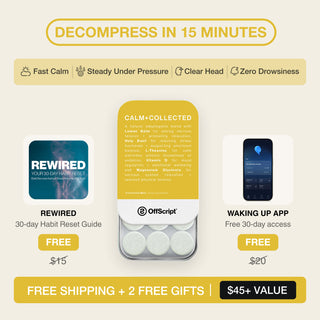
The design logic follows from everything above: multiple mechanisms, multiple timescales, nothing that binds a receptor and forces it open. L-theanine for the acute edge, lemon balm for the GABA-breakdown route, holy basil + magnesium for the slower baseline. Full label, no proprietary blend:
Promotes calm, focused attention without drowsiness.
Traditional herb used to promote a settled mood.
Adaptogen traditionally used to support resilience under stress.
A gentle, well-absorbed form of magnesium.
Supports normal mood + immune function.
What it won't do: sedate you, treat a diagnosed anxiety disorder, or replace a prescription. What it's built to do: take the edge off the physical stress response while leaving your thinking intact.
CALM UNDER PRESSURE
Calm that doesn't cost you your edge. 12 mints per tin, 2 tins per order.
SHOP CALM+COLLECTEDIf You're Already Taking A Benzodiazepine
This deserves a section, not a footnote.
Do not reduce your dose on your own. Benzodiazepine discontinuation is one of the few withdrawal syndromes that can be medically dangerous, and doing it safely means a gradual, planned taper with your prescriber. People who taper well do it slowly + with support. No supplement makes that process unnecessary.
Tell your prescriber what else you're taking. Several calming botanicals can add to the effects of sedative medication, and your doctor needs the full picture. Lemon balm may interact with sedatives + thyroid medication. Holy basil may affect blood sugar. If you're pregnant or breastfeeding, the safety data for most of these simply isn't there.
"Natural" is a description of origin, not a safety guarantee. We'd rather say that out loud than let the word do work it hasn't earned.
Key Takeaways
- Benzodiazepines amplify your own GABA signal at the GABA-A receptor. That's why they work fast, and why the nervous system adapts to them.
- Tolerance and dependency aren't bolted-on side effects — they follow directly from sustained receptor amplification. Never stop or reduce a benzodiazepine on your own.
- No supplement is equivalent to a benzodiazepine, and none treats an anxiety disorder. The honest target is everyday stress load.
- L-theanine has the strongest human evidence here; lemon balm works the GABA-breakdown route; ashwagandha acts on cortisol over weeks; magnesium's evidence is suggestive but methodologically weak.
- Auditing your caffeine intake is free, fast, and probably outperforms anything you can buy.
Explore The Series
- Natural alternatives to anxiety medication: an honest guide
- Lemon balm for anxiety: the calming herb with real research
- GABA supplements: can they really calm your mind?
References
- Nobre AC, Rao A, Owen GN. L-theanine, a natural constituent in tea, and its effect on mental state. Asia Pac J Clin Nutr. 2008;17 Suppl 1:167-168. PubMed
- Evans M, et al. A Randomized, Triple-Blind, Placebo-Controlled, Crossover Study to Investigate the Efficacy of a Single Dose of AlphaWave® L-Theanine on Stress in a Healthy Adult Population. Neurol Ther. 2021;10(2):1061-1078. PubMed
- Savage K, Firth J, Stough C, Sarris J. GABA-modulating phytomedicines for anxiety: A systematic review of preclinical and clinical evidence. Phytother Res. 2018;32(1):3-18. PubMed
- Chandrasekhar K, Kapoor J, Anishetty S. A prospective, randomized double-blind, placebo-controlled study of safety and efficacy of a high-concentration full-spectrum extract of ashwagandha root in reducing stress and anxiety in adults. Indian J Psychol Med. 2012;34(3):255-262. PubMed
- Boyle NB, Lawton C, Dye L. The Effects of Magnesium Supplementation on Subjective Anxiety and Stress—A Systematic Review. Nutrients. 2017;9(5):429. PubMed
- Fredholm BB, Bättig K, Holmén J, Nehlig A, Zvartau EE. Actions of caffeine in the brain with special reference to factors that contribute to its widespread use. Pharmacol Rev. 1999;51(1):83-133. PubMed
FAQ
Is there a natural supplement that works like Xanax?
No, and be sceptical of anything marketed that way. Benzodiazepines act directly on the GABA-A receptor to amplify your brain's inhibitory signal, and nothing available as a supplement does that. Compounds like L-theanine and lemon balm support your own regulation through different, gentler mechanisms — real effects, but not equivalent ones.
Can I use supplements to come off Xanax?
Not on your own. Benzodiazepine withdrawal can cause seizures, and any reduction has to be a gradual taper planned and supervised by your prescriber. If you want to discuss adding something alongside a supervised taper, that's a conversation to have with the doctor managing it — not a decision to make from an article.
What's the strongest natural option for anxiety?
By weight of human evidence, L-theanine. It's associated with increased alpha-wave activity — the EEG pattern of calm wakefulness — and a placebo-controlled crossover trial found a single dose reduced the response to an acute stressor in healthy adults. It doesn't sedate, which is the point.
Why do benzodiazepines cause dependency?
Because of how they work, not despite it. Sustained amplification of the GABA-A receptor prompts the nervous system to adapt — the same dose starts doing less, and the underlying balance recalibrates around a drug that's now expected. Remove it abruptly and inhibition sits below baseline, which is what produces rebound symptoms.
How fast do natural calming supplements work?
It depends on the mechanism. L-theanine has evidence for an acute effect within roughly an hour. Lemon balm sits in a similar window. Ashwagandha and magnesium work on slower systems — cortisol regulation and baseline nutrient status — and are measured in weeks. None of them are rescue medication.