




Search "natural supplements for ADHD adults" and you'll get two kinds of pages. One implies a botanical blend can stand in for a prescription. The other says nothing natural does anything at all. Both are wrong, and neither helps the person typing the query.
Here's the version we'd want if we were the one searching: what the research genuinely shows, who it was tested in, and — the part almost nobody publishes — where the evidence runs out.
What People Are Actually Searching For
The intent behind the phrase is more specific than it looks. Some people are diagnosed + medicated, and it's working, but they want to know whether anything helps in the hours the dose doesn't cover. Some are diagnosed and haven't started medication, and want the full menu before committing. Some have decided with a clinician to come off stimulants. And some are undiagnosed, on a nine-month waitlist, looking for anything at all in the meantime.
Four different questions, four honest answers. What they share is a reasonable premise: supporting attention + mental energy is a legitimate thing to want, whatever your diagnostic status. The trouble starts when a brand answers that by pretending a supplement is a substitute for care.
Why The Interest Is Rising
Adult ADHD is recognised far more than it was a decade ago — people told they were disorganised in the nineties are getting assessed in their thirties + forties. That's largely good. It also means a lot of newly diagnosed adults are learning their own neurology from scratch, in public.
The other half is access. Telehealth became a markedly more common route for starting a stimulant prescription across the COVID-19 period — an analysis of Medicaid + CHIP enrollees tracked that shift directly (Creedon et al., 2025). More people on stimulants means more people with questions about tolerance, about the gap between doses, about what daily dependence means. That's what drives the supplement search. It isn't anti-medicine sentiment — it's people wanting to understand the whole system they're now part of.
What The Evidence Genuinely Shows — And In Whom
This is the section most articles skip, so we'll be blunt.
The supplement evidence in diagnosed ADHD populations is thin. Trials exist, but they tend to be small, mixed in design + inconsistent in outcome. Anyone telling you a nootropic blend has robust clinical evidence in diagnosed adult ADHD is describing a literature that doesn't exist yet.
What does exist — and it's genuinely decent — is research on specific compounds improving attention, cognitive performance, or resilience to mental fatigue in healthy adults under cognitive load. Replicated, well-designed, and exactly what it says on the tin: healthy adults, demanding tasks, attention outcomes.
Those two things are not the same, and the distance between them is where most supplement marketing goes wrong. Healthy-adult attention data does not become ADHD data because a brand puts the word ADHD in a headline. Below is what the research shows, described as what it is.
The Ingredients With Mechanisms Worth Knowing
L-Tyrosine — the dopamine precursor
Dopamine is central to attention + motivation, which is why it comes up constantly in ADHD conversations. L-Tyrosine is the amino acid your body converts into L-DOPA and then dopamine. It doesn't force release the way a stimulant does — it supplies raw material to a system your brain still regulates.
The detail that matters: a review found the benefit concentrated specifically under stress or high cognitive demand, when neurotransmitter turnover is elevated (Jongkees et al., 2015). Not a general mood lift, not a baseline upgrade. Support under load. A narrow claim, and the correct one.
L-Theanine + caffeine — the attention pairing
The most replicated combination in the natural cognition literature. Caffeine drives alertness by blocking adenosine, the molecule that accumulates through the day + signals fatigue. L-Theanine, an amino acid from tea, takes off the wired, scattered edge caffeine alone can produce.
Together they improved attention + reduced task-related tiredness in healthy adults (Haskell et al., 2008), and a later study found the combination outperformed either compound alone (Kahathuduwa et al., 2017). "Alert without jittery" is the difference between a usable afternoon and a wasted one.
A labeling note, since the branded form comes up in searches: Suntheanine is a well-known patented form of L-theanine used in several of the published trials. The compound is the same amino acid; the brand name signals a standardized manufacturing process, not a different ingredient.
CognatiQ — BDNF, on a longer timescale
A patented whole coffee fruit extract studied for its effect on plasma brain-derived neurotrophic factor, a protein involved in neuronal growth + plasticity (Reyes-Izquierdo et al., 2013). Infrastructure rather than performance — nothing you feel in twenty minutes, and a different category of claim entirely.
Citicoline — acetylcholine raw material
Citicoline supplies choline, the building block for acetylcholine, the neurotransmitter most associated with attention, memory + learning. A study in healthy adult women reported improved attentional performance following citicoline administration (McGlade et al., 2012). One study, one population — promising, not settled.
Rhodiola Rosea — mental stamina under stress
An adaptogen with a controlled trial reporting improvements in mental fatigue measures during stress-induced fatigue (Darbinyan et al., 2000). Sustaining effort, not sharpening it.
Rhodiola For ADHD: The Honest Read On A Popular Search
"Rhodiola for ADHD" is one of the most-searched supplement questions in this space, so it deserves its own straight answer rather than a buried paragraph.
Here is what the research actually contains. Rhodiola rosea has controlled human trials in healthy adults: a standardized extract improved a composite mental-performance index by roughly 20% in physicians working night duty (Darbinyan et al., 2000), and a separate 28-day trial in adults with stress-related fatigue reported reduced burnout, improved attention + a lowered cortisol-awakening response (Olsson et al., 2009). What the research does not contain is a body of well-designed trials in diagnosed ADHD populations. If someone tells you rhodiola is proven for ADHD, they are extrapolating.
Why the interest persists anyway: the overlap is real at the symptom level. Mental fatigue, effort that collapses mid-task, focus that degrades under stress — these are everyday realities for many adults with ADHD, and they are exactly the outcomes rhodiola was tested on in healthy adults. So the honest framing is this: rhodiola is a reasonable, evidence-supported tool for stress-related mental fatigue in adults generally. Whether that translates to your ADHD is something the literature cannot yet answer + a two-week self-test (below) answers better than any blog. It is not a treatment, + it is not a reason to change a prescription.
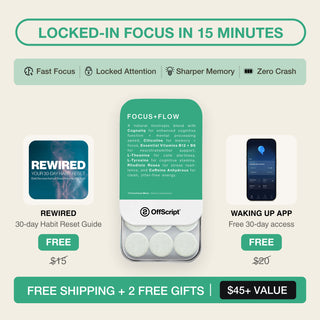
What's Actually In FOCUS+FLOW
The full label, real doses, no proprietary blend hiding the numbers behind a total:
Patented coffee-fruit extract, clinically studied to support BDNF.
Calm, focused attention without the jitters.
Dopamine precursor for drive + focus under pressure.
Adaptogen that supports mental stamina under stress.
Clean, measured energy — smoothed by L-Theanine.
Citicoline-sourced choline; raw material for acetylcholine, the memory + learning neurotransmitter.
Supports neurotransmitter production.
Supports cellular energy.
It's a focus formula. It is not an ADHD product, it is not a treatment, and it is not a reason to change anything you've decided with a prescriber.
FOCUS ON COMMAND
Full doses on the label. Try it for yourself and judge it on your own days.
SHOP FOCUS+FLOWWhat Supplements Cannot Do
Worth stating plainly, because the omission is how people get hurt.
No supplement diagnoses anything. If you suspect ADHD, the answer is an assessment, not a purchase — self-medicating around an unanswered question muddies the picture rather than clearing it.
No supplement replicates a prescription stimulant. The mechanisms aren't comparable + the effect sizes aren't in the same range. A brand that blurs this is selling to your hope.
And nothing in a tin outranks the basics. Sleep, exercise + a day structured so attention isn't running on brute force do more for most people than any formula. Caffeine timing matters here too: research measuring sleep after a dose found that caffeine taken even six hours before bed measurably disrupted it (Drake et al., 2013). Wrecking your sleep to sharpen your afternoon is a trade that loses.
How To Evaluate A Product Honestly
Four questions that filter out most of the category.
Are the doses on the label? "Proprietary blend" means you can't tell whether a studied ingredient is present at a studied amount or as a dusting.
Does the brand say who the research was done in? Healthy adults under cognitive load is a different population from diagnosed ADHD. A brand that won't distinguish them is either careless or counting on you not to notice.
Does it claim to treat anything? If it does, that's your answer. Supplements aren't permitted to make disease-treatment claims, and the ones that do are telling you exactly how much they respect the rules — + you.
Does it tell you what it can't do? Rare, and the most useful signal available.
Key Takeaways
- ADHD is a medical condition. Diagnosis + treatment decisions belong to you and your clinician — no supplement changes that.
- Supplement evidence in diagnosed ADHD populations is thin. The stronger evidence is for attention in healthy adults under load. Different claims.
- L-Tyrosine supplies dopamine raw material, with benefit concentrated under stress or high cognitive demand. It does not force release.
- L-Theanine with caffeine is the most replicated attention pairing in the natural literature, and outperformed either alone.
- Rhodiola's trials are in healthy adults under fatigue, not diagnosed ADHD — useful for mental stamina, unproven as an ADHD tool.
- Sleep, exercise + day structure outrank anything you can buy. Judge any product on two weeks of your own data.
Explore The Series
- The best natural Adderall alternatives, honestly assessed
- Life after Adderall: rebuilding focus without the prescription
- The ADHD dopamine crash, explained
- Rhodiola Rosea for Mental Fatigue: What the Science Says
- How to Increase Dopamine Naturally
References
- Creedon TB, Wen H, Ali MM, Haffajee RL. Trends in telehealth initiation of prescription stimulants for child and adult enrollees in Medicaid and CHIP during COVID-19. Health Aff (Millwood). 2025;44(8):996-1004. PubMed
- Jongkees BJ, Hommel B, Kühn S, Colzato LS. Effect of tyrosine supplementation on clinical and healthy populations under stress or cognitive demands—A review. J Psychiatr Res. 2015;70:50-57. PubMed
- Haskell CF, Kennedy DO, Milne AL, Wesnes KA, Scholey AB. The effects of L-theanine, caffeine and their combination on cognition and mood. Biol Psychol. 2008;77(2):113-122. PubMed
- Kahathuduwa CN, Dassanayake TL, Amarakoon AMT, Weerasinghe VS. Acute effects of theanine, caffeine and theanine-caffeine combination on attention. Nutr Neurosci. 2017;20(6):369-377. PubMed
- Reyes-Izquierdo T, Nemzer B, Shu C, et al. Modulatory effect of coffee fruit extract on plasma levels of brain-derived neurotrophic factor in healthy subjects. Br J Nutr. 2013;110(3):420-425. PubMed
- McGlade E, Locatelli A, Hardy J, et al. Improved attentional performance following citicoline administration in healthy adult women. Food Nutr Sci. 2012;3(6):769-773.
- Darbinyan V, Kteyan A, Panossian A, et al. Rhodiola rosea in stress induced fatigue. Phytomedicine. 2000;7(5):365-371. PubMed
- Olsson EM, von Schéele B, Panossian AG. A randomised, double-blind, placebo-controlled, parallel-group study of the standardised extract SHR-5 of the roots of Rhodiola rosea in the treatment of subjects with stress-related fatigue. Planta Med. 2009;75(2):105-112. PubMed
- Drake C, Roehrs T, Shambroom J, Roth T. Caffeine effects on sleep taken 0, 3, or 6 hours before going to bed. J Clin Sleep Med. 2013;9(11):1195-1200. PubMed
FAQ
Do natural supplements work for ADHD in adults?
The research in diagnosed ADHD populations is thin and inconsistent. What is better established is that certain compounds support attention and cognitive performance in healthy adults under cognitive load. That may still be useful to you, but it is not evidence in ADHD and we won't present it as though it were. Treatment decisions belong with your clinician.
Does rhodiola rosea help with ADHD?
There is no solid trial evidence in diagnosed ADHD. What rhodiola does have is controlled-trial evidence in healthy adults: better mental performance under fatigue and improved attention in stress-related fatigue over 28 days. Those outcomes overlap with things many adults with ADHD struggle with, which explains the interest, but overlap is not proof. It is a mental-stamina tool, not a treatment.
Can I take a focus supplement alongside my prescribed medication?
That is a question for your prescriber, not for us. FOCUS+FLOW contains 100mg of caffeine, which is directly relevant if you are already taking a stimulant, so raise it specifically. Do not add anything to a prescribed regimen without asking first.
Which ingredient has the strongest evidence for attention?
The L-theanine and caffeine combination. It has been replicated across multiple trials in healthy adults, improving attention, reducing task-related tiredness, and outperforming either compound alone. L-tyrosine is well supported too, but specifically under stress or high cognitive demand rather than generally.
Is Suntheanine different from L-theanine?
No — Suntheanine is a patented, standardized branded form of the same amino acid, used in several published trials. When you see Suntheanine on a label it signals a specific manufacturing process, not a different ingredient. The research on L-theanine and attention applies to the compound itself.
Does FOCUS+FLOW contain citicoline?
Yes. The label reads "Choline (as Citicoline)" at 18mg — that is 18mg of elemental choline sourced from citicoline, written the standard way supplement facts panels list a nutrient with its source form.
I think I have ADHD but I'm not diagnosed. Should I try supplements first?
Get assessed. A supplement cannot diagnose anything, and layering one on top of an unanswered question makes the picture harder to read. If you are on a long waitlist, the highest-value things you can do meanwhile are sleep, exercise and restructuring your day so attention does not depend on brute force.