





Most people sabotage their focus within four minutes of waking up. They reach across the nightstand, grab the phone, then stumble toward a coffee machine — all before their brain has finished the chemical handoff from sleep to wakefulness. It feels productive. It's actually the reason the 10 a.m. crash exists. The truth is that a sharp, resilient morning routine for focus has very little to do with willpower + everything to do with sequencing: doing the right things in the right order so your own physiology does the heavy lifting. You don't need a stimulant prescription to think clearly. You need to stop overriding the system that already knows how to wake you up.
This is the OffScript position in a nutshell. The body has a built-in wake-up protocol — a cascade of hormones, light-sensitive signals, + neurotransmitters designed to bring you online. The goal isn't to bulldoze that system with synthetic force. It's to support it. Here's how to build a morning that produces genuine mental clarity, backed by the actual mechanisms involved.
The First Hour Decides How the Day Goes
Within roughly 30 to 45 minutes of waking, healthy adults experience a sharp, natural spike in cortisol called the cortisol awakening response. This isn't the "stress hormone" caricature — in the morning, cortisol is your ally. It raises blood pressure + blood sugar, sharpens alertness, and helps clear the sleep pressure that built up overnight. A well-timed morning routine works with this surge rather than blunting it.
What amplifies that response? Light, movement, + a short delay before caffeine. What flattens it? Dim rooms, doomscrolling in bed, and pouring a stimulant onto a system that's already ramping. The research on light is especially clean: transitioning from dim to bright light in the morning produced an immediate elevation in cortisol of roughly 50% in one controlled study, and post-awakening bright-light exposure has been shown to enhance the cortisol awakening response itself. Get the first hour right + you're not "hacking" anything — you're just refusing to fight your own biology.
Step 1: Get Light Before You Get Caffeine
The single highest-leverage move in any morning routine for focus is also the cheapest: get bright light into your eyes early. Morning light — ideally outdoor sunlight, even on an overcast day — hits specialized cells in the retina that report directly to your brain's master clock. This anchors your circadian rhythm, sets a timer for melatonin release roughly 16 hours later (which is why morning light improves that night's sleep), + reinforces the cortisol surge that drives alertness.
In a study on the cortisol awakening response, post-awakening light exposure meaningfully increased the cortisol response compared with staying in dim conditions, and separate work found that the shift from dim to bright morning light triggered an immediate cortisol elevation. Practically: get outside for five to ten minutes, or sit by a bright window if you can't. No sunglasses. On dark winter mornings, a bright artificial light does part of the job. This one habit does more for daytime focus than any amount of caffeine you drink in a dim kitchen.
Step 2: Delay the Caffeine (Yes, Really)
Here's the counterintuitive part. Caffeine works by blocking adenosine receptors — it's a non-selective antagonist at the A1 and A2A adenosine receptors. Adenosine is the molecule that accumulates while you're awake and makes you feel sleepy; caffeine slips into its parking spots so the "you're tired" signal can't dock. The catch: caffeine doesn't remove adenosine. It masks it. When the caffeine wears off, all that backed-up adenosine floods the newly free receptors at once — that's the crash.
Right after waking, adenosine is already low + your cortisol is climbing on its own, so you don't actually need caffeine yet. Drinking it immediately spends your ammunition on a fight you're already winning. Waiting 90 to 120 minutes lets the natural cortisol peak run its course, gives residual adenosine time to clear, + means caffeine lands when it can do real work — extending alertness through the late morning instead of front-loading it. The payoff is smoother energy + less of that early-afternoon nosedive. If you build one new rule into your morning, make it this one: light first, movement next, caffeine third. That rule matters even more for a tired mom running on broken sleep.
Step 3: Move, Then Fuel
You don't need a punishing workout. Five to fifteen minutes of movement — a brisk walk (bonus: combine it with your light exposure), light resistance work, or mobility — raises core temperature, boosts circulation to the brain, + reinforces the wake-up cascade. Movement also nudges dopamine + norepinephrine, the neurotransmitters most tied to drive and attention.
When you do eat, prioritize protein over a sugar-forward breakfast. A spike-and-crash glucose curve is the enemy of steady concentration. Protein supplies the amino acid building blocks — including tyrosine, which we'll come back to — that your brain uses to manufacture focus-related neurotransmitters. The sequence again: light, movement, real food, + only then caffeine or a targeted nootropic. Order is the whole game.
The Ingredient Stack Behind a Focused Morning
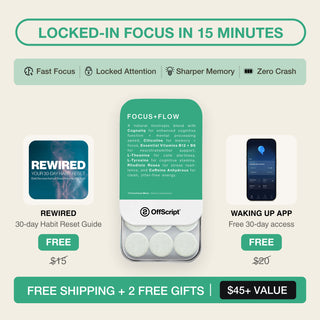
Once the behavioral foundation is in place, the right nootropics can sharpen the edge — not by whipping your nervous system, but by supplying the raw materials + signaling your brain uses to focus. This is exactly the logic behind OffScript's Focus+Flow, formulated to slot into the delayed-caffeine window rather than replace the fundamentals. Here's what's actually in the formula, at the mechanism level.
Patented coffee-fruit extract, clinically studied to support BDNF — the protein behind neuron growth + plasticity.
Calm, focused attention without the jitters — the counterweight to caffeine.
Dopamine precursor for drive + focus when you're pushing under pressure.
Adaptogen that supports mental stamina under stress.
Clean, measured energy — smoothed by L-Theanine.
Raw material for acetylcholine, the memory + learning neurotransmitter.
Supports neurotransmitter production.
Supports cellular energy.
Here's what each of those is doing once it's in your system:
- CognatiQ (whole coffee fruit extract) — This patented, clinically studied extract targets BDNF, or brain-derived neurotrophic factor, a protein that supports the growth, maintenance, + plasticity of neurons. In a controlled study, a single dose of whole coffee fruit concentrate raised plasma BDNF by roughly 143% over baseline. More BDNF is associated with better learning + cognitive resilience — the substrate on which focus is built.
- Choline (as Citicoline) — Choline is the raw material your body uses to make acetylcholine, the neurotransmitter most tied to attention, memory, + learning. Focus+Flow sources its 18mg of choline from citicoline, the most heavily studied form — which means the citicoline research applies here directly. In placebo-controlled trials, citicoline has been linked to improved memory + cognitive performance in healthy adults. The target is simple: keep the acetylcholine system well supplied.
- L-Theanine + Caffeine Anhydrous — This is the classic pairing, and the reason it's classic is real. Caffeine antagonizes adenosine for alertness; L-theanine, an amino acid from tea, promotes calm, alpha-wave brain activity that takes the jittery edge off. Reviewed together, the combination reliably improves attention + reaction time more than either compound alone — calm alertness instead of the wired-and-tired feeling. Delaying it to the 90-minute window makes it work even better.
- L-Tyrosine — The direct amino-acid precursor to dopamine + norepinephrine, the neurotransmitters that govern motivation and focus. Under cognitively demanding or stressful conditions, your brain burns through these faster; supplying more tyrosine gives it the raw material to keep production up when you're pushing hard.
- Rhodiola Rosea — An adaptogen used to support mental stamina under stress, it helps round out the stack so a demanding morning doesn't drain your edge by midday.
- Vitamin B6 + B12 — Essential cofactors in neurotransmitter synthesis + cellular energy metabolism. They aren't stimulants; they're the enzymatic support crew that lets the rest of the machinery run. B6 in particular is required to convert precursors like tyrosine into finished neurotransmitters.
Notice the pattern: nothing here overrides your system. Each ingredient supports a process your brain already runs — making neurons more resilient, feeding neurotransmitter production, + balancing stimulation with calm.
FOCUS ON COMMAND
Built to slot into the delayed-caffeine window — clean, crash-free focus that works with your morning, not against it.
SHOP FOCUS+FLOWBuild a Morning Routine for Focus That Compounds
The best part of a real morning routine for focus is that it's cumulative. Morning light tonight improves your sleep, which improves tomorrow's cortisol response, which makes tomorrow's focus easier — a loop that gets stronger the longer you run it. You don't need a prescription or a heroic overhaul. You need light before caffeine, a little movement, protein over sugar, and, if you want a sharper edge, a nootropic that works with your biology instead of against it.
That's the whole reason we built Focus+Flow — to be the natural, mechanism-first upgrade to a morning you're already running well. If you're curious whether the difference is real, the honest answer is to test it against your own baseline for a couple of weeks + watch your late-morning clarity. Try it for yourself and see what a properly sequenced morning actually feels like.
Key Takeaways
- Your body runs its own wake-up protocol — a cortisol surge 30 to 45 minutes after waking. A good morning works with it, not against it.
- Get bright light in your eyes before caffeine; it anchors your circadian rhythm + reinforces the natural cortisol response.
- Delay caffeine 90 to 120 minutes. Adenosine is already low on waking, so early caffeine wastes its effect and sets up the crash.
- Sequence beats willpower: light, movement, protein, then caffeine or a nootropic.
- Focus+Flow supplies raw materials — CognatiQ, citicoline-sourced choline, L-tyrosine, the L-theanine + caffeine pairing — that support the processes your brain already uses to focus.
Explore The Series
- L-Theanine and Caffeine: The Perfect Natural Focus Stack
- The 2PM Crash Isn't a Willpower Problem
- CognatiQ, Coffee Fruit Extract, and BDNF
References
- Scheer FAJL, Buijs RM. Transition from Dim to Bright Light in the Morning Induces an Immediate Elevation of Cortisol Levels. The Journal of Clinical Endocrinology & Metabolism, 2001. https://academic.oup.com/jcem/article/86/1/151/2841140
- Petrowski K, et al. The effects of post-awakening light exposure on the cortisol awakening response in healthy male individuals. Psychoneuroendocrinology. https://www.sciencedirect.com/science/article/abs/pii/S0306453018306565
- Reichert CF, et al. Adenosine, caffeine, and sleep–wake regulation: state of the science and perspectives. Journal of Sleep Research, 2022. https://onlinelibrary.wiley.com/doi/10.1111/jsr.13597
- Reyes-Izquierdo T, et al. Modulatory effect of coffee fruit extract on plasma levels of brain-derived neurotrophic factor in healthy subjects. British Journal of Nutrition, 2013. https://pubmed.ncbi.nlm.nih.gov/23312069/
- Nakazaki E, et al. Citicoline and Memory Function in Healthy Older Adults: A Randomized, Double-Blind, Placebo-Controlled Clinical Trial. The Journal of Nutrition, 2021. https://www.ncbi.nlm.nih.gov/pmc/articles/PMC8349115/
- Zaragoza J, et al. The Cognitive-Enhancing Outcomes of Caffeine and L-theanine: A Systematic Review. PMC, 2022. https://pmc.ncbi.nlm.nih.gov/articles/PMC8794723/
FAQ
How long should I wait to drink coffee in the morning?
A window of about 90 to 120 minutes after waking works well for most people. On waking, adenosine — the molecule caffeine blocks — is already low + your cortisol is climbing naturally, so early caffeine adds little and sets up a harder crash later. Waiting lets the natural cortisol peak run its course so caffeine extends alertness into the late morning instead of front-loading it.
Does morning light really matter more than caffeine for focus?
For most people, yes. Bright morning light hits cells in the retina that anchor your circadian rhythm and reinforce the cortisol awakening response. In controlled research, the shift from dim to bright morning light produced an immediate rise in cortisol. It also times that night's melatonin release, so it improves the sleep that drives tomorrow's focus — something caffeine can't do.
Is it bad to check my phone first thing in the morning?
Scrolling in a dim room is a missed opportunity more than a catastrophe. You're spending your sharpest early minutes on low-light input + reactive stress instead of the light, movement, and sequencing that amplify your natural wake-up cascade. Getting light + a little movement first sets up a measurably better first hour.
When should I take Focus+Flow in my morning routine?
Focus+Flow is designed to slot into the delayed-caffeine window — after light, movement, and protein, roughly 90 minutes into your morning. It contains 100mg of caffeine alongside L-theanine, so treating it as your morning caffeine source (rather than stacking it on top of coffee) keeps the calm-alertness balance intact.
Can nootropics replace a good morning routine?
No — and Focus+Flow isn't built to. The behavioral foundation (light, delayed caffeine, movement, protein) does the heavy lifting. A nootropic supplies raw materials like L-tyrosine + choline and signaling support like CognatiQ to sharpen the edge on top of a morning you're already running well. It's an upgrade to the fundamentals, not a substitute for them.