




Thesis is one of the best-known nootropic brands in the world, + "does Thesis work" is a fair thing to type before you commit to a subscription. Here is our honest review. We make a competing product, so read this knowing that, check every claim against Thesis's own site, + weigh us accordingly. We have tried to write the review we would want to read if we were the ones being reviewed.
What Thesis Actually Is
Thesis is a personalized nootropic system, not a single product. You take an onboarding quiz about your goals + habits, and Thesis recommends a starter kit of different formulas to trial, one blend per week. The blends are goal-based: Clarity for mental speed + working memory, Motivation for drive + task initiation, Energy, Logic, Creativity, Stress Reset for calm, + Neuroprotection for long-horizon brain health. Each comes in daily capsule packets, + every formula is offered in a caffeinated version or a caffeine-free version, chosen at checkout.
The idea underneath is genuinely good: people respond differently to the same ingredients, so instead of one general-purpose stack, you sample several + keep what works for you. That is a more honest model of how nootropics actually behave than most of the category admits.
What Thesis Gets Right
Worth saying clearly + up front, because a lot of competitor reviews skip it.
They publish their doses. Thesis lists ingredients + amounts rather than hiding behind a proprietary blend. In this category that is not the norm, + it is the single most important thing a supplement brand can do. We hold ourselves to the same standard, + we will happily credit anyone else who meets it.
Every blend has a caffeine-free version. Chosen at checkout, across the whole range. For stimulant-sensitive people, or anyone taking a blend late in the day, that is a real piece of product design + more than most competitors bother with.
The ingredient choices are defensible. These are not novelty compounds. Blends draw on things with genuine human research behind them, at doses you can look up + evaluate rather than guess at.
The personalization is an honest answer to a real problem. Individual response to nootropics varies a lot, + most brands paper over that by selling one formula to everyone. Thesis built its whole model around admitting it. Whatever else you conclude, that is the intellectually honest position.
Does Thesis Work? The Honest Breakdown
Three separate questions hide inside that search, so here are three separate answers.
Do the ingredients work? Many have real human research behind them at meaningful doses, + Thesis doses them transparently enough that you can check. The caffeinated versions also pair caffeine with L-theanine, a combination with replicated controlled-trial support for attention (Haskell et al., 2008) that has outperformed either compound alone (Kahathuduwa et al., 2017). So the effect people report is real, + it rests on a well-evidenced foundation plus the additional actives in whichever blend you are taking.
Does the personalization work? It is a sensible framework, + it is also self-reported. You are assessing blends across weeks when novelty + expectation are strongest, which is a limitation of any at-home trial rather than a criticism of Thesis specifically. Our own product has exactly the same problem. If you run it, track something concrete: time to start a task, blocks completed, how you felt at 4PM. Structured self-report is genuinely useful, it is just worth doing properly.
Will it work for you? Unknowable in advance, which is the truthful answer for every nootropic, ours included. The fair test for any of these products is two weeks, same time of day, same type of task, with your own before-and-after notes.
Thesis Clarity, Reviewed
Clarity is Thesis's focus-and-processing blend + usually the first one people search. The structural things to know: it is a swallowed capsule product, so onset runs on digestion time, roughly 30 to 60 minutes. That is a design choice rather than a flaw. A daily capsule routine is the right format for a product meant to be taken consistently every morning, which is what Thesis is.
Pricing as listed in August 2026, on 25 servings per order: $129 one-time, or $59 for a first subscription month + $79 a month after. Thesis lists $2.36 a dose for that introductory month + about $1.96 on the three-month plan. At the ongoing $79 rate it works out nearer $3.16. Check their site for current numbers; subscription pricing changes.
Who Clarity fits: someone who wants a comprehensive daily capsule routine, values guided personalization, + is buying a system rather than a single product. Who it does not fit: someone who wants to feel something in fifteen minutes, on demand, without a subscription.
Thesis + ADHD: Read This Part Carefully
A lot of people find Thesis while searching for ADHD help, so the plain version matters here. Thesis is a supplement, not a treatment. No nootropic blend, theirs or ours, has the body of evidence in diagnosed ADHD populations that would justify treatment language, + supplements are not permitted to make treatment claims. If you have or suspect ADHD, diagnosis + treatment decisions belong with your clinician, + no supplement changes that. What a supplement can honestly offer is attention + energy support of the kind studied in healthy adults under cognitive load. We wrote the full version of that distinction in Natural Supplements for ADHD Adults. This is a caution about the whole category, ours included, not about Thesis in particular.
Strengths + Weaknesses
| Where Thesis is strong | Where it is a harder sell |
|---|---|
| Publishes ingredients + doses, no proprietary blends | Premium pricing, at the top end of the category |
| Caffeine-free version of every single blend | Capsule route means 30 to 60 minute onset + water |
| Goal-based blends instead of one-size-fits-all | Personalization rests on self-report, as all at-home trials do |
| Structured way to sample formulas + find your fit | Subscription model suits daily routines, not occasional use |
| Range covers focus, drive, calm + long-term brain health | Breadth means more to manage than a single formula |
Where Thesis Beats FOCUS+FLOW
We would rather say this ourselves than have you find it out afterwards.
Breadth. Thesis covers goals we simply do not. If you want a blend aimed at creativity, or logic, or long-horizon neuroprotection, we do not make one. They do, + within the range you get a coherent system rather than four unrelated products.
Personalization. We sell one focus formula. If it is not the right fit for you, that is the end of the conversation. Thesis is built to find your fit across several blends, which is a real advantage if you do not already know what works for you.
A comprehensive daily routine. If what you want is a considered stack taken every morning as part of a routine, capsules are a sensible format + Thesis has built that thoughtfully. Our product is designed for the opposite use case.
Caffeine-free across the range. Every Thesis blend has a caffeine-free option. FOCUS+FLOW contains caffeine, full stop. If you want stimulant-free focus specifically, they serve you + we do not.
Thesis vs FOCUS+FLOW: The Structural Difference
We compared these fully in Thesis Alternative: How FOCUS+FLOW Compares, so here is the short version. These are different kinds of product aimed at different moments, not better and worse versions of the same thing.
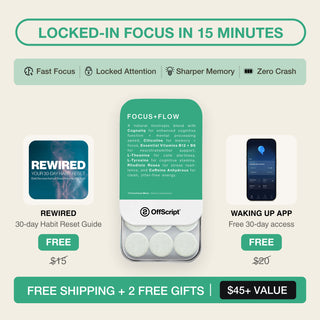
Thesis is capsules, digested, personalized, built as a daily routine, at roughly $1.96 to $3.16 a dose depending on which plan you are on. FOCUS+FLOW is one formula in a fast-dissolving mint: it absorbs through the mouth, skips first-pass digestion (a route shown to absorb caffeine faster than swallowed capsules (Kamimori et al., 2002)), works in about fifteen minutes, + costs $2.46 a serving one-time or $1.63 on subscription.
If you want breadth, guided experimentation + a daily routine, Thesis is the stronger fit + we would tell you so. If you want speed, simplicity + on-demand use at a lower ongoing price, that is what we built.
ONE FORMULA, EVERY DOSE PRINTED
Sublingual focus in about fifteen minutes. $39 on subscription, 24 mints.
SHOP FOCUS+FLOWVerdict
Thesis is a serious, transparent product built on a genuinely good idea, priced at the premium end + delivered in a format built for daily routine rather than speed. It is a strong choice for people who want a guided, comprehensive capsule system + value finding their personal fit across several blends. It is the wrong buy for people who want fast, on-demand focus, who do not want a subscription, or who are hoping any supplement can stand in for clinical care.
We compete with them + we still think it is a good product. Judge it, + us, on your own two-week test.
Key Takeaways
- Thesis is a quiz-personalized capsule system with goal-based blends, each available caffeinated or caffeine-free.
- It publishes ingredients + doses rather than hiding behind proprietary blends, which is the right standard + not the category norm.
- Personalization is a sensible framework, though like any at-home trial it rests on self-report. Track concrete outcomes.
- It is premium-priced (25 servings per order, $79/month ongoing as listed) + built for routine, with 30 to 60 minute capsule onset.
- Thesis beats us on breadth, personalization + caffeine-free options. We are faster, simpler + cheaper per serving.
- It is not an ADHD treatment, + neither is any supplement. That decision belongs with a clinician.
Explore The Series
- Thesis Alternative: How FOCUS+FLOW Compares
- Qualia Mind Alternative: How FOCUS+FLOW Compares
- Best Alpha Brain Alternatives: 5 Options Compared
- Natural Supplements for ADHD Adults
References
- Haskell CF, Kennedy DO, Milne AL, Wesnes KA, Scholey AB. The effects of L-theanine, caffeine and their combination on cognition and mood. Biol Psychol. 2008;77(2):113-122. PubMed
- Kahathuduwa CN, Dassanayake TL, Amarakoon AMT, Weerasinghe VS. Acute effects of theanine, caffeine and theanine-caffeine combination on attention. Nutr Neurosci. 2017;20(6):369-377. PubMed
- Kamimori GH, Karyekar CS, Otterstetter R, et al. The rate of absorption and relative bioavailability of caffeine administered in chewing gum versus capsules to normal healthy volunteers. Int J Pharm. 2002;234(1-2):159-167. PubMed
FAQ
Does Thesis actually work?
The ingredients are real + transparently dosed, + the caffeinated blends rest on the well-replicated caffeine + L-theanine pairing alongside the other actives in each formula, so the effect people report is genuine. The personalization layer is a sensible framework that, like any at-home trial, relies on self-report. Whether it works for you is answerable only by a tracked two-week trial, which is true of every nootropic including ours.
Is Thesis good for ADHD?
Thesis is a supplement, not a treatment, + no nootropic has treatment-level evidence in diagnosed ADHD. If you have or suspect ADHD, that conversation belongs with a clinician. What supplements can honestly offer is attention support of the kind studied in healthy adults under cognitive load. This applies to the whole category, not to Thesis specifically.
How much does Thesis cost?
As listed in August 2026, on 25 servings per order: $129 one-time for a blend like Clarity, or $59 for a first subscription month + $79 a month after. That works out to $2.36 a dose on the introductory month, about $1.96 on the three-month plan, + around $3.16 at the ongoing monthly rate. Check their site for current pricing.
Is Thesis worth it?
If you want a comprehensive daily capsule routine + value working out which blend suits you across several options, yes, it is a well-built product + the price buys you genuine breadth. If you want one thing that works fast, on demand, without a subscription, you will find it expensive for what you use.
What is a cheaper alternative to Thesis?
For the caffeine + L-theanine mechanism in a faster format, FOCUS+FLOW runs $2.46 a serving one-time or $1.63 on subscription as a sublingual mint with every dose printed. It is worth being clear that this is not a like-for-like swap: we sell one focus formula, not a personalized system across seven blends. The DIY route, coffee plus an L-theanine capsule, is cheaper still if you do not mind managing two things.
Is Thesis a stimulant?
The caffeinated versions contain caffeine, a stimulant, alongside L-theanine + the blend's other ingredients. Every formula is also offered caffeine-free, chosen at checkout, which is a genuine point in Thesis's favor for stimulant-sensitive users + something our own product does not offer.
These statements have not been evaluated by the Food and Drug Administration. This product is not intended to diagnose, treat, cure, or prevent any disease. Thesis® is a trademark of its owner. OffScript is not affiliated with or endorsed by Thesis. Formulations, offerings + pricing referenced were taken from takethesis.com in August 2026 + change frequently; check the manufacturer's current pages before purchasing.
