




The phrase "adaptogens for energy" contains a small but important error, + clearing it up is the most useful thing this article can do.
Adaptogens do not provide energy. A stimulant borrows alertness against your later state. An adaptogen does something different: it is a class of plants studied for reducing the cost of sustained demand, so you arrive at 4PM with more left. The subjective result can feel similar. The mechanism + the timescale are not.
Understanding that difference is the difference between one of these working for you + concluding they are all nonsense.
What "Adaptogen" Actually Means
A loosely defined category rather than a regulated one. The working definition: a plant compound that helps the body maintain equilibrium under stress, without being a stimulant + without a strong directional push in either direction.
The looseness matters, because it means the label is applied generously. Plenty of things marketed as adaptogens have close to no human evidence. A few have quite a lot.
The Ones With Evidence Relevant To Energy
Rhodiola rosea, the one that fits best
If the complaint is fatigue under prolonged demand, this is the adaptogen with the most directly relevant research. The studied effect is specifically on mental fatigue during sustained work rather than on alertness in the moment (Darbinyan et al., 2000).
It is also the fastest-acting of the group, with effects reported over days rather than the many weeks ashwagandha requires. That makes it the most practical entry point.
Ashwagandha, the baseline one
Works on the stress response over weeks. A commonly referenced randomised, double-blind, placebo-controlled trial found reductions in stress scores + serum cortisol over roughly 60 days (Chandrasekhar et al., 2012).
Relevant to energy only indirectly: if your exhaustion is coming from a chronically elevated stress response, lowering that helps. Take it once + you will feel nothing, which is why so many people write it off.
It also needs more caution than it usually gets. There are rare but documented reports of liver injury associated with ashwagandha supplements, it can affect thyroid hormone levels, + it is generally advised against in pregnancy + for people with hormone-sensitive conditions or autoimmune thyroid disease.
Holy basil (tulsi)
Randomised placebo-controlled evidence on stress outcomes (Lopresti et al., 2022), with a review summarising the broader human evidence (Jamshidi & Cohen, 2017). A lighter caution profile than ashwagandha, which is a genuine practical advantage.
The wider picture
A systematic review of human trials on plants + phytonutrients acting on the hypothalamic-pituitary-adrenal axis maps where this regulation genuinely responds to intervention (Lopresti, 2022). It is worth reading as a corrective to how the category is marketed.
What They Will Not Do
- Replace a stimulant. No adaptogen produces the acute lift caffeine does, + none is trying to.
- Work in an afternoon. Rhodiola is the quickest + still wants days. Ashwagandha wants weeks.
- Fix a deficiency. If you are tired because your ferritin, B12, thyroid or vitamin D is off, an adaptogen does not touch that. Get the blood test.
- Outrun short sleep. Nothing in this category does.
How To Actually Test One
Most people get no useful information from trying adaptogens because of how they try them.
One at a time. Starting three simultaneously guarantees you learn nothing about any of them.
For long enough. Rhodiola, one to two weeks. Ashwagandha or holy basil, six to eight. Judging either at day three is judging nothing.
At a dose that matches the research, which means the label must print per-ingredient amounts. A proprietary blend makes the test meaningless before it starts.
Against a specific complaint. "More energy" is too vague to evaluate. "Am I still functional at 5PM on a heavy week" is answerable.
Where Adaptogens Sit In Our Formula
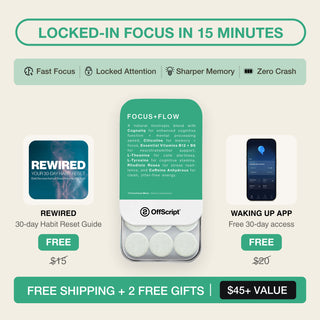
FOCUS+FLOW carries rhodiola at 100mg, + it is explicitly not the engine. The caffeine + L-theanine pairing does the acute work; rhodiola + tyrosine are there for the back half of a long day. We think that layering is the honest way to use an adaptogen: underneath something that handles the moment, not pretending to be it.
Patented coffee-fruit extract, clinically studied to support BDNF.
Calm, focused attention without the jitters.
Dopamine precursor for drive + focus under pressure.
Adaptogen that supports mental stamina under stress.
Clean, measured energy, smoothed by L-Theanine.
Raw material for acetylcholine, the memory + learning neurotransmitter.
Supports neurotransmitter production.
Supports cellular energy.
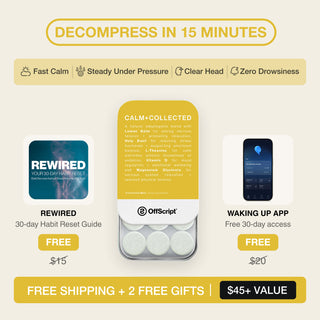
If you want an adaptogen without a stimulant, CALM+COLLECTED uses holy basil + is caffeine-free.
Key Takeaways
- Adaptogens do not supply energy. They reduce the cost of sustained demand, which is a different thing that can feel similar.
- Rhodiola fits the energy complaint best + acts fastest, over days rather than weeks.
- Ashwagandha works on the baseline over roughly eight weeks + needs real screening first.
- Holy basil has placebo-controlled stress evidence with a lighter caution profile.
- None of them fixes a deficiency or outruns short sleep. Get bloods before buying.
- Test one at a time, for long enough, at a printed dose, against a specific complaint.
Explore The Series
- The Best Adaptogens For Stress + Focus
- Rhodiola Rosea for Mental Fatigue: What the Science Says
- L-Theanine vs Ashwagandha
- How Adaptogens Help Balance Cortisol
- How To Get Energy Without Caffeine
- Supplements For Burnout
References
- Darbinyan V, et al. Rhodiola rosea in stress induced fatigue. Phytomedicine. 2000. PubMed
- Chandrasekhar K, Kapoor J, Anishetty S. A prospective, randomized double-blind, placebo-controlled study of safety and efficacy of a high-concentration full-spectrum extract of ashwagandha root. Indian J Psychol Med. 2012. PubMed
- Lopresti AL, Smith SJ, Metse AP, Drummond PD. A randomized, double-blind, placebo-controlled trial investigating the effects of an Ocimum tenuiflorum (holy basil) extract on stress. Front Nutr. 2022. PubMed
- Jamshidi N, Cohen MM. The Clinical Efficacy and Safety of Tulsi in Humans. Evid Based Complement Alternat Med. 2017. PMC
- Lopresti AL. Modulation of the hypothalamic-pituitary-adrenal (HPA) axis by plants and phytonutrients: a systematic review of human trials. Nutr Neurosci. 2022. PubMed
FAQ
Do adaptogens give you energy?
Not in the way a stimulant does. They do not supply acute alertness. What the research supports is a reduction in the cost of sustained demand, so fatigue accumulates more slowly across a long or stressful period. That can feel like more energy, but it arrives over days to weeks rather than in an afternoon.
What is the best adaptogen for energy?
Rhodiola rosea, because its studied effect is specifically on mental fatigue under prolonged demand rather than on general wellbeing, and because it acts faster than the others, over days rather than many weeks. Ashwagandha and holy basil work on the stress response over a longer horizon, which helps energy only indirectly.
How long do adaptogens take to work?
Rhodiola is generally reported over one to two weeks. Ashwagandha and holy basil are studied over roughly six to eight weeks, and a single dose of either produces nothing noticeable. Judging any of them after a few days will tell you nothing useful.
Can you take adaptogens with caffeine?
Yes, and they are not competing. Caffeine handles the acute moment while an adaptogen works on stamina across a longer period. Many formulas layer them deliberately. Keep track of your total caffeine separately, since the adaptogen does nothing to offset it.
Are adaptogens safe?
Mostly, but not uniformly. Ashwagandha in particular warrants screening: there are rare but documented reports of liver injury, it can affect thyroid hormone levels, and it is generally advised against in pregnancy and for hormone-sensitive or autoimmune thyroid conditions. Speak to a doctor before starting any adaptogen if you are pregnant, have a thyroid condition or take prescription medication.
These statements have not been evaluated by the Food and Drug Administration. This product is not intended to diagnose, treat, cure, or prevent any disease. This article is educational and is not medical advice.