




You've seen the video. Someone squeezes a dropper under their tongue, stares at the camera, and thirty seconds later they're deep-cleaning their apartment at 7am. Anti-lazy drops are one of the most shared supplement formats on social media right now, and the pitch is irresistible: motivation, in liquid form, on demand.
Here's the honest version. Some of the ingredients that show up in these drops have real research behind them. The format has real problems. And "lazy" isn't a biochemical state you can dissolve in glycerin. Let's take the category apart properly, because underneath the trend there's a genuinely useful idea + a lot of fairy dust.
What Are Anti-Lazy Drops?
Anti-lazy drops are liquid tinctures marketed for motivation, drive, and task initiation. You take them by dropper, usually under the tongue. Most formulas draw from the same ingredient pool: saffron extract, L-theanine, B vitamins, adaptogens like Rhodiola, sometimes a plant-based caffeine source, all suspended in a glycerin or alcohol base.
The under-the-tongue instruction isn't an accident. Sublingual delivery is a legitimate route: the tissue under your tongue is thin + densely vascularized, and compounds absorbed there enter the bloodstream without a first pass through the liver. Reviews of buccal + sublingual delivery describe exactly why the route works and when it matters. It's the same mechanism behind our fast-dissolving mints, so we're not here to dunk on the concept. The concept is sound.
The execution is where the category earns its skepticism.
What's Actually in Anti-Lazy Drops?
Read the labels and a pattern shows up fast.
- Proprietary blends. Many drops list a "motivation blend" or "focus complex" with one combined number. You can't tell whether the saffron is at a studied dose or a sprinkle. When a formula hides individual doses, assume the expensive ingredients are underdosed. That's what the hiding is for.
- Dropper-sized ceilings. A dropper holds about 1ml. Compare that to the doses used in actual research: 150mg of L-theanine, 100mg of Rhodiola, 100mg of caffeine. Getting research-level amounts of several actives into a few drops of liquid that still tastes acceptable is very hard. Most formulas don't try. They list impressive ingredients at token amounts.
- Serving-size drift. Squeeze a dropper twice and you'll get two different volumes. Tinctures make precise, repeatable dosing harder than it should be, which matters when the active window of an ingredient depends on hitting a real dose.
- The base itself. Alcohol or glycerin, flavoring, sweeteners. Not harmful, but it's carrier, not cargo. You're often paying premium prices for water weight.
Do Anti-Lazy Drops Work?
Split the question in two.
Do the ingredients work? Some do, at the right doses. L-theanine paired with caffeine is the most replicated combination in the focus literature: trials found the pair improves accuracy on demanding attention-switching tasks + reduces distraction, and EEG studies show alpha-band changes consistent with calm, sustained attention. Tyrosine feeds dopamine production, which is the neurotransmitter actually involved in drive + task initiation. Rhodiola has human research on mental fatigue. These are real levers.
Do the drops deliver them? Usually not at the doses the research used. A formula with 20mg of a "focus blend" per serving is not the formula from the studies, no matter how good the ingredient names look. And no supplement, in any format, manufactures motivation out of nothing. What the good ingredients actually do is remove friction: steadier arousal, less mental noise, more dopamine raw material. You still have to start the task. Anyone promising more than that is selling the video, not the bottle.
Drops vs Mints: Same Idea, Different Execution
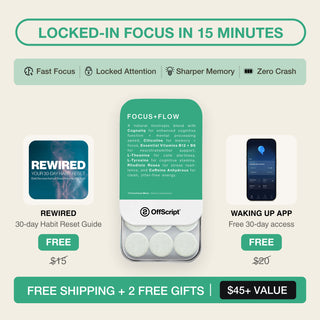
We should be direct about our position: OffScript doesn't make drops. FOCUS+FLOW is a fast-dissolving mint, and it uses the same sublingual logic the drops advertise. The difference is what we put behind it.
A mint is a fixed, manufactured dose. Every mint carries the same milligrams, so there's no dropper drift. It dissolves against the same vascularized tissue, so the delivery mechanism is identical. And because a mint doesn't have to fight a tincture's taste + volume limits, it can carry research-level doses: our label lists every ingredient at its exact amount, and the doses match the studies we cite.
Faster onset, honest doses, zero guesswork. That's the whole argument.
What's Actually in FOCUS+FLOW
Here's the full label. The doses are the doses.
Patented coffee-fruit extract, studied for its effect on BDNF.
Calm, focused attention without the jitters.
Dopamine precursor for drive + focus under pressure.
Adaptogen that supports mental stamina under stress.
Clean, measured energy, smoothed by L-Theanine.
Raw material for acetylcholine, the memory + learning neurotransmitter.
Supports neurotransmitter production.
Supports cellular energy.
Two mechanisms worth knowing. L-tyrosine is the amino acid your brain converts into dopamine, the neurotransmitter behind drive + task initiation. That's the lever "anti-lazy" products are actually reaching for, and we dose it at 100mg alongside the cofactors that support the conversion. CognatiQ is a patented whole coffee fruit extract: in a study in the British Journal of Nutrition, a 100mg dose was associated with a roughly 143% increase in plasma BDNF from baseline in healthy adults. Small acute study, honestly reported, dose matched on our label.
How to Judge Any Motivation Supplement
Drops, mints, gummies, powders. The format changes, the questions don't. Is every active disclosed at an individual milligram dose? Do those doses match the published research, or just gesture at it? Is there a real mechanism named, or just a mood board? And is anyone promising to fix "laziness"? Because laziness is usually sleep debt, task dread, or a dopamine system that wants raw material + a reason. A good formula helps with the last part. Nothing in a dropper handles the rest.
Read the full FOCUS+FLOW label and hold it to the same standard. That's the only comparison that means anything.
Key Takeaways
- Anti-lazy drops are liquid tinctures built on a real idea: sublingual delivery of focus + motivation ingredients.
- The category's weak points are proprietary blends, token doses limited by dropper volume, and imprecise serving sizes.
- Ingredients like L-theanine, tyrosine + Rhodiola have real research, but only at doses most drops don't disclose or don't reach.
- A fast-dissolving mint uses the same sublingual route with a fixed, manufactured dose and a fully disclosed label.
- No supplement creates motivation from nothing. The good ones remove friction: steadier energy, less noise, more dopamine raw material.
Explore The Series
- The Complete Guide to Nootropic Mints
- L-Tyrosine: The Dopamine Precursor That Keeps You Sharp Under Pressure
- L-Theanine + Caffeine: The Perfect Natural Focus Stack
References
- "Sublingual and Buccal Delivery: A Historical and Scientific Prescriptive." Pharmaceutics, 2025. MDPI
- Owen GN, et al. "The combined effects of L-theanine and caffeine on cognitive performance and mood." Nutritional Neuroscience, 2008. PubMed
- Kelly SP, et al. "L-theanine and caffeine in combination affect human cognition as evidenced by oscillatory alpha-band activity and attention task performance." Journal of Nutrition, 2008. PubMed
- Reyes-Izquierdo T, et al. "Modulatory effect of coffee fruit extract on plasma levels of brain-derived neurotrophic factor in healthy subjects." British Journal of Nutrition, 2013. PubMed
FAQ
What are anti-lazy drops supposed to do?
They're marketed to support motivation, drive, and task initiation, usually through a mix of saffron, L-theanine, B vitamins, and adaptogens taken under the tongue. The realistic version of that promise is friction removal: steadier arousal, less mental noise, and raw material for dopamine production. No drop format creates motivation by itself.
What ingredients are in anti-lazy drops?
Common ingredient decks include saffron extract, L-theanine, B6 + B12, Rhodiola or other adaptogens, and sometimes a plant-based caffeine source, in a glycerin or alcohol tincture base. The problem is rarely the ingredient list. It's that many labels group everything into a proprietary blend, so you can't verify whether any single ingredient is at a researched dose.
Do anti-lazy drops actually work?
The honest answer: the best ingredients in the category have real research at real doses, and most drops don't demonstrably contain those doses. A 1ml dropper physically limits how much active material a serving can carry. If a label doesn't show per-ingredient milligrams, assume marketing over mechanism.
Are drops or mints better for sublingual delivery?
Both use the same route: absorption through the vascularized tissue in your mouth. A fast-dissolving mint has two practical advantages: every mint is a fixed manufactured dose with no dropper variance, and a mint can carry research-level doses that a palatable tincture can't. FOCUS+FLOW lists every dose on the label for exactly this reason.
Can I take FOCUS+FLOW instead of anti-lazy drops?
If what you want from the drops is clean stimulation, calm focus, and dopamine support, that's what FOCUS+FLOW is built for: 100mg caffeine smoothed by 150mg L-theanine, 100mg L-tyrosine, 100mg Rhodiola, and 100mg CognatiQ, fully disclosed. If you're sensitive to caffeine, pregnant, or on prescription medication, talk to your doctor first.