




"Are nootropics safe?" is a fair question with a problem buried inside it. Nootropic isn't a regulated category with a safety profile — it's a marketing word. It covers L-theanine, a compound humans have been drinking in tea for a thousand years, and it also covers unapproved research chemicals sold by anonymous vendors with zero human safety data. Asking whether nootropics are safe is like asking whether plants are edible. Depends entirely which one, at what dose, taken by whom. Here's the honest version, from a company that sells one.
The Word Covers Too Much Ground To Answer At Once
Split the category into three tiers and the question gets answerable.
Tier one: well-studied dietary compounds. Caffeine, L-theanine, citicoline, L-tyrosine, magnesium, B vitamins. Decades of human data, established dose ranges, documented interactions.
Tier two: botanicals + adaptogens. Rhodiola, ashwagandha, lemon balm, lion's mane. Long traditional use, a real but thinner modern evidence base, and genuine variability between extracts.
Tier three: synthetics + prescription-adjacent compounds. Racetams, modafinil analogues, unscheduled research chemicals, sometimes sold "not for human consumption" with a wink. This is where the danger lives, and where almost every alarming nootropics headline comes from.
Most of the fear is about tier three. Most of what people buy is tier one + two. Collapsing them into one question is how you get both scare pieces and overconfident marketing.
The Regulatory Reality Nobody In This Industry Wants To Print
In the United States, supplements fall under the Dietary Supplement Health and Education Act of 1994. In plain language: they are not pre-approved by the FDA the way prescription drugs are. A company does not have to prove a product works, or that it's safe, before putting it on a shelf. Regulators act after the fact.
We benefit from that framework. We're also telling you about it, because it's the strongest reason to be skeptical of every supplement company, this one included. When the barrier to entry is that low, the burden of proof moves onto the brand: full dose disclosure, third-party testing, ingredients with published human research, no claim the evidence can't carry.
Practically, the label is the safety document. If it won't tell you the exact dose of every active, you're trusting a stranger's judgment about how much stimulant to put in your body.
Why "Natural" Does Not Mean Automatically Safe
Natural is our brand word, so we should be the ones to say this clearly: it is not a synonym for harmless. Nicotine is natural. Foxglove is natural. Ephedra is natural, and it got pulled from the US market for good reason. What natural actually buys you is a longer relationship between the compound and human biology, and usually a better-characterised metabolic pathway. That's a meaningful advantage. It is not immunity.
Three things matter more than origin. Dose — caffeine at 100mg is a mild, well-understood stimulant; at 1,000mg it's a medical event. Interactions — a plant compound can amplify or blunt a prescription drug regardless of how wholesome the plant is. Individual variation — people clear caffeine at genuinely different rates, which is why one cup is unremarkable for you and a 3am ceiling-stare for someone else. Any brand claiming its product is safe for everyone because it's natural has stopped thinking.
Are Nootropics Safe For Daily Use?
Ingredient by ingredient, the honest answer splits.
Caffeine is fine daily for most healthy adults inside known limits. The European Food Safety Authority concluded that single doses up to 200mg, and habitual intakes up to 400mg per day, don't raise safety concerns for healthy adults (EFSA, 2015). Tolerance still builds — a diminishing-returns problem more than a safety one, but a real cost.
L-theanine, citicoline, magnesium + B vitamins are routinely taken daily and have been studied that way.
Adaptogens like rhodiola are typically studied over weeks, not years, which is why many people cycle them. We don't have decades of continuous-use data. That's an unknown, and it should be named as one.
The genuine daily-use risk usually isn't one ingredient. It's stacking. Pre-workout, coffee, a focus supplement, an afternoon energy drink — past 500mg of caffeine before lunch, because no label told you about the other three.
The Common Side Effects, And Where They Actually Come From
Jitters, racing heart, anxiety, headaches, GI upset, wrecked sleep. Read that list and you're mostly reading a description of too much caffeine.
Caffeine works by blocking adenosine receptors — it doesn't create energy, it suppresses the signal telling you you're tired (Fredholm et al., 1999). Useful trick, with a bill attached: the fatigue you blocked is still queued up behind it.
Sleep is where people underestimate the cost. In a controlled study, a 400mg dose taken even six hours before bed measurably disrupted sleep (Drake et al., 2013). Six hours — a good reason not to trust your gut feeling about whether the afternoon coffee is affecting you.
L-theanine is the standard answer to the jittery edge, and the research supports it — the combination outperforms caffeine alone on attention measures, with less of the wired feeling (Haskell et al., 2008)(Kahathuduwa et al., 2017). But smoothing the feel of caffeine isn't removing it. The dose is still in you, still on the same clock, still counting toward your daily total.
What We Know About Long-Term Effects
Less than anyone selling these products would like. It's the weakest part of the evidence base for nearly every nootropic ingredient, and pretending otherwise is the category's most common dishonesty.
Caffeine is the exception — one of the most-studied substances on earth, with decades of habitual-use data behind it. For most other ingredients, the longest good human trials run eight to twelve weeks. That's enough to say no safety signal appeared over three months. It is not enough to say "safe for a decade." Anyone implying otherwise is filling a gap with confidence.
What follows is unglamorous but useful: favour boring, well-characterised ingredients at doses the research actually used, over novel compounds with an exciting story and no history.
Who Should Be Cautious Or Skip Them Entirely
What Full Disclosure Actually Looks Like
Here's our entire FOCUS+FLOW label, with nothing behind a blend:
Patented coffee-fruit extract, clinically studied to support BDNF.
Calm, focused attention without the jitters.
Dopamine precursor for drive + focus under pressure.
Adaptogen that supports mental stamina under stress.
Clean, measured energy — smoothed by L-Theanine.
Citicoline-sourced choline; raw material for acetylcholine, the memory + learning neurotransmitter.
Supports neurotransmitter production.
Supports cellular energy.
Two things to take from that list, neither of them a sales point. First: this is a caffeinated product. 100mg is roughly a cup of coffee. It counts toward your daily ceiling, it belongs in the morning, and if you're already three coffees deep it's the wrong thing to add. Second: the coffee-fruit extract is there for a studied mechanism — support for BDNF, a protein involved in neuroplasticity (Reyes-Izquierdo et al., 2013) — not as a second stimulant.
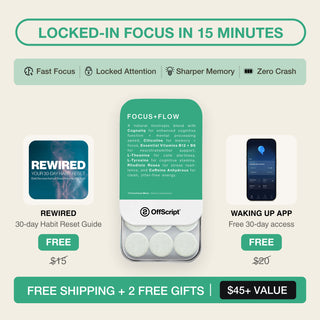
If caffeine is exactly what you need to avoid, don't take this one. CALM+COLLECTED is caffeine-free — L-theanine, lemon balm, holy basil, magnesium glycinate + vitamin D — and does a different job.
FOCUS ON COMMAND
Every dose printed on the tin. No proprietary blends. 12 mints per tin, 2 tins per order.
SHOP FOCUS+FLOWKey Takeaways
- "Nootropic" isn't a safety category. Dietary compounds, botanicals + unapproved research chemicals carry wildly different risk.
- Supplements aren't pre-approved by the FDA, so the burden of proof sits with the brand. A proprietary blend hiding doses is the failure mode to watch for.
- Caffeine causes most reported side effects. EFSA puts 200mg per dose and 400mg per day inside the safe range for healthy adults, and a dose taken even six hours before bed disrupts sleep.
- Long-term data is thin for everything except caffeine — most good trials run 8–12 weeks. Reassuring, not conclusive.
- Pregnancy, under 18, heart or blood pressure conditions, and any prescription are reasons to talk to a clinician, not to read another review.
Explore The Series
- What are nootropics? A beginner's guide
- Natural vs synthetic: an honest breakdown
- Does caffeine raise cortisol?
References
- EFSA Panel on Dietetic Products, Nutrition and Allergies. Scientific Opinion on the safety of caffeine. EFSA Journal. 2015;13(5):4102. doi:10.2903/j.efsa.2015.4102
- Fredholm BB, Bättig K, Holmén J, et al. Actions of caffeine in the brain with special reference to factors that contribute to its widespread use. Pharmacol Rev. 1999;51(1):83-133. PubMed
- Drake C, Roehrs T, Shambroom J, Roth T. Caffeine effects on sleep taken 0, 3, or 6 hours before going to bed. J Clin Sleep Med. 2013;9(11):1195-1200. PubMed
- Haskell CF, Kennedy DO, Milne AL, et al. The effects of L-theanine, caffeine and their combination on cognition and mood. Biol Psychol. 2008;77(2):113-122. PubMed
- Kahathuduwa CN, Dassanayake TL, Amarakoon AMT, Weerasinghe VS. Acute effects of theanine, caffeine and theanine-caffeine combination on attention. Nutr Neurosci. 2017;20(6):369-377. PubMed
- Reyes-Izquierdo T, Nemzer B, Shu C, et al. Modulatory effect of coffee fruit extract on plasma levels of brain-derived neurotrophic factor in healthy subjects. Br J Nutr. 2013;110(3):420-425. PubMed
FAQ
Are nootropics safe to take every day?
It depends on the ingredient. Caffeine, L-theanine, citicoline, magnesium and B vitamins have been studied with daily use, and EFSA considers up to 400mg of caffeine per day acceptable for healthy adults. Adaptogens like rhodiola are usually studied over weeks rather than years, so continuous long-term use is less well characterised. The bigger everyday risk is stacking caffeinated products without adding up the total.
What are the most common nootropic side effects?
Jitters, elevated heart rate, anxiety, headaches, stomach upset and disturbed sleep. Almost all of these trace back to caffeine dose rather than to the non-stimulant ingredients. Reducing the dose, moving it earlier in the day, or choosing a caffeine-free formula resolves most of them.
Are nootropics FDA approved?
No, and no supplement is. Under the 1994 DSHEA framework, dietary supplements aren't pre-approved for safety or efficacy the way prescription drugs are; the FDA acts after products reach the market. That's why dose disclosure and third-party testing matter — they're the only real accountability in the category.
Who should not take nootropics?
Anyone pregnant or breastfeeding, anyone under 18, and anyone with high blood pressure, an arrhythmia or another heart condition should avoid stimulant formulas without medical advice. The same applies if you take prescription medication — especially SSRIs, MAOIs, prescribed stimulants, thyroid medication or blood thinners — or have any diagnosed condition.
Does "natural" mean a nootropic is safe?
No. Natural usually means a longer human history with the compound and a better-understood metabolic pathway, which is a genuine advantage, but it doesn't make anything inert. Dose, drug interactions and individual variation determine safety far more than whether an ingredient came from a plant.