





Here is an uncomfortable fact for anyone who assumes "natural" always wins: in the mid-1990s, a major trial gave synthetic beta-carotene to smokers on the theory that this antioxidant would protect their lungs. The intervention was halted early because the supplement group developed more lung cancer, not less. An isolated, synthesized version of a nutrient that is protective in whole vegetables turned out to behave very differently on its own.
That story is why the natural vs synthetic supplements debate deserves more than a slogan. Most wellness marketing treats "natural" as a moral category + "synthetic" as a slur. The truth is more useful and more interesting: sometimes the source of a compound changes everything about how it works in your body, and sometimes it changes nothing at all. If you read ingredient lists + want proof instead of promises, this is the breakdown worth having.
The label isn't the question. The molecule and the matrix are.
"Natural" and "synthetic" describe where a molecule came from, not what it does once it's in your bloodstream. What actually determines whether a supplement works comes down to two things: the exact molecular form of the compound, + the matrix it arrives in — the other cofactors, fibers, and phytochemicals riding alongside it.
Vitamin C is the cleanest example of the source not mattering. Synthetic ascorbic acid + the vitamin C in an orange are the identical molecule. When researchers ran a randomized, steady-state crossover study comparing synthetic vitamin C against kiwifruit-derived vitamin C, they found no significant differences in bioavailability across plasma, white blood cells, or any tissue tested. Your body cannot tell the two apart, because chemically there is nothing to tell apart. Anyone charging a premium for "natural" vitamin C is selling you a story, not a better molecule.
So no — synthetic does not automatically mean inferior. Holding that line honestly is the whole point. The label is a starting question, not an answer.
Where the source genuinely changes the outcome
Now the other side, because it's just as real. For some nutrients, "natural" + "synthetic" are not the same molecule, and the difference shows up in your blood.
Vitamin E is the textbook case. Natural vitamin E exists as a single form (RRR-alpha-tocopherol), while the synthetic version is a blend of eight stereoisomers, only one of which matches what your body is built to use. Human bioavailability work has long pegged natural vitamin E as meaningfully more potent than the synthetic all-racemic form, because your liver's transport protein selectively grabs the natural configuration + discards much of the rest. Same nutrient name on the label; different amount actually reaching your cells.
Folate tells a similar story with a mechanistic twist. Synthetic folic acid is inert until your body converts it, step by step, into the active form your cells use. A large share of people carry MTHFR gene variants that slow that conversion, leaving unconverted folic acid circulating. The methylated form, 5-MTHF, skips the bottleneck entirely — it is already the active molecule the body puts to work, which is why it doesn't depend on an enzyme step that not everyone runs efficiently. And then there's the beta-carotene trial from the intro: an isolated synthetic dose behaving nothing like the same compound wrapped in a whole carrot. The matrix mattered.
The honest conclusion isn't "natural always wins." It's this: the source matters when the natural + synthetic versions are different molecules, or when the natural version comes packaged with cofactors that change how it acts. When they're the identical molecule, it doesn't. That distinction is the entire game.
How this logic plays out in a focus supplement
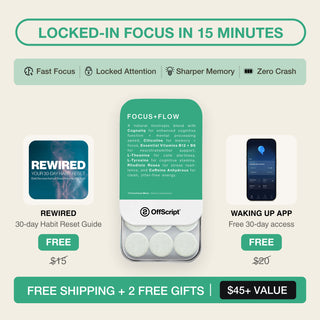
This is exactly the lens to bring to nootropics, where "natural alternative to Adderall" gets thrown around loosely. A stimulant prescription works by force — flooding your synapses with dopamine + norepinephrine on a schedule your body didn't choose. A well-built natural formula works differently: it supports the machinery your brain already uses to focus, then gets out of the way. That's the design philosophy behind OffScript's Focus+Flow, and each ingredient earns its place by mechanism, not vibes.
Start with the ingredient that best illustrates why "natural" can be genuinely sophisticated rather than merely gentle: CognatiQ, a patented whole-coffee-fruit extract. In a controlled study in healthy subjects, whole coffee fruit concentrate raised blood levels of BDNF — brain-derived neurotrophic factor — by roughly 143% compared with baseline. BDNF is the protein that supports the growth + maintenance of neurons and the strength of the connections between them. Notably, the polyphenols in the whole fruit drove the effect, not caffeine. That is the natural matrix doing something a single isolated compound wouldn't.
Here's the full formula, with real label doses — every ingredient has to explain itself:
Patented coffee-fruit extract, clinically studied to support BDNF.
Calm, focused attention without the jitters.
Dopamine precursor for drive + focus under pressure.
Adaptogen that supports mental stamina under stress.
Clean, measured energy — smoothed by L-Theanine.
Raw material for acetylcholine, the memory + learning neurotransmitter.
Supports neurotransmitter production.
Supports cellular energy.
A few of those ingredients are worth unpacking, because they show the same source-versus-molecule logic at work:
- Choline is the raw material your body uses to build phosphatidylcholine, a core component of neuronal membranes, + to make acetylcholine, the neurotransmitter of attention. It's not forcing a signal — it's supplying substrate. Focus+Flow's label reads "Choline (as Citicoline)" — the choline is sourced from citicoline, and that exact form has been studied directly: in a randomized, double-blind, placebo-controlled trial, citicoline supplementation was associated with improved memory performance in healthy older adults, which is the kind of mechanism-first evidence worth looking for.
- L-Theanine plus Caffeine is the pairing that defines "calm alertness." L-theanine promotes alpha-wave brain activity linked to relaxed attention, and in controlled research it has been studied for supporting focus + reducing stress reactivity. Paired with caffeine, it smooths the jitter + crash while keeping the alertness — the opposite of a stimulant spike.
- L-Tyrosine is the amino acid your body converts into dopamine, the neurotransmitter behind motivation + drive. Instead of dumping dopamine into your system, it restocks the shelf so your brain can make its own, especially under stress or heavy cognitive load.
- Vitamins B6 and B12 are cofactors in neurotransmitter production — the enzymatic helpers without which the other ingredients can't do their jobs.
None of this "treats" anything or replaces medical care. The point is mechanistic support: give the brain the substrates + signals it already relies on, and let it regulate itself.
FOCUS ON COMMAND
Every ingredient named, dosed, and explained — read the label with your usual skepticism.
SHOP FOCUS+FLOWHow to actually evaluate a supplement
Forget the "natural" badge on the front of the bottle. Here's the checklist that survives scrutiny:
- Which molecular form is it? Methylfolate over folic acid, RRR-alpha-tocopherol over all-rac, chelated minerals over cheap oxides. When forms differ, the form is the decision.
- Is it dosed to match the research? A trendy ingredient at 10% of the studied dose is a label decoration. Look for amounts that reflect actual trials.
- Is it a real, verifiable compound? Patented, clinically studied ingredients like CognatiQ give you something to check. Proprietary blends that hide doses give you nothing.
- Does the mechanism make sense? If a brand can't tell you how something works, be skeptical that it does.
Run that filter + the natural vs synthetic supplements question mostly dissolves. You stop asking "is it natural?" and start asking "is it the right molecule, at the right dose, doing something my body can actually use?"
The bottom line
Natural isn't automatically better, + synthetic isn't automatically worse. What's better is understanding the difference well enough that no one can market to your assumptions. Sometimes the source is irrelevant. Sometimes, as with vitamin E, folate, and that beta-carotene trial, it changes the entire outcome. The skill worth building is telling those cases apart.
That's the standard we hold ourselves to. If you want to see what it looks like when every ingredient has to explain itself — molecule, dose, + mechanism — take a look at Focus+Flow and read the label with your usual skepticism. That's exactly the reaction it's built to survive.
Key Takeaways
- "Natural" vs "synthetic" describes a molecule's origin, not what it does in your body — the form + the matrix are what actually matter.
- When the two versions are the identical molecule (vitamin C), the source is irrelevant + paying a premium for "natural" is buying a story.
- When they're different molecules (vitamin E, folate) or the natural version carries active cofactors (beta-carotene, coffee fruit), the source can change the outcome.
- A well-built nootropic supports the machinery your brain already uses — CognatiQ, L-theanine + caffeine, L-tyrosine, choline — rather than forcing a signal like a stimulant.
- Evaluate any supplement by four questions: right molecular form, research-matched dose, verifiable compound, and a mechanism that makes sense.
Explore The Series
- CognatiQ + Coffee Fruit Extract: The BDNF Connection
- Citicoline: The Memory Neurotransmitter Hack
- What Are Nootropics? A Beginner's Guide
References
- Omenn GS, et al. Effects of a Combination of Beta Carotene and Vitamin A on Lung Cancer and Cardiovascular Disease. New England Journal of Medicine, 1996. https://www.nejm.org/doi/full/10.1056/NEJM199605023341802
- Carr AC, et al. A Randomized Steady-State Bioavailability Study of Synthetic versus Natural (Kiwifruit-Derived) Vitamin C. Nutrients, 2013. https://pmc.ncbi.nlm.nih.gov/articles/PMC3798928/
- Hoppe PP, Krennrich G. Bioavailability and potency of natural-source and all-racemic alpha-tocopherol in the human: a dispute. European Journal of Nutrition, 2000. https://pubmed.ncbi.nlm.nih.gov/11131364/
- Ferrazzano GF, et al. Active Folate Versus Folic Acid: The Role of 5-MTHF (Methylfolate) in Human Health. Cureus / PubMed, 2022. https://pubmed.ncbi.nlm.nih.gov/35999905/
- Reyes-Izquierdo T, et al. Modulatory effect of coffee fruit extract on plasma levels of brain-derived neurotrophic factor in healthy subjects. British Journal of Nutrition, 2013. https://pubmed.ncbi.nlm.nih.gov/23312069/
- Nakazaki E, et al. Citicoline and Memory Function in Healthy Older Adults: A Randomized, Double-Blind, Placebo-Controlled Clinical Trial. The Journal of Nutrition, 2021. https://pmc.ncbi.nlm.nih.gov/articles/PMC8349115/
- Williams JL, et al. Safety and Efficacy of AlphaWave L-Theanine Supplementation in Healthy Adults with Moderate Stress: A Randomized, Double-Blind, Placebo-Controlled Trial. Nutrients / PMC, 2024. https://pmc.ncbi.nlm.nih.gov/articles/PMC11263523/
FAQ
Is natural always better than synthetic in supplements?
No. It depends entirely on the compound. When the natural + synthetic versions are the identical molecule — like vitamin C — your body can't tell them apart, and "natural" is just marketing. When they're different molecules (vitamin E, folate) or the natural version carries active cofactors, the source can genuinely change how much reaches your cells.
Why does the form of a vitamin matter more than whether it's "natural"?
Because your body acts on molecular form, not label language. Synthetic vitamin E is a blend of eight stereoisomers your liver only partly uses, while natural RRR-alpha-tocopherol is the single form it's built to grab. Folic acid needs an enzyme step some people run slowly, while methylfolate is already active. The form is the decision, not the origin story.
Does Focus+Flow contain citicoline?
Yes. The label reads "Choline (as Citicoline), 18mg" — that's 18mg of elemental choline sourced from citicoline, which is standard supplement-facts labeling: the nutrient first, its source form in parentheses. So the citicoline research applies to this formula directly, including the randomized, double-blind, placebo-controlled trial linking citicoline supplementation to improved memory performance in healthy older adults.
How is a natural nootropic different from a prescription stimulant?
A stimulant forces the outcome — it floods your synapses with dopamine + norepinephrine on a fixed schedule. A natural formula like Focus+Flow supplies substrates + cofactors (CognatiQ, L-tyrosine, choline, B-vitamins) that support the systems your brain already uses to focus, then steps back and lets it regulate itself. It's support, not override, and it makes no claim to treat any condition.
What's the fastest way to tell if a supplement is worth buying?
Flip the bottle over and ask four questions: Is it the right molecular form? Is it dosed to match the actual research? Is it a real, verifiable compound rather than a hidden "proprietary blend"? And does the mechanism make sense? If a brand can't answer those, the "natural" badge on the front isn't doing you any favors.