




Coffee and energy drinks run the same active ingredient. Caffeine is caffeine, whether it was brewed or canned. The real comparison lives in everything around the molecule: how consistent the dose is, what else comes along, what it costs per hit and what the research says about each package. On those axes coffee wins for most daily focus use, energy drinks win on convenience and dose reliability, and both lose on speed to a format neither of them can match.
Caffeine Content: The Can Is More Honest
A brewed cup of coffee typically lands between 80mg and 200mg depending on beans, roast and pour, and you rarely know where in that range you are. An energy drink prints its number: commonly 80mg in a small can, 160mg to 300mg in the big ones. That printed consistency is a genuine advantage of the can. Unpredictable dosing is how a two-coffee morning quietly becomes 400mg.
What Rides Along
Coffee brings polyphenols and decades of largely reassuring long-term research on moderate intake. Energy drinks bring their formula: typically taurine, B vitamins, sometimes guarana stacking extra caffeine on top of the printed number, and in full-sugar versions 25g to 50g of sugar. Clinical reviews of energy beverages flag the sugar load and the stacked stimulants, not the caffeine itself, as the main concerns (Higgins et al., 2010). Zero-sugar versions remove the biggest issue, and to be fair to the category, they now sell in huge volume.
The sugar matters for focus specifically: a meta-analysis found carbohydrate loads produce measurably higher fatigue and lower alertness within an hour (Mantantzis et al., 2019). A full-sugar can is a focus tool that undoes itself.
Speed: A Tie, And Not A Fast One
Both are swallowed, so both absorb through the gut on a 30 to 45 minute climb to peak. Neither has a speed advantage over the other. The fast lane belongs to oral absorption: caffeine taken through the mouth reaches blood substantially quicker than swallowed caffeine (Kamimori et al., 2002). Hold that thought.
The Verdict By Use Case
Daily desk focus: coffee, black or lightly dressed. Predictable enough once you know your cup, pleasant ritual, good long-term research. Need a printed dose on a road trip or before a shift: a zero-sugar energy drink does the job, and the label honesty is real. Trying to focus on a clock, in meetings, without 12 ounces of liquid: neither format is built for it.
The Third Option
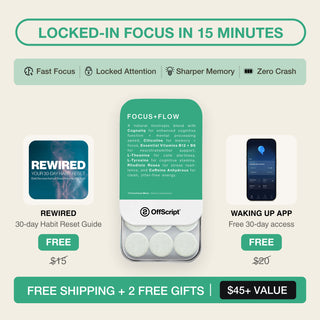
We make it, so weigh this section accordingly. FOCUS+FLOW is a fast-dissolving mint: 100mg naturally sourced caffeine, the printed-dose advantage of the can, balanced with 150mg L-theanine, the pairing controlled trials show improves attention over caffeine alone (Haskell et al., 2008; Kahathuduwa et al., 2017). Sublingual absorption makes it active in about 15 minutes, roughly half the wait of either drink, with zero sugar and a printed eight-ingredient stack. 24 mints for $59, or $39 on subscription.
Side By Side
| Coffee | Energy drinks | FOCUS+FLOW | |
|---|---|---|---|
| Caffeine | 80mg to 200mg, varies per cup | 80mg to 300mg, printed | 100mg, printed |
| Time to effect | About 30 to 45 min | About 30 to 45 min | About 15 min |
| Sugar | Whatever you add | 0g to 50g by version | Zero |
| Caffeine balanced | No | Rarely | Yes, 150mg L-theanine |
| Best for | Daily ritual | Printed dose on the go | Fast focus on a clock |
Whichever You Pick
Track the total across sources, keep single doses moderate, and stop by early afternoon: caffeine even six hours before bed measurably cuts sleep quality (Drake et al., 2013), and bad sleep is the most expensive focus problem there is.
THE THIRD OPTION
Printed dose like the can, balance neither drink has, speed neither can reach.
SHOP FOCUS+FLOWKey Takeaways
- Same molecule, different package: coffee wins on research and ritual, energy drinks on printed doses.
- Full-sugar cans undermine their own purpose; zero-sugar versions fix the biggest problem.
- Both take 30 to 45 minutes through the gut. Neither is fast.
- A sublingual mint combines the printed dose, an L-theanine balance and a 15 minute onset.
Explore The Series
- Caffeine Mints Vs Coffee
- Caffeinated Mints Vs Energy Drinks
- Why Do Energy Drinks Make You Tired?
- The Best Plant-Based Energy Drinks, Ranked
- L-Theanine + Caffeine: The Perfect Natural Focus Stack
References
- Higgins JP, et al. Energy beverages: content and safety. Mayo Clin Proc. 2010. PMID 21037046
- Mantantzis K, et al. Sugar rush or sugar crash? A meta-analysis of carbohydrate effects on mood. Neurosci Biobehav Rev. 2019. PMID 30951762
- Kamimori GH, et al. The rate of absorption and relative bioavailability of caffeine administered in chewing gum versus capsules. Int J Pharm. 2002. PMID 11839447
- Haskell CF, et al. The effects of L-theanine, caffeine and their combination on cognition and mood. Biol Psychol. 2008. PMID 18006208
- Kahathuduwa CN, et al. Acute effects of theanine, caffeine and theanine-caffeine combination on attention. Nutr Neurosci. 2017. PMID 26869148
- Drake C, et al. Caffeine effects on sleep taken 0, 3, or 6 hours before going to bed. J Clin Sleep Med. 2013. PMID 24235903
FAQ
Is coffee better than energy drinks?
For daily focus, usually yes: better long-term research, no formula riding along, and zero sugar if you drink it black. Energy drinks win on printed doses and convenience, and zero-sugar versions close most of the health gap. The molecule is identical in both.
Which has more caffeine, coffee or energy drinks?
They overlap. Brewed coffee runs about 80mg to 200mg per cup depending on the brew. Energy drinks run about 80mg in small cans to 300mg in the largest, with the number printed. The can is more predictable; the cup is more variable.
Which works faster, coffee or an energy drink?
Neither. Both are swallowed and absorb through the gut in roughly 30 to 45 minutes. Only oral-absorption formats, like caffeine gum and sublingual mints, meaningfully beat that timeline, acting in about 15 minutes.
Is it bad to replace coffee with energy drinks?
Not inherently, if you choose zero-sugar, watch the total caffeine and stop by early afternoon. The failure mode is stacking: a large can plus guarana plus your morning coffee can quietly pass 400mg. Count everything.
These statements have not been evaluated by the Food and Drug Administration. This product is not intended to diagnose, treat, cure, or prevent any disease. All third party product names and trademarks are the property of their respective owners. Nutritional figures are category ranges from publicly listed manufacturer information in September 2026; check each product's current label.
