




Energy drinks make you tired for three well-documented reasons: the sugar crash that follows a large glucose spike, the adenosine rebound that arrives when caffeine wears off, and the tolerance that builds when either becomes a daily habit. None of this means energy drinks are uniquely bad. It means the standard formula, a big caffeine dose riding on a bigger sugar dose, writes a check your afternoon has to cash.
Reason 1: The Sugar Crash Is Real, And Measured
A full-sugar energy drink can carry 25g to 50g of sugar, absorbed fast. Blood glucose spikes, insulin answers, and the overshoot leaves you lower than you started. A meta-analysis of 31 studies found that carbohydrate consumption produces no sustained mood benefit and measurably higher fatigue and lower alertness within the first hour (Mantantzis et al., 2019). That is the "sugar rush" literature politely reporting that the rush is a loan.
Sugar-free versions dodge this one entirely, which is worth saying plainly: if you love the can, going sugar-free removes the biggest crash mechanism.
Reason 2: The Adenosine Rebound
Caffeine does not create energy. It blocks adenosine, the molecule that signals sleep pressure, by occupying its receptors (Fredholm et al., 1999). The pressure keeps building behind the blockade. When the caffeine clears, several hours of accumulated adenosine lands at once. That wave of heaviness two to five hours after a big dose is not your energy failing. It is the queue clearing.
The bigger and more sudden the dose, the sharper the rebound. A 200mg to 300mg can on an empty stomach sets up a steeper cliff than the same caffeine spread out or paired with compounds that soften the curve.
Reason 3: Tolerance Turns The Drink Into Maintenance
Daily caffeine upregulates adenosine receptors. Within weeks, the same can produces less lift, and skipping it produces genuine withdrawal: fatigue, fog and headache that reliably begin within a day of stopping (Juliano + Griffiths, 2004). At that point the energy drink is not adding energy. It is servicing a debt. If the can has stopped working and you feel worse without it, that is the mechanism.
There is also a quieter fourth factor: timing. Caffeine taken even six hours before bed measurably cuts sleep quality (Drake et al., 2013), and worse sleep makes tomorrow's fatigue worse, which invites tomorrow's second can.
How To Get Energy Without The Crash
Four moves, in order of impact. Cut the sugar: choose zero-sugar formats so the glucose cliff disappears. Cap and time the caffeine: 100mg to 200mg doses, none after early afternoon. Pair it: controlled trials show caffeine + L-theanine improves attention while smoothing the comedown compared with caffeine alone (Haskell et al., 2008). And protect sleep like it is the product, because it is.
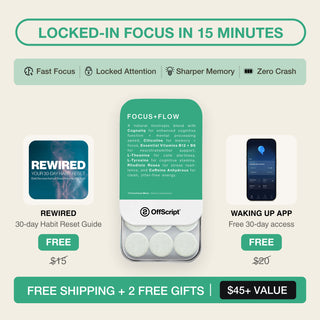
This is the problem FOCUS+FLOW was built around, so weigh what follows accordingly. One mint delivers 100mg naturally sourced caffeine balanced with 150mg L-theanine, zero sugar, plus coffee fruit extract, L-tyrosine, Rhodiola, citicoline and B vitamins. Sublingual absorption makes it active in about 15 minutes, and the moderate, balanced dose is designed to land without the cliff. 24 mints for $59, or $39 on subscription.
ENERGY WITHOUT THE INVOICE
100mg caffeine + 150mg L-theanine, zero sugar. The lift without the loan.
SHOP FOCUS+FLOWKey Takeaways
- The post-energy-drink slump has three causes: sugar crash, adenosine rebound and tolerance.
- The sugar crash is the biggest and easiest to remove: go zero-sugar and it disappears.
- The rebound scales with dose size and suddenness. Moderate, balanced doses land softer.
- If the can no longer works and skipping it hurts, that is tolerance, and a reset beats a bigger can.
Explore The Series
- The 2PM Crash Isn't A Willpower Problem
- Clean Energy Without The Crash
- Coffee Vs Energy Drinks: Which Is Better For Focus?
- Caffeine Jitters: Why They Happen + How To Get Rid Of Them
References
- Mantantzis K, et al. Sugar rush or sugar crash? A meta-analysis of carbohydrate effects on mood. Neurosci Biobehav Rev. 2019. PMID 30951762
- Fredholm BB, et al. Actions of caffeine in the brain with special reference to factors that contribute to its widespread use. Pharmacol Rev. 1999. PMID 10049999
- Juliano LM, Griffiths RR. A critical review of caffeine withdrawal. Psychopharmacology. 2004. PMID 15448977
- Drake C, et al. Caffeine effects on sleep taken 0, 3, or 6 hours before going to bed. J Clin Sleep Med. 2013. PMID 24235903
- Haskell CF, et al. The effects of L-theanine, caffeine and their combination on cognition and mood. Biol Psychol. 2008. PMID 18006208
FAQ
Why do energy drinks make me tired instead of energized?
Three mechanisms: the crash after a large sugar spike, the adenosine rebound when caffeine wears off, and tolerance from daily use. If your drink is full-sugar, the glucose crash usually arrives first, within about an hour.
Why do energy drinks make me sleepy right away?
Usually the sugar. A fast 25g to 50g glucose load can produce measurable fatigue within 30 to 60 minutes as insulin overshoots. Dehydration and drinking on an empty stomach can sharpen the effect. A zero-sugar version on a normal stomach usually removes it.
How do I stop the energy drink crash?
Go zero-sugar, keep single doses moderate (100mg to 200mg caffeine), take nothing after early afternoon, and pair caffeine with L-theanine, which trials show smooths the curve. If you drink several cans daily, taper rather than quitting cold to avoid withdrawal fatigue.
Do energy drinks work at all, then?
Yes. The caffeine genuinely improves alertness, and well-made products deliver it reliably. The tired feeling afterward is not proof they are fake, it is the pharmacology of big sugar and big boluses. Change the dose shape and the crash changes with it.
These statements have not been evaluated by the Food and Drug Administration. This product is not intended to diagnose, treat, cure, or prevent any disease. General caffeine guidance varies by individual. If fatigue is persistent regardless of caffeine, talk to your clinician.
