




Exhausted all day, awake at 11PM. Eight hours in bed + you wake up feeling worse than when you lay down. Alert at 3AM for no reason you can name. These are not four separate problems. They are the same problem seen from different hours, + the shape of your cortisol curve is the thing they have in common. Here is how cortisol + sleep actually interact, why the loop is so hard to break from inside it, + what genuinely resets it.
What The Curve Is Supposed To Do
Cortisol is not a night-time hormone. It has a job at each end of the day, + the timing is the entire point.
It should sit at its lowest in the hours around midnight, which is what allows sleep to consolidate. It then climbs steeply in the first thirty to forty-five minutes after you wake, a rise distinct enough to have its own name in the literature, + that surge is a large part of why you can get vertical at all. Across the day it declines steadily back toward the night-time trough.
High in the morning, low at night. That slope is health. A systematic review of human trials on the hypothalamic-pituitary-adrenal axis, the chain that produces cortisol, maps where this regulation genuinely responds to intervention (Lopresti, 2022).
What Flattening Feels Like
Under sustained pressure the curve compresses from both ends. The morning rise weakens, + the evening fails to fall the way it should. Translated into lived experience:
- Morning grogginess that coffee does not fix. The weak surge means your body never delivers the wake-up signal, so you outsource it to caffeine, which works but does not restore the underlying rhythm.
- A second wind at 10 or 11PM. The evening stays switched on. This is the most recognisable single sign, + people often mistake it for being a night owl.
- Waking at 3AM alert rather than groggy. Not needing the bathroom, not from noise. Awake, mind running, unable to get back down. Some overnight rise is normal; the problem is when it arrives early + brings your attention with it.
- Light, unrefreshing sleep. Time in bed stops converting into recovery.
Why The Loop Is Self-Sustaining
This is the part that makes it stubborn. The relationship runs both ways.
A dysregulated stress response degrades sleep. Degraded sleep then makes the stress response more reactive the following day, so ordinary pressure reads as a bigger threat, which feeds the evening elevation, which degrades the next night. Nobody enters this loop by choosing one bad night. It builds.
The practical consequence: you generally cannot break it from the stress side alone, because the stress side is being re-supplied nightly. The sleep side is the more reliable entry point, even when sleep is the symptom that feels least under your control.
What Actually Resets It
Morning light, within an hour of waking. The single strongest anchor available. Outdoor light, even on an overcast day, is far brighter than indoor lighting + it sets the timing of the whole curve. Ten minutes outside does more for your 11PM than anything you take at 11PM.
A consistent wake time. More important than a consistent bedtime, because the wake time is what the morning surge is anchored to. Holding it steady across weekends is the unglamorous fix most people skip.
Move the last coffee earlier. This is the highest-value single change for the evening end. Controlled work found that habitual drinkers develop partial tolerance to caffeine's cortisol effect, but the response was reduced rather than eliminated, + cortisol still climbed after afternoon doses (Lovallo et al., 2005). Your morning cup is the dose your body expects. The 4PM one lands exactly where you need the curve falling. We covered this fully in does caffeine raise cortisol.
Dim the last hour, genuinely. Bright light late pushes the curve in the wrong direction. Lamps rather than overheads does more than a screen filter.
Rethink the nightcap. Alcohol shortens sleep latency then fragments the second half of the night, which is precisely the window where 3AM waking lives.
Give the day an ending. An evening that never formally closes keeps the system on. A short, boring, repeated wind-down sequence works better than a perfect one you abandon.
What About The 3AM Waking
Worth its own note, because it frightens people. A degree of overnight cortisol rise is normal; it is the ramp toward morning. Waking briefly is also normal. The version worth addressing is waking fully alert, early, with an active mind, several nights a week.
Practically: do not check the time, because the arithmetic of how little sleep remains is itself activating. Keep the room dark. If you are awake more than twenty minutes, get up, stay dim, do something dull, return when sleepy. Chasing sleep in bed teaches your brain that the bed is where you lie awake.
If it persists for weeks, that is worth raising with a clinician rather than layering on supplements. Sleep apnoea, thyroid problems, perimenopause + depression all produce this pattern + all have real treatments.
Where A Supplement Honestly Fits
On top of the timing work, not instead of it. Nothing here outruns a wake time that moves three hours on weekends.
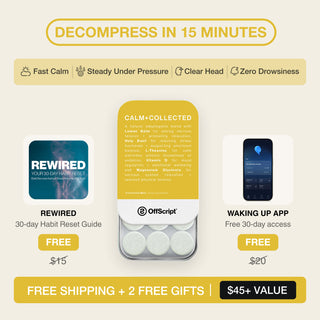
CALM+COLLECTED is built for the evening end of this problem without being a sedative, which matters: the goal is to come down, not to be switched off. L-Theanine is the anchor, with a triple-blind placebo-controlled crossover trial showing a single dose reduced the acute stress response (Evans et al., 2021). Holy basil works the adaptogen route across weeks rather than minutes (Lopresti et al., 2022). Magnesium glycinate sits underneath as a cofactor, with the key systematic review calling the evidence for subjective anxiety suggestive but limited by study quality (Boyle et al., 2017).
Promotes calm without sedation. Works inside the hour.
A traditional herb long used to promote a settled mood.
The adaptogen layer, judged over weeks rather than a single night.
A gentle, well-absorbed form, easier on the stomach than oxide.
Commonly low in people who work indoors.
One honest limit: this is a calm formula, not a sleep aid. It contains no melatonin + nothing sedating. If your goal is to be knocked out, this is the wrong tool. If your goal is to stop arriving at bedtime still switched on, it is the right one. We wrote about that distinction in natural calm without melatonin.
CALM UNDER PRESSURE
For the evening that will not end. Caffeine-free, no melatonin, every dose printed.
SHOP CALM+COLLECTEDKey Takeaways
- Cortisol should be lowest around midnight + spike sharply after waking. The steep slope is the healthy state, not a low total.
- Flattening reads as morning grogginess, a 10PM second wind + waking alert at 3AM. Same problem, different hours.
- The loop is bidirectional: stress degrades sleep, poor sleep makes the stress response more reactive. Sleep is the more reliable entry point.
- Morning light + a consistent wake time set the curve. Moving the last coffee earlier is the highest-value evening change.
- Weeks of persistent early waking belongs with a clinician. Sleep apnoea, thyroid conditions, perimenopause + depression all produce it.
Explore The Series
- How To Lower Cortisol Naturally: The Complete Guide
- Signs of High Cortisol: What Is Real + What Is Not
- Natural Calm Without Melatonin: What Else Actually Works
- Magnesium Glycinate + L-Theanine: The Non-Sedating Evening Reset
- Does Caffeine Raise Cortisol?
References
- Lopresti AL. Modulation of the hypothalamic-pituitary-adrenal (HPA) axis by plants and phytonutrients: a systematic review of human trials. Nutr Neurosci. 2022;25(8):1704-1730. PubMed
- Lovallo WR, et al. Caffeine stimulation of cortisol secretion across the waking hours in relation to caffeine intake levels. Psychosomatic Medicine. 2005. PMC
- Evans M, et al. A Randomized, Triple-Blind, Placebo-Controlled, Crossover Study to Investigate the Efficacy of a Single Dose of AlphaWave L-Theanine on Stress in a Healthy Adult Population. Neurol Ther. 2021;10(2):1061-1078. PubMed
- Lopresti AL, Smith SJ, Metse AP, Drummond PD. A randomized, double-blind, placebo-controlled trial investigating the effects of an Ocimum tenuiflorum (holy basil) extract on stress. Front Nutr. 2022;9:965130. PubMed
- Boyle NB, Lawton C, Dye L. The effects of magnesium supplementation on subjective anxiety and stress: a systematic review. Nutrients. 2017;9(5):429. PubMed
FAQ
Does cortisol affect sleep?
Directly, and in both directions. Cortisol should reach its lowest point around midnight so sleep can consolidate, then rise sharply after you wake. When sustained pressure flattens that curve, the evening stays elevated and sleep becomes lighter and harder to start. Poor sleep then makes the stress response more reactive the next day, which feeds the following night.
Why do I wake up at 3am every night?
Some overnight cortisol rise is normal as your body ramps toward morning, and brief waking is normal too. Waking fully alert with an active mind several nights a week suggests that ramp is arriving early. Alcohol is a common contributor, because it fragments the second half of the night. If it persists for weeks, get it looked at, since sleep apnoea, thyroid problems, perimenopause and depression all produce this pattern.
How do I lower cortisol at night?
Mostly by what you do much earlier. Get outdoor light within an hour of waking, keep a consistent wake time, and move your last coffee earlier, since cortisol still responds to afternoon doses even in habitual drinkers. In the evening, dim the last hour properly, reconsider the nightcap, and give the day a defined ending rather than letting it trail off.
What does tired but wired mean?
It is the everyday description of a flattened cortisol curve. The morning surge is too weak, so you wake groggy and reach for caffeine, and the evening decline is too shallow, so you get a second wind at 10 or 11PM. It feels like two contradictory problems but it is one timing problem seen at both ends of the day.
Is CALM+COLLECTED a sleep aid?
No. It contains no melatonin and nothing sedating, and it is not designed to knock you out. It is built to support the stress response so you arrive at bedtime less switched on, which is a different job. If you want something that makes you drowsy, a dedicated sleep product is the right category.
These statements have not been evaluated by the Food and Drug Administration. This product is not intended to diagnose, treat, cure, or prevent any disease. This article is educational and is not medical advice.