




Most people looking for a melatonin alternative are not looking because melatonin is dangerous. They are looking because it did not work, or because it worked + left them groggy, or because they do not love taking a hormone every night. All three are reasonable, + all three trace back to the same misunderstanding about what melatonin is.
Why Melatonin Disappoints So Many People
Melatonin is a timing signal, not a sedative. It is the hormone your brain releases when darkness falls, telling the body night has started. Taken as a supplement it can shift when your body expects sleep, which is why it genuinely helps jet lag + delayed body clocks.
What it does not do is quiet a busy mind, lower an elevated stress response, or keep you asleep at 3AM. If your problem is one of those, melatonin is the wrong tool, + no dose fixes a wrong tool.
The grogginess complaint has a mechanical explanation too. Common doses, 5mg or 10mg, are far above what the body produces naturally. Oversized late-evening doses can still be active in the morning, which reads as a hangover.
First, Name The Actual Problem
Melatonin-free options only beat melatonin if they are matched to the real complaint.
Cannot fall asleep because the mind will not stop: that is an arousal problem. See racing thoughts at night. The tools are behavioural first + calming, non-sedating support second.
Fall asleep fine, wake at 3AM: that is usually stress-hormone timing plus blood sugar. See the 3AM guide. Melatonin was never going to touch this, which is likely why you are here.
Sleep enough, wake unrestored: rule out sleep apnoea (snoring, gasping, witnessed pauses), alcohol, + late caffeine before buying anything.
The Melatonin-Free Options, By Evidence
Magnesium glycinate
The most sensible foundation. Magnesium is a cofactor in hundreds of processes including nervous system regulation, + the glycinate form is well absorbed + gentle on the stomach. The honest read on the evidence: a systematic review of magnesium for subjective anxiety + stress called it suggestive but limited by study quality (Boyle et al., 2017). It is a reasonable, low-risk nightly base, not a knockout drop.
L-theanine
The best acute option for the wired-but-tired evening. A single dose reduced the response to a stressor in a randomised, triple-blind, placebo-controlled crossover trial (Evans et al., 2021). It promotes relaxed alertness rather than sedation, so it lowers the arousal that blocks sleep without a next-morning cost.
Lemon balm
A traditional calming herb with a long history of use for settling the evening. Frequently paired with theanine + magnesium in evening formulas for exactly that reason.
Holy basil
The baseline layer rather than the tonight layer: randomised placebo-controlled evidence on stress outcomes over weeks (Lopresti et al., 2022). Right choice when the sleep problem sits on top of a sustained stressful period.
Glycine, apigenin, tart cherry, valerian, chamomile
Each has some supporting research + a following. Ranked honestly: glycine has small human studies on sleep quality worth watching; apigenin rides one famous protocol more than a deep evidence base; tart cherry contains trace melatonin, so it is not truly melatonin-free; valerian's trial record is old + inconsistent; chamomile is pleasant + mild. None is a first pick over the three above.
The Combination Logic
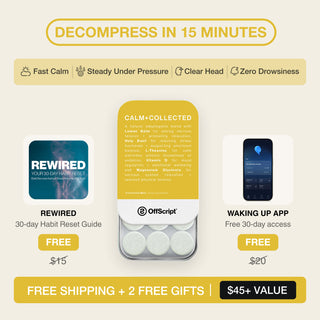
The evening stack that makes mechanical sense is an acute calmer (theanine), a traditional settler (lemon balm), a baseline adaptogen (holy basil) + the cofactor underneath (magnesium glycinate). That is CALM+COLLECTED's exact structure, caffeine-free + melatonin-free, every dose printed.
Promotes calm, focused attention without drowsiness. Works inside the hour.
A traditional herb long used to promote a settled mood.
The adaptogen layer, studied over weeks rather than afternoons.
A gentle, well-absorbed form, easier on the stomach than oxide.
Commonly low in people who work indoors.
Key Takeaways
- Melatonin is a clock signal. It shifts when sleep happens; it does not sedate, quiet a mind, or fix 3AM waking.
- It genuinely earns its place for jet lag, shift transitions + late body clocks.
- Match the alternative to the actual problem: arousal, stress-hormone timing, or an unrested morning each have different answers.
- The evidence-ranked melatonin-free core: L-theanine acutely, holy basil for the baseline, magnesium glycinate underneath, lemon balm alongside.
- Tart cherry is not truly melatonin-free. Valerian's record is old + inconsistent.
- Months of insomnia = CBT-I via a doctor, not a bigger supplement.
Explore The Series
- Natural Calm Without Melatonin
- Why Do I Wake Up At 3AM? The Cortisol Answer
- Racing Thoughts At Night: How To Shut It Down
- The Magnesium Glycinate + L-Theanine Evening Reset
- Cortisol + Sleep: The Curve That Decides Your Night
- Sleep Gummies Without Melatonin
References
- Boyle NB, Lawton C, Dye L. The effects of magnesium supplementation on subjective anxiety and stress: a systematic review. Nutrients. 2017. PubMed
- Evans M, et al. A Randomized, Triple-Blind, Placebo-Controlled, Crossover Study to Investigate the Efficacy of a Single Dose of AlphaWave L-Theanine on Stress in a Healthy Adult Population. Neurol Ther. 2021. PubMed
- Lopresti AL, et al. A randomized, double-blind, placebo-controlled trial investigating the effects of an Ocimum tenuiflorum (holy basil) extract on stress. Front Nutr. 2022. PubMed
- Lopresti AL. Modulation of the hypothalamic-pituitary-adrenal (HPA) axis by plants and phytonutrients: a systematic review of human trials. Nutr Neurosci. 2022. PubMed
FAQ
What is the best alternative to melatonin?
It depends on the actual problem. For a wired mind at bedtime, L-theanine has the strongest acute evidence and works without sedation. For sleep problems sitting on a stressful period, holy basil works on the baseline over weeks. Magnesium glycinate is the sensible low-risk foundation under either. If the problem is 3AM waking, no supplement substitutes for fixing the stress-hormone timing driving it.
Why does melatonin not work for me?
Usually because your problem is not a timing problem. Melatonin tells the body when night starts, which helps jet lag and late body clocks. It does not sedate, quiet racing thoughts, or prevent middle-of-the-night waking. Using it for those is using a clock signal as a sedative, and no dose fixes a wrong tool.
Why does melatonin make me groggy the next day?
Common doses of 5mg to 10mg are far above what the body produces on its own, and a large late-evening dose can still be active in the morning. If you use melatonin for a genuine timing purpose, smaller doses taken deliberately are the standard advice. If you were using it as a sedative, the grogginess is a sign to switch approach rather than dose.
Is magnesium better than melatonin for sleep?
They do different jobs. Melatonin shifts sleep timing. Magnesium is a cofactor that supports nervous system regulation, with evidence a systematic review described as suggestive but limited by study quality. For most everyday trouble sleeping driven by stress rather than a shifted clock, a magnesium-plus-theanine approach fits the problem better than melatonin does.
When should I see a doctor about sleep instead?
Insomnia lasting months deserves CBT-I, the first-line treatment, via a doctor or therapist. Heavy snoring, gasping awake or witnessed breathing pauses need a sleep apnoea assessment. Sleep problems alongside persistent low mood deserve a professional conversation. Pregnant, on sedatives or antidepressants, or managing a chronic condition: ask before taking any sleep supplement.
These statements have not been evaluated by the Food and Drug Administration. This product is not intended to diagnose, treat, cure, or prevent any disease. This article is educational and is not medical advice.