




It is never interesting thoughts. Nobody lies awake at 11PM composing poetry. It is the email you should have sent, the thing you said in the meeting, tomorrow's list running on a loop, + the meta-thought that makes it all worse: calculating how little sleep you are now going to get.
The racing mind is not a malfunction. It is an unfinished process, + treating it that way is what actually works.
Why The Brain Does This At Night
Two things collide at bedtime. The first is that it is the day's first genuinely unstimulated moment. All day, every open loop in your head was crowded out by input. Remove the input + the loops surface. The brain is not sabotaging you, it is doing deferred maintenance at the only quiet slot you gave it.
The second is arousal. If your stress response is still elevated from the day, your body is in a state built for problem-solving, + the brain obliges by finding problems. This is the same elevated-evening-cortisol picture that drives the 3AM wake, showing up at the front of the night instead of the middle.
Understanding that changes the strategy. You cannot argue a maintenance process into stopping. You can schedule it earlier, + you can lower the arousal it runs on.
The Techniques With Real Evidence
Scheduled worry, done earlier
The single most useful behavioural tool: give the loops a slot before bed. Fifteen minutes, pen + paper, two columns: what is on my mind, + the next physical action for each. This is not journalling for its own sake. Writing the next action is what closes a loop, because the brain holds onto tasks it considers unresolved. Done at 8PM, there is far less left to surface at 11.
The count-back rule
If you are in bed + running, do not stay past roughly 15 to 20 minutes. Get up, keep lights low, do something genuinely boring, return when sleepy. This protects the bed's association with sleep rather than with rumination. It feels counterproductive + it is the correct move.
Cognitive shuffling
Deliberately thinking of random, unconnected, unemotional images or words. It works by occupying the verbal channel the rumination runs on with material that has no thread to follow. Low effort, surprisingly effective, + free.
Slow exhale breathing
Longer exhale than inhale, for a few minutes. The exhale is the part of the breath cycle that engages the parasympathetic brake. It does not empty the mind. It lowers the arousal the mind is running on, which is the actual target.
What Makes It Worse
- Afternoon caffeine. Habitual drinkers keep a partial cortisol response to later doses even after tolerance develops to the morning cup (Lovallo et al., 2005). A wired mind at 11PM often started at 3PM.
- Working until the minute you get in bed. The brain needs a gap between output + sleep. No offramp means the maintenance process starts when the light goes off.
- The phone. Not only the light. Content is input, + input defers the loops rather than closing them. You are queueing more maintenance.
- Sleep math. Calculating remaining hours is itself arousing. The count-back rule exists partly to interrupt it.
Where Supplements Honestly Fit
Under the techniques, not instead of them. The evening-relevant evidence: a single dose of L-theanine reduced the response to a stressor in a randomised, triple-blind, placebo-controlled crossover trial (Evans et al., 2021). It promotes the relaxed-alert state rather than sedation, which is exactly the right shape for a racing mind: less edge, no grogginess to pay for. Holy basil carries randomised placebo-controlled evidence on stress outcomes over weeks (Lopresti et al., 2022), the baseline layer. Magnesium is the cofactor underneath, with evidence a systematic review called suggestive but limited (Boyle et al., 2017).
Note that none of this is melatonin, deliberately. Melatonin times sleep onset. It does not quiet a mind, + a racing mind with melatonin on board is just a racing mind that is also slightly groggy.
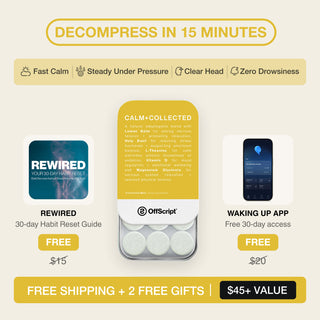
Promotes calm, focused attention without drowsiness. Works inside the hour.
A traditional herb long used to promote a settled mood.
The adaptogen layer, studied over weeks rather than afternoons.
A gentle, well-absorbed form, easier on the stomach than oxide.
Commonly low in people who work indoors.
Key Takeaways
- The racing mind is deferred maintenance meeting the day's first quiet moment, running on leftover arousal.
- Schedule the loops earlier: 15 minutes, on paper, with a next action per item. Closing loops is what quiets them.
- Do not stay in bed running past 20 minutes. Get up, low light, boring task, return sleepy.
- Slow-exhale breathing + cognitive shuffling lower the arousal + occupy the verbal channel.
- Afternoon caffeine, no evening offramp + sleep math are the three biggest aggravators.
- Weeks of racing thoughts, sped-up thinking or low mood alongside it: talk to a professional. CBT-I exists + works.
Explore The Series
- Why Do I Wake Up At 3AM? The Cortisol Answer
- Cortisol + Sleep: The Curve That Decides Your Night
- The Best Supplements For Anxiety
- Natural Calm Without Melatonin
- The Magnesium Glycinate + L-Theanine Evening Reset
- Melatonin Alternatives That Actually Work
References
- Evans M, et al. A Randomized, Triple-Blind, Placebo-Controlled, Crossover Study to Investigate the Efficacy of a Single Dose of AlphaWave L-Theanine on Stress in a Healthy Adult Population. Neurol Ther. 2021. PubMed
- Lopresti AL, et al. A randomized, double-blind, placebo-controlled trial investigating the effects of an Ocimum tenuiflorum (holy basil) extract on stress. Front Nutr. 2022. PubMed
- Boyle NB, Lawton C, Dye L. The effects of magnesium supplementation on subjective anxiety and stress: a systematic review. Nutrients. 2017. PubMed
- Lovallo WR, et al. Caffeine stimulation of cortisol secretion across the waking hours in relation to caffeine intake levels. Psychosomatic Medicine. 2005. PMC
FAQ
How do I stop racing thoughts at night?
Give the loops an earlier slot: fifteen minutes before bed with pen and paper, listing what is on your mind and the next physical action for each item, which is what actually closes a loop. In bed, use slow-exhale breathing to lower arousal and cognitive shuffling to occupy the verbal channel. If you are still running after about 20 minutes, get up, keep lights low, do something boring and return when sleepy.
Why does my brain race the moment I lie down?
Bedtime is usually the first unstimulated moment of the day, so every unresolved item finally has room to surface, and it does so on top of whatever stress arousal is left from the day. It is deferred maintenance, not malfunction, which is why scheduling it earlier works and arguing with it does not.
What supplement helps with racing thoughts at night?
L-theanine has the most relevant acute evidence: a single dose reduced the response to a stressor in a triple-blind placebo-controlled trial, and it promotes calm without sedation, which suits a racing mind. Holy basil and magnesium work on the baseline over weeks. Melatonin is the wrong tool here, because it times sleep onset rather than quieting cognition.
Is it bad to stay in bed when I cannot sleep?
After about 15 to 20 minutes, yes. Staying in bed ruminating trains an association between the bed and being awake and anxious. Getting up, keeping lights low and returning when genuinely sleepy protects the bed's association with sleep. It feels counterproductive the first few times and is the standard advice for a reason.
When are racing thoughts a medical issue?
When they occur most nights for weeks, feel sped-up or uncontrollable rather than just busy, or come with persistent low mood, dread or panic symptoms. Those deserve a professional conversation. Chronic insomnia also has an effective first-line treatment, CBT-I, which a doctor or therapist can refer you to.
These statements have not been evaluated by the Food and Drug Administration. This product is not intended to diagnose, treat, cure, or prevent any disease. This article is educational and is not medical advice.