


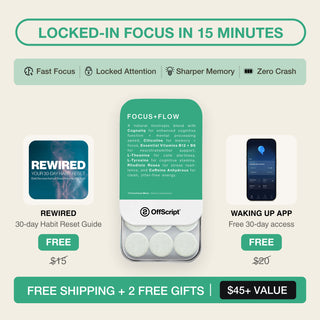


A focus mint is a cognitive supplement built to dissolve in your mouth rather than be swallowed. That single design decision is the whole proposition, + whether it matters depends on two separate questions: does the delivery route do anything, + is there anything worth delivering.
Plenty of products in this category answer the first question well + the second one badly. Here is how to tell them apart.
What The Format Actually Buys You
The tissue lining your cheeks + the floor of your mouth is thin, densely supplied with blood vessels, + drains into general circulation without passing through the liver first. Reviews of buccal + sublingual delivery describe this as bypassing hepatic first-pass metabolism. It is why nitroglycerin goes under the tongue.
The clearest data on a cognitive compound taking that route comes from caffeinated gum: peak plasma concentration in roughly 44 to 80 minutes versus 84 to 120 minutes for the same dose in a capsule. A Sports Medicine review of alternate caffeine delivery forms found the same pattern.
Two honest qualifications.
Faster is not more. Total absorption over the full time course was broadly comparable to a capsule. You are buying onset, not extra milligrams.
Not every compound crosses equally. Caffeine is small + lipid-soluble, which is close to ideal for this route. Larger or more water-loving molecules cross less readily, + honest formulators will say the buccal contribution for those is modest. Whatever is not absorbed in the mouth gets swallowed + absorbed normally, so nothing is lost, but the speed advantage is uneven across a formula.
The Part That Matters More Than The Format
A fast delivery system for nothing much is still nothing much. Most of the category lives or dies on what is inside, + the same three failures show up repeatedly.
Caffeine with decoration. If you removed everything except the caffeine + the product felt the same, the rest was label material. This is extremely common.
Proprietary blends. A blend total tells you nothing about whether any individual ingredient is present at a dose the research used. If a brand will not disclose per-ingredient amounts, assume there is a reason.
Fairy dusting. A famous nootropic at 10mg so it can appear on the panel, when the studies used 200mg. Technically accurate, functionally absent.
What Is Worth Having Inside
Caffeine with L-theanine. The most replicated combination in the cognitive literature, + the reason matters. Caffeine alone raises arousal, which is not the same thing as focus, + is why a large coffee can leave you alert + scattered. Paired with theanine, trials found improved accuracy on demanding attention-switching tasks + reduced susceptibility to distraction, with EEG work showing alpha-band changes consistent with sustained attention.
L-tyrosine, situationally. A dopamine + noradrenaline precursor with evidence under acute depletion such as sleep deprivation or sustained heavy load. It does little in a rested person, so it earns its place on hard days rather than every day.
Rhodiola rosea. Targets mental fatigue under prolonged demand rather than moment-to-moment attention (Darbinyan et al., 2000).
A choline source. Citicoline feeds acetylcholine, involved in attention + learning. Mechanism is sound, evidence thinner than the enthusiasm.
Mints Versus The Other Fast Formats
Gum uses the same route but asks you to chew for several minutes + keeps part of the dose in the base, which you then throw away. Pouches also use the same route, need 15 to 30 minutes parked in your lip, + have so little room that the category is overwhelmingly caffeine with a vitamin garnish.
A mint dissolves completely, needs no management, + has enough space to carry a real formula. That is the case for the format, + it is a narrow, practical case rather than a dramatic one.
How To Judge Any Focus Mint
- Are individual doses printed, or hidden in a blend?
- Do those doses match what the research actually used?
- Is anything managing the caffeine, or is caffeine the entire product?
- What is the sweetener + base made of, given it dissolves in your mouth?
- Does the brand tell you to let it dissolve, which is the difference between the format working + not?
What Is In Ours
Full label, individual doses, no proprietary blend.
Patented coffee-fruit extract, clinically studied to support BDNF.
Calm, focused attention without the jitters.
Dopamine precursor for drive + focus under pressure.
Adaptogen that supports mental stamina under stress.
Clean, measured energy, smoothed by L-Theanine.
Raw material for acetylcholine, the memory + learning neurotransmitter.
Supports neurotransmitter production.
Supports cellular energy.
Key Takeaways
- The format's advantage is real: oral absorption bypasses first-pass liver metabolism + reaches you sooner.
- Faster is not more. Total absorption over time is broadly comparable to a capsule.
- Caffeine suits the route well. Larger molecules cross less readily, so the speed benefit is uneven across a formula.
- Let it dissolve. Chewing or washing it down removes the advantage entirely.
- Delivery means nothing without contents. Watch for proprietary blends + fairy-dusted doses.
- Caffeine paired with L-theanine is the combination with the best replicated evidence.
Explore The Series
- Nootropic Mints: The Complete Guide
- Nootropic Lozenges vs Mints
- Caffeine Pouches vs Mints
- What Is Nootropic Gum? Does It Actually Work?
- What Are Sublingual Supplements + Why They Work Faster
- How To Take Sublingual Mints
References
- Kamimori GH, et al. The rate of absorption and relative bioavailability of caffeine administered in chewing gum versus capsules to normal healthy volunteers. International Journal of Pharmaceutics. 2002. PubMed
- Wickham KA, Spriet LL. Administration of Caffeine in Alternate Forms. Sports Medicine. 2018. PMC
- Sublingual and Buccal Delivery: A Historical and Scientific Prescriptive. Pharmaceutics. 2025. MDPI
- Owen GN, et al. The combined effects of L-theanine and caffeine on cognitive performance and mood. Nutritional Neuroscience. 2008. PubMed
- Kelly SP, et al. L-theanine and caffeine in combination affect human cognition as evidenced by oscillatory alpha-band activity and attention task performance. Journal of Nutrition. 2008. PubMed
- Darbinyan V, et al. Rhodiola rosea in stress induced fatigue. Phytomedicine. 2000. PubMed
FAQ
Do focus mints actually work?
The delivery route genuinely works: compounds absorbed through the lining of the mouth bypass first-pass liver metabolism and arrive sooner than the same dose in a capsule. Whether a given product works depends entirely on what is inside it. A fast delivery system carrying fairy-dusted doses or a proprietary blend is still not doing much.
How long do focus mints take to work?
Faster than a capsule, with the clearest evidence coming from caffeinated gum using the same route, which reached peak plasma concentration at roughly 44 to 80 minutes versus 84 to 120 for capsules. The critical variable is contact time. Let the mint dissolve rather than chewing it, and do not wash it down.
Are focus mints better than pills?
For onset, yes, because part of the dose enters circulation directly rather than routing through the gut and liver. For total amount absorbed, they are broadly comparable. The practical advantages are speed, no water needed and discretion, rather than a larger effective dose.
What should be in a good focus mint?
Caffeine paired with L-theanine at a sensible ratio is the combination with the strongest replicated evidence for attention. Beyond that, L-tyrosine for demanding or sleep-deprived days, rhodiola for mental fatigue, and a choline source such as citicoline. Most importantly, individual doses should be printed rather than hidden inside a proprietary blend.
Can you take more than one focus mint?
Count the caffeine rather than the mints, and include coffee and tea in the total. The ceiling the FDA generally cites for healthy adults is 400mg a day. Anyone pregnant, with a heart rhythm condition or an anxiety disorder, or taking prescription medication should speak to a doctor before adding concentrated caffeine.
These statements have not been evaluated by the Food and Drug Administration. This product is not intended to diagnose, treat, cure, or prevent any disease. This article is educational and is not medical advice.