




The most interesting thing about nootropic gum has nothing to do with the ingredients. It's the delivery. In a controlled pharmacokinetic study of 84 healthy adults, caffeine delivered in chewing gum hit peak plasma concentration in roughly 44 to 80 minutes, versus 84 to 120 minutes for the same dose in a capsule. Same compound. Same dose. Radically different timeline. That single finding is why an entire category of chewable brain supplements exists — and why the honest question isn't "does nootropic gum work," but "what part of it is actually doing the work."
Most of the supplement industry would rather you didn't ask. A capsule is cheap to make, easy to ship, and impossible to argue with because nobody can feel what's happening in their small intestine. Gum changed the conversation by making onset something you could notice. But gum also carries baggage — sweeteners, gum base, sugar alcohols, and the small problem that you have to keep chewing for the delivery mechanism to work at all. There's a better version of the same idea, and it's worth understanding the mechanism before you pick a format.
What Is Nootropic Gum, Exactly?
Nootropic gum is chewing gum with cognitive-support compounds loaded into the gum base — typically caffeine, L-theanine, B vitamins, and sometimes an adaptogen or a choline source. You chew it, the compounds release into saliva, and some fraction crosses the lining of your cheeks + under your tongue directly into the bloodstream. The rest gets swallowed and takes the ordinary route through your stomach + liver.
That first pathway is the entire pitch. The tissue inside your mouth is thin, densely vascularized, and — critically — it drains into systemic circulation without passing through the liver first. Pharmacology reviews of buccal + sublingual delivery describe this as bypassing hepatic first-pass metabolism, which is why the route is used clinically for compounds that get chewed up by the liver on the way in. Nitroglycerin goes under the tongue for a reason.
Whether that matters for a given nootropic depends entirely on the compound. Caffeine is a useful test case because it's small, lipid-soluble, and crosses membranes easily — exactly the profile that benefits from oral-mucosal contact. Larger or more water-loving molecules don't cross nearly as well, and honest formulators will tell you the buccal contribution for those is modest.
Does Nootropic Gum Actually Work?
For onset, yes — and the evidence is better than most supplement claims. A 2018 review in Sports Medicine on alternate caffeine delivery forms concluded that caffeinated gum is absorbed more quickly via the buccal mucosa than capsules taken orally, while total absorption over time is not meaningfully different. A more recent randomized trial in resistance-trained men found caffeinated gum produced comparable strength + power outcomes to capsules with fewer reported side effects, which tracks: less of the dose sitting in your stomach means less gastrointestinal complaining.
Now the caveats, because this is where the category oversells itself.
- Chew time is a real variable. Buccal absorption only happens while the compound is in contact with the tissue. Stop chewing early + you've swallowed most of the dose. Protocols in the research typically specify five minutes of chewing.
- Release from the gum base is incomplete. Relative bioavailability in the Kamimori data came in below capsules before correcting for how much caffeine the gum actually let go of. Some of your dose stays in the wad.
- Dose ceilings are low. You can only load so much active material into gum before it tastes like a chemistry set. This is why gum formulas skew heavily toward caffeine + a token amount of everything else.
- The base itself isn't inert. Sugar alcohols, synthetic sweeteners, plasticizers, and titanium dioxide are common. For an audience that reads labels, the excipient list often matters more than the actives.
So nootropic gum works, in the narrow sense that a fast-onset caffeine delivery system works. What it generally doesn't do is deliver clinically meaningful amounts of the compounds that make a nootropic formula worth taking in the first place.
Gum vs. Fast-Dissolving Mints: The Format Question
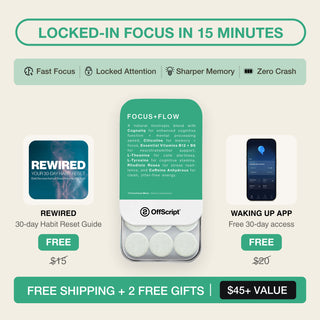
Here's where we should be direct about our own position: OffScript doesn't make gum. FOCUS+FLOW is a fast-dissolving mint. We think that's the better expression of the same insight, and the reasoning is straightforward.
A mint that dissolves in your mouth gets the same oral-mucosal contact a gum does — without requiring you to chew for five minutes, without a gum base holding part of your dose hostage, and without the sweetener load. You put it under your tongue, it dissolves, and the compounds are in solution + in contact with tissue immediately. What isn't absorbed buccally is swallowed + absorbed normally, exactly as it would be from a capsule. You lose nothing.
We won't claim a specific bioavailability multiple for our mints, because we haven't run that trial + we're not going to invent a number. What we will say is that the mechanism behind the gum research — dissolved compound in prolonged contact with vascularized oral tissue — is the same mechanism a dissolving mint uses, and the mint version removes the format's biggest liabilities. Also, discreetly letting a mint dissolve during a meeting is a very different social experience from chewing gum through one.
What's Actually In FOCUS+FLOW
Format is only half the argument. The other half is whether there's enough of anything real inside it. Here's the full label — the doses are the doses.
Patented coffee-fruit extract, clinically studied to support BDNF.
Calm, focused attention without the jitters.
Dopamine precursor for drive + focus under pressure.
Adaptogen that supports mental stamina under stress.
Clean, measured energy — smoothed by L-Theanine.
Raw material for acetylcholine, the memory + learning neurotransmitter.
Supports neurotransmitter production.
Supports cellular energy.
Two of those deserve a mechanism, not a marketing line. CognatiQ is a patented whole coffee fruit extract studied for its effect on brain-derived neurotrophic factor, the signalling protein involved in neuroplasticity + the survival of neurons. In a study published in the British Journal of Nutrition, a 100mg dose of whole coffee fruit concentrate was associated with a roughly 143% increase in plasma BDNF from baseline in healthy adults — greater than brewed coffee or the isolated fractions tested alongside it. It's a small acute study, not proof of long-term cognitive change, and we'd rather say so than round it up.
The L-theanine + caffeine pairing at 150mg to 100mg is the most replicated stack in the nootropic literature. L-theanine crosses the blood-brain barrier + promotes alpha-wave activity associated with relaxed alertness, which appears to blunt caffeine's edge without blunting its effect. Trials have found the combination improves accuracy on demanding attention-switching tasks + reduces susceptibility to distraction, with EEG work showing changes in alpha-band activity consistent with more sustained attentional deployment. That's the difference between wired + focused.
How to Judge Any Chewable Nootropic
Whether you're evaluating nootropic gum, a mint, or a lozenge, the questions are the same. Are the actives disclosed at individual doses, or hidden in a proprietary blend? Do those doses match what the research used, or are they fairy dust? Is there anything managing the caffeine, or is caffeine the whole product wearing a lab coat? And what's the delivery vehicle made of — because you'll be holding it in your mouth, which is the point.
The reason we built FOCUS+FLOW as a mint rather than a pill or a gum is that the oral route is genuinely the interesting one, and gum only gets you halfway there. You can read the full FOCUS+FLOW label and decide for yourself — which is the only version of this decision worth making.
Key Takeaways
- Nootropic gum's real advantage is onset speed: caffeine in gum peaked in ~44–80 minutes versus ~84–120 for capsules in controlled testing.
- Faster is not stronger — total absorption over time was broadly comparable. You're buying timing, not dose.
- Gum's limits are structural: incomplete release from the base, required chew time, low active-ingredient ceilings, and a long excipient list.
- A fast-dissolving mint uses the same oral-mucosal mechanism without the gum base, the chewing, or the sweetener load.
- FOCUS+FLOW is a mint, not a gum — 100mg CognatiQ, 150mg L-theanine, 100mg caffeine, fully disclosed.
Explore The Series
- What Are Nootropics? A Beginner's Guide
- Why L-Theanine + Caffeine Is The Smartest Stack
- CognatiQ, Coffee Fruit Extract + BDNF
References
- Kamimori GH, et al. "The rate of absorption and relative bioavailability of caffeine administered in chewing gum versus capsules to normal healthy volunteers." International Journal of Pharmaceutics, 2002. PubMed
- Wickham KA, Spriet LL. "Administration of Caffeine in Alternate Forms." Sports Medicine, 2018. PMC
- "Caffeinated chewing gum produces comparable strength and power gains to capsules with fewer side effects in resistance-trained men." PMC
- "Sublingual and Buccal Delivery: A Historical and Scientific Prescriptive." Pharmaceutics, 2025. MDPI
- Reyes-Izquierdo T, et al. "Modulatory effect of coffee fruit extract on plasma levels of brain-derived neurotrophic factor in healthy subjects." British Journal of Nutrition, 2013. PubMed
- Owen GN, et al. "The combined effects of L-theanine and caffeine on cognitive performance and mood." Nutritional Neuroscience, 2008. PubMed
- Kelly SP, et al. "L-theanine and caffeine in combination affect human cognition as evidenced by oscillatory alpha-band activity and attention task performance." Journal of Nutrition, 2008. PubMed
FAQ
Does nootropic gum work faster than pills?
For caffeine, yes. Controlled pharmacokinetic work found gum reached peak plasma concentration in roughly 44 to 80 minutes compared with 84 to 120 minutes for capsules, because part of the dose is absorbed through the lining of the mouth rather than the gut. Total absorption over the full time course was broadly similar, so the advantage is speed of onset, not a larger effective dose.
Is nootropic gum better than a fast-dissolving mint?
They use the same underlying mechanism — dissolved compound in contact with vascularized oral tissue. A mint removes gum's main drawbacks: you don't have to chew for five minutes, no portion of the dose stays trapped in the gum base, and there's no need for a heavy sweetener or plasticizer load. FOCUS+FLOW is a mint for those reasons.
Why do chewing gum formulas rely so heavily on caffeine?
Two reasons. Caffeine is small and lipid-soluble, so it crosses the oral mucosa readily, and gum has a low ceiling on how much active material it can carry before taste and texture fall apart. That combination pushes formulators toward caffeine plus small, mostly symbolic amounts of everything else.
What does CognatiQ actually do?
CognatiQ is a patented whole coffee fruit extract studied for its effect on brain-derived neurotrophic factor, a protein involved in neuroplasticity and neuron survival. In a study published in the British Journal of Nutrition, a 100mg dose was associated with roughly a 143% increase in plasma BDNF from baseline in healthy adults. It is an acute finding in a small sample, not evidence of long-term cognitive change.
Can I take a nootropic mint with coffee?
You can, but count your total caffeine. FOCUS+FLOW contains 100mg of caffeine anhydrous per serving, roughly a cup of coffee. Adding it on top of an existing coffee habit stacks the stimulant load without adding any of the benefit the L-theanine pairing is there to provide. If you are sensitive to caffeine or pregnant, or you take prescription medication, talk to your doctor first.