




Pouches + mints are competing expressions of the same insight: your mouth is a better entry point than your stomach. Both put dissolved compounds against oral tissue. Both beat a capsule on onset. The interesting question is not which mechanism is better, because it is the same mechanism. It is which container gets in the way less.
We make mints, so state the bias up front + then judge on the specifics. Here is the honest side by side.
The Shared Mechanism
The tissue inside your cheeks + under your tongue is thin, densely vascularised, + drains into general circulation without routing through the liver first. Reviews of buccal + sublingual delivery describe this as bypassing hepatic first-pass metabolism, which is why the route is used clinically for compounds the liver would otherwise chew up.
Caffeine suits it well. Controlled work on caffeinated gum, the closest analogue with real pharmacokinetic data, found peak plasma concentration in roughly 44 to 80 minutes versus 84 to 120 minutes for capsules. A Sports Medicine review of alternate caffeine delivery forms confirmed the pattern, + made the important qualification: total absorption over the full time course is broadly comparable. The oral route front-loads a dose. It does not enlarge it.
That applies to a pouch + a mint equally. So the format comparison comes down to four practical differences.
1. Contact Time
Pouch: 15 to 30 minutes, actively parked in your lip. The absorption advantage exists only while dissolved compound is against tissue, so the clock is doing real work. Take it out at five minutes + you have mostly bought a swallowed dose.
Mint: dissolves on its own, typically a few minutes, with no decision required. You are not managing a timer + there is no moment where you have to choose to keep going.
Advantage: mint, mainly because it removes a way to get it wrong.
2. What Stays Behind
Pouch: some of the dose never leaves the material. This is documented in the gum research, where relative bioavailability landed below capsules until it was corrected for how much the base actually released. A pouch has the same issue. The milligrams on the tin are what went in, not necessarily what reached you, + you throw the remainder away.
Mint: dissolves completely. There is no carrier left to hold anything back. What is not absorbed buccally is swallowed + absorbed conventionally, exactly as it would be from a capsule. Nothing is lost.
Advantage: mint, clearly.
3. Dose Ceiling
This is the one that actually shapes what you can buy.
Pouch: very little room. Caffeine is potent by weight so 100mg fits easily, but a meaningful dose of L-theanine is 100mg to 200mg + is bulkier, + an adaptogen at a studied dose is bulkier again. The physical limit is why the category is overwhelmingly caffeine with a vitamin garnish.
Mint: more room, though not unlimited. Enough to carry a full formula rather than one active with decoration.
Advantage: mint. This is the difference that matters most, because caffeine alone is a blunt instrument. The most replicated finding in this literature is not caffeine, it is caffeine paired with L-theanine, which improves accuracy on demanding attention-switching tasks + reduces susceptibility to distraction, with EEG work showing alpha-band changes consistent with sustained attention. A format that cannot fit the theanine cannot deliver that.
4. How Easy It Is To Overshoot
Pouch: very. The whole appeal is that it is discreet, hands-free + leaves nothing on your desk. Those same properties strip away every cue that tells you how much you have had. Nicotine pouch habits transfer badly here: "a few through the day" at 100mg each lands you at the daily ceiling without ever feeling like consumption.
Mint: somewhat better, because a tin with a countable number of mints gives you a visible reference. Not immune, just less frictionless.
Where Pouches Genuinely Win
Being fair about it: a pouch delivers over a longer window. If you want caffeine trickled across half an hour rather than arriving in a few minutes, the pouch does that by design + a mint does not. For a long drive or a slow build before training, some people prefer that curve.
They are also more rugged. A tin of pouches survives a gym bag in summer better than a mint will.
The Side By Side
- Absorption route: identical. Both buccal, both bypass first-pass metabolism.
- Onset: mint is faster, pouch is more gradual.
- Dose delivered: mint delivers all of it, pouch retains some in the material.
- Effort: mint requires none, pouch requires 15 to 30 minutes of commitment.
- Formula capacity: mint fits a real stack, pouch fits caffeine.
- Discretion: roughly equal, though a pouch is visible in the lip + a mint is not.
- Durability: pouch wins.
What We Built + Why
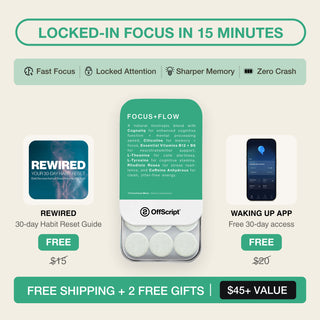
FOCUS+FLOW is a mint because the format lets us put a real formula behind the delivery rather than caffeine in a faster wrapper. The label is the argument.
Patented coffee-fruit extract, clinically studied to support BDNF.
Calm, focused attention without the jitters.
Dopamine precursor for drive + focus under pressure.
Adaptogen that supports mental stamina under stress.
Clean, measured energy, smoothed by L-Theanine.
Raw material for acetylcholine, the memory + learning neurotransmitter.
Supports neurotransmitter production.
Supports cellular energy.
Key Takeaways
- Same absorption route. Both bypass first-pass liver metabolism through oral tissue.
- A pouch holds part of the dose back in material you discard. A mint dissolves completely.
- A pouch needs 15 to 30 minutes of contact. A mint needs no management.
- The pouch dose ceiling is the real constraint, + it is why the category is caffeine with a vitamin garnish.
- Pouches genuinely win on a slower release curve + on surviving a gym bag.
- Neither format gives you a stopping cue. Count milligrams.
Explore The Series
- Caffeine Pouches: Do They Actually Work?
- Energy Pouches: What They Are + What To Look For
- What Is Nootropic Gum? Does It Actually Work?
- Nootropic Lozenges vs Mints
- What Are Sublingual Supplements + Why They Work Faster
- Caffeine Mints: The Complete Guide
References
- Kamimori GH, et al. The rate of absorption and relative bioavailability of caffeine administered in chewing gum versus capsules to normal healthy volunteers. International Journal of Pharmaceutics. 2002. PubMed
- Wickham KA, Spriet LL. Administration of Caffeine in Alternate Forms. Sports Medicine. 2018. PMC
- Sublingual and Buccal Delivery: A Historical and Scientific Prescriptive. Pharmaceutics. 2025. MDPI
- Owen GN, et al. The combined effects of L-theanine and caffeine on cognitive performance and mood. Nutritional Neuroscience. 2008. PubMed
- Kelly SP, et al. L-theanine and caffeine in combination affect human cognition as evidenced by oscillatory alpha-band activity and attention task performance. Journal of Nutrition. 2008. PubMed
FAQ
Are caffeine pouches or mints better?
They use the same absorption route, so the difference is the container. A mint dissolves completely, needs no management and has room for a fuller formula. A pouch holds some of the dose in material you throw away and requires 15 to 30 minutes of contact, but it releases more gradually and survives a gym bag better. For most people wanting a complete focus formula rather than caffeine alone, the mint is the better vehicle.
Do mints absorb faster than pouches?
Generally yes, because a mint dissolves in a few minutes and puts everything into solution at once, whereas a pouch releases gradually across 15 to 30 minutes. Neither delivers more total compound than the other by virtue of format alone. Both beat a capsule on onset because they bypass first-pass liver metabolism.
Why do caffeine pouches contain so little besides caffeine?
Physical space. Caffeine is potent by weight so 100mg takes up almost no room, but a meaningful dose of L-theanine is 100mg to 200mg and bulkier, and adaptogens at studied doses are bulkier again. A pouch cannot hold a full formula without becoming unpleasant, which is why the category settles on caffeine with small amounts of B vitamins.
Is it easier to take too much caffeine from pouches?
Yes. Pouches are discreet, need no preparation and leave nothing behind, so they remove every cue that normally tells you how much you have had. A cup of coffee has a beginning and an end. A tin in your pocket does not. Track total milligrams across the day rather than counting units, and remember coffee and tea count toward the same total.
Does anything stay behind in a caffeine pouch?
Some of the dose does. Research on caffeinated gum found relative bioavailability below capsules until it was corrected for incomplete release from the base, and a pouch has the same limitation. The figure printed on the tin is what was loaded in, not necessarily what reached your bloodstream. A mint dissolves fully, so nothing is retained.
These statements have not been evaluated by the Food and Drug Administration. This product is not intended to diagnose, treat, cure, or prevent any disease. This article is educational and is not medical advice.