




Caffeine pouches arrived by borrowing a format rather than inventing one. Take the small fibre pouch people already tuck under their lip for nicotine, fill it with caffeine instead, and you have a product that is fast, silent, hands-free + requires no drink. The pitch is good. The category is growing quickly. And the honest answer to "do they work" is yes, with three caveats that most of the brands selling them would rather not put on the tin.
Here is what the absorption science actually supports, how much caffeine you are really getting, the safety issue created by the format itself, + how pouches compare to the other fast-onset options.
What A Caffeine Pouch Actually Is
A caffeine pouch is a small permeable sachet holding caffeine, usually alongside sweetener, flavouring, a plant fibre filler + sometimes B vitamins or L-theanine. You park it between your gum + upper lip. Saliva moves through the pouch, dissolves the contents, + the dissolved caffeine sits in prolonged contact with the inside of your mouth.
Critically, there is no tobacco + no nicotine in a caffeine pouch. The format is borrowed, not the drug. That distinction matters more than it sounds, + we will come back to it.
Doses in the category typically run 50mg to 100mg of caffeine per pouch, which is somewhere between half a cup + a full cup of coffee. Some brands go higher.
Do They Work? What The Absorption Science Says
The mechanism is real + it is the same one that makes sublingual medicine work. The tissue lining your cheeks + the floor of your mouth is thin, densely supplied with blood vessels, + drains into general circulation without first passing through the liver. Pharmacology reviews of buccal + sublingual delivery describe this as bypassing hepatic first-pass metabolism. It is why nitroglycerin goes under the tongue rather than down the hatch.
Caffeine is an unusually good candidate for that route. It is a small, lipid-soluble molecule, which is exactly the profile that crosses membranes easily.
Now the honest part: there is very little published pharmacokinetic work on caffeine pouches specifically. The category is newer than the research cycle. What we do have is solid data on the closest analogue, caffeinated chewing gum, which uses the same buccal route. In controlled testing of 84 healthy adults, caffeine in gum reached peak plasma concentration in roughly 44 to 80 minutes versus 84 to 120 minutes for the same dose in a capsule. A later review in Sports Medicine on alternate caffeine delivery forms reached the same conclusion: faster absorption through the oral mucosa, with total absorption over the full time course broadly comparable to capsules.
So the reasonable claim is that a caffeine pouch gets you there sooner than a pill. The unreasonable claim, which you will see made, is that it gets you more.
The Three Caveats
- Contact time is the whole variable. Buccal absorption only happens while dissolved caffeine is against the tissue. Pull the pouch after two minutes + you have wasted most of the advantage. Most brands suggest 15 to 30 minutes for a reason.
- Release is incomplete. Some of the dose stays in the pouch material + goes in the bin with it. This is a known issue in the gum data, where relative bioavailability came in below capsules before correcting for how much the base actually released. The number on the tin is what went in, not necessarily what reached you.
- Most of it still gets swallowed. Saliva carries a good portion of the dissolved caffeine down your throat, where it is absorbed conventionally through the gut. The buccal fraction is a head start, not the whole delivery.
The Safety Issue Nobody Puts On The Tin
This is the part worth reading even if you buy someone else's pouches.
The format is borrowed from nicotine pouches, + it carries over the behaviour that goes with them. Nicotine pouch users think in terms of "a few through the day." Applied to caffeine, that habit is a problem, because the pouch is discreet, requires no preparation, leaves no cup on the desk + gives you no natural stopping cue. Coffee has friction built in. You have to make it, carry it, finish it. A tin in your pocket has none of that.
At 100mg a pouch, four across a working day is 400mg, which is the ceiling the FDA generally cites for healthy adults. Add a morning coffee + you are over it without ever having felt like you were consuming much of anything.
There is a second, smaller issue: because caffeine pouches look exactly like nicotine pouches, they get left in bags + on counters where the distinction is not obvious. Keep them away from children, who are far more sensitive to caffeine by body weight.
Caffeine Pouches vs Coffee
Pouches win on speed, portability + precision. You know you took 100mg because it says so; a home-brewed cup can range from 70mg to 180mg depending on bean, grind + how heavy-handed you were.
Coffee wins on ritual, on being a pleasant thing to drink, + on the polyphenol content that comes with actual coffee rather than isolated caffeine.
Where pouches genuinely make sense: driving, flights, the gym, a long meeting block, anywhere without a kettle, + anywhere a cup would be conspicuous.
Caffeine Pouches vs Mints: Our Position
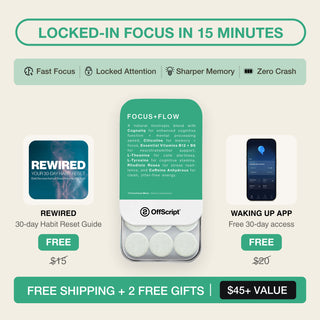
We should be straight about where we stand, because it is relevant. OffScript does not make pouches. FOCUS+FLOW is a fast-dissolving mint. We think the mint is the better expression of the same underlying idea, for three reasons.
The first is that a dissolving mint gets the same oral-mucosal contact without asking you to park a fibre sachet in your lip for half an hour. It dissolves, the compounds are in solution + against the tissue immediately, + whatever is swallowed absorbs normally. Nothing stays trapped in a pouch you throw away.
The second is dose ceiling. A pouch has limited room, which is why the category skews so heavily toward caffeine alone with a token amount of anything else. There is not much space for a real nootropic formula in there.
The third is that caffeine on its own is a blunt tool. The most replicated finding in this literature is not about caffeine by itself, it is about caffeine paired with L-theanine. Trials have found the combination improves accuracy on demanding attention-switching tasks + reduces susceptibility to distraction, with EEG work showing alpha-band changes consistent with more sustained attention. That is the difference between wired + focused, + it is the thing most pouches leave out.
What Is Actually In FOCUS+FLOW
Full label, individual doses, no proprietary blend.
Patented coffee-fruit extract, clinically studied to support BDNF.
Calm, focused attention without the jitters.
Dopamine precursor for drive + focus under pressure.
Adaptogen that supports mental stamina under stress.
Clean, measured energy, smoothed by L-Theanine.
Raw material for acetylcholine, the memory + learning neurotransmitter.
Supports neurotransmitter production.
Supports cellular energy.
How To Judge Any Caffeine Pouch
Four questions. What is the caffeine dose per pouch, stated in milligrams? Is there anything in there managing the caffeine, or is caffeine the entire product? What is the pouch material + the sweetener load, given you will hold it in your mouth for half an hour? And is the brand telling you how long to keep it in, which is the single biggest determinant of whether you get the onset advantage you paid for?
If a tin cannot answer all four, it is a caffeine delivery device with a marketing budget.
Key Takeaways
- The mechanism is real. Buccal absorption bypasses first-pass liver metabolism, + caffeine is well suited to that route.
- Pouch-specific pharmacokinetic data is thin. The evidence comes from caffeinated gum, which reached peak plasma in roughly 44 to 80 minutes versus 84 to 120 for capsules.
- Faster is not stronger. Total absorption over time is broadly comparable to a capsule.
- Contact time decides everything. Pull it early + you lose the advantage you bought.
- The real risk is losing count. The format removes every natural stopping cue coffee has. Track milligrams, not pouches.
- Caffeine alone is blunt. The replicated cognitive finding is caffeine paired with L-theanine, which most pouches have no room for.
Explore The Series
- What Is Nootropic Gum? Does It Actually Work?
- Caffeine Mints: The Complete Guide
- The Best Caffeine Alternatives for Focus + Alertness
- What Are Sublingual Supplements + Why They Work Faster
- Clean Energy Without The Crash
- Caffeine Mints vs Coffee
References
- Kamimori GH, et al. The rate of absorption and relative bioavailability of caffeine administered in chewing gum versus capsules to normal healthy volunteers. International Journal of Pharmaceutics. 2002. PubMed
- Wickham KA, Spriet LL. Administration of Caffeine in Alternate Forms. Sports Medicine. 2018. PMC
- Sublingual and Buccal Delivery: A Historical and Scientific Prescriptive. Pharmaceutics. 2025. MDPI
- Owen GN, et al. The combined effects of L-theanine and caffeine on cognitive performance and mood. Nutritional Neuroscience. 2008. PubMed
- Kelly SP, et al. L-theanine and caffeine in combination affect human cognition as evidenced by oscillatory alpha-band activity and attention task performance. Journal of Nutrition. 2008. PubMed
FAQ
Do caffeine pouches actually work?
Yes, for onset speed. Caffeine absorbs through the lining of the mouth directly into circulation, bypassing first-pass liver metabolism. There is little published pharmacokinetic work on pouches specifically, but the closest analogue, caffeinated gum, reached peak plasma concentration in roughly 44 to 80 minutes versus 84 to 120 minutes for capsules. Total absorption over the full time course was broadly comparable, so the advantage is timing rather than a larger effective dose.
How long should you keep a caffeine pouch in?
Most brands suggest 15 to 30 minutes, and contact time is the single biggest factor in whether you get the onset advantage. Buccal absorption only occurs while dissolved caffeine is against the tissue. Remove it after a couple of minutes and most of the dose is simply swallowed and absorbed through the gut at ordinary speed.
Do caffeine pouches contain nicotine?
No. Caffeine pouches borrow the format from nicotine pouches but contain no nicotine and no tobacco. The typical contents are caffeine, sweetener, flavouring, a plant fibre filler and sometimes B vitamins or L-theanine. Because the two look nearly identical, keep them clearly labelled and away from children.
How many caffeine pouches a day is safe?
Count milligrams rather than pouches. At 100mg each, four pouches reaches 400mg, the ceiling the FDA generally cites for healthy adults, and that is before any coffee or tea. The format removes the natural stopping cues a cup of coffee provides, which is why people lose track. If you are pregnant, have a heart rhythm condition, take prescription medication or have an anxiety disorder, speak to a doctor first.
Are caffeine pouches better than caffeine mints?
They use the same underlying mechanism, but a fast-dissolving mint removes the pouch's drawbacks. Nothing stays trapped in material you throw away, you are not holding a sachet in your lip for half an hour, and a mint has more room for a full formula. Pouches tend to be caffeine alone, whereas the most replicated cognitive finding in this area is caffeine paired with L-theanine.
These statements have not been evaluated by the Food and Drug Administration. This product is not intended to diagnose, treat, cure, or prevent any disease. This article is educational and is not medical advice.