




Energy pouches are the fastest-growing shape in a very old business. The business is selling people caffeine. The shape is new: a small fibre sachet you tuck under your lip, no drink, no cup, no noise. Strip the branding away + almost every product in the category is caffeine plus a short list of B vitamins, + the honest work is figuring out which part is doing something + which part is there to give the tin a longer ingredient list.
This is a map of the category: what goes in them, what each ingredient actually contributes, + the four things worth checking before you buy a tin.
What An Energy Pouch Is
A permeable sachet holding a powdered blend, held between gum + upper lip. Saliva dissolves the contents, some fraction absorbs through the lining of the mouth, the rest gets swallowed + absorbed conventionally.
The format is borrowed from nicotine pouches. The contents are not. There is no nicotine + no tobacco in an energy pouch, though the two are close enough in appearance that keeping them apart matters in a house with children.
"Energy pouch" + "caffeine pouch" are largely the same product under two names. Brands reach for "energy" when they want to foreground B vitamins or an amino acid, + "caffeine" when they want to foreground the dose. Read the panel rather than the noun.
What Is Actually In Them
Working through the usual panel, from most to least load-bearing.
Caffeine, 50mg to 100mg typically. This is the product. Everything else is supporting cast. Caffeine is small + lipid-soluble, which makes it well suited to absorption through oral tissue, + reviews of buccal + sublingual delivery describe that route as bypassing first-pass liver metabolism. The closest thing to hard data on the format comes from caffeinated gum, where caffeine reached peak plasma in roughly 44 to 80 minutes versus 84 to 120 minutes for capsules. Faster, not bigger: a Sports Medicine review of alternate caffeine delivery forms found total absorption over the full time course broadly comparable.
B vitamins, usually B6 + B12. These are real cofactors in energy metabolism, which is why they end up on the label. What they are not is stimulants. B vitamins help your cells convert food into usable energy; they do not create alertness in someone who is not deficient. If your B12 is normal, more B12 does not make you sharper. Their presence on a tin is largely there so the word "energy" has something to point at besides caffeine.
Taurine. Carried over from energy drinks. The evidence for taurine improving alertness on its own is thin, + the doses in a pouch are far below what the energy drink trials used.
L-theanine, in a minority of products. This one earns its place. Paired with caffeine it is the most replicated combination in the whole cognitive supplement literature, improving accuracy on demanding attention-switching tasks + reducing susceptibility to distraction, with EEG work showing alpha-band changes consistent with sustained attention. If a pouch contains it at a sensible ratio, that is a genuine point of difference.
Sweeteners, flavouring, plant fibre filler. Structural. Worth reading, because you will hold this in your mouth for half an hour.
The Dose Ceiling Problem
A pouch is small. That physical limit shapes the entire category.
There is only so much powder you can fit in a sachet before it stops dissolving cleanly + starts tasting like a chemistry set. Caffeine is potent by weight, so 100mg takes up almost no room. A meaningful dose of L-theanine is 100mg to 200mg, which is bulkier. An adaptogen at a studied dose is bulkier still.
The result is predictable: caffeine at a real dose, everything else at a fraction of one. This is not brands being lazy. It is the format telling them what will fit.
Energy Pouches vs Energy Drinks
Pouches win on precision + portability. A tin tells you the milligrams. They carry no sugar, no acid, no 500ml of liquid, + they do not need refrigeration.
Energy drinks win on nothing much, other than being a drink, + carrying larger doses of the secondary ingredients that a pouch has no room for.
The real difference is behavioural, + it does not favour pouches. A can has an ending. You finish it + the decision to have another is conscious. A tin in your pocket has no such cue, which is exactly how people end up well past where they meant to be.
Four Things To Check On Any Tin
- Caffeine in milligrams, per pouch. Stated plainly. If it is buried in a blend, put it down.
- Is anything managing the caffeine? L-theanine at a real dose is the only common ingredient that reliably does this. B vitamins do not.
- Recommended contact time. Buccal absorption only happens while the dissolved compound is against the tissue. A brand that does not tell you how long to keep it in is not thinking about whether it works.
- The excipient list. Sweeteners, pouch material, fillers. Half an hour in your mouth is a long time.
Where We Stand
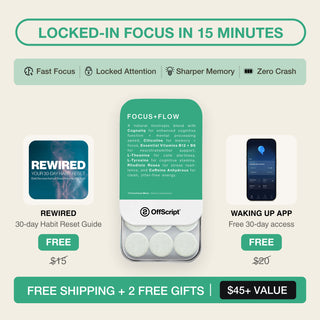
Straight, because it is relevant: OffScript does not make pouches. FOCUS+FLOW is a fast-dissolving mint. We built it that way because the mint keeps the good part of the format + drops the constraints.
A mint gets the same oral-mucosal contact without a sachet in your lip for thirty minutes + without part of the dose staying behind in material you throw away. More importantly, it has room. That is why FOCUS+FLOW can carry 150mg of L-theanine against 100mg of caffeine, plus 100mg of L-tyrosine + 100mg of rhodiola, rather than caffeine with a vitamin garnish.
Patented coffee-fruit extract, clinically studied to support BDNF.
Calm, focused attention without the jitters.
Dopamine precursor for drive + focus under pressure.
Adaptogen that supports mental stamina under stress.
Clean, measured energy, smoothed by L-Theanine.
Raw material for acetylcholine, the memory + learning neurotransmitter.
Supports neurotransmitter production.
Supports cellular energy.
Note the B vitamins are on our label too. We are not pretending they are the engine. They are cofactors, they belong there, + the engine is the caffeine paired with the theanine.
Key Takeaways
- Energy pouches + caffeine pouches are largely the same product. Read the panel, not the noun.
- Caffeine is the active ingredient. B vitamins are cofactors, not stimulants, + do nothing extra if you are not deficient.
- The format has a hard dose ceiling, which is why secondary ingredients arrive at token amounts.
- Buccal absorption is faster than a capsule but not larger. You are buying onset, not milligrams.
- L-theanine at a real ratio to caffeine is the one secondary ingredient that consistently earns its place.
- The format removes every natural stopping cue. Track milligrams.
Explore The Series
- Caffeine Pouches: Do They Actually Work?
- What Is Nootropic Gum? Does It Actually Work?
- The Best Energy Mints
- Caffeinated Mints vs Energy Drinks
- Clean Energy Without The Crash
- Why L-Theanine + Caffeine Is The Smartest Stack
References
- Kamimori GH, et al. The rate of absorption and relative bioavailability of caffeine administered in chewing gum versus capsules to normal healthy volunteers. International Journal of Pharmaceutics. 2002. PubMed
- Wickham KA, Spriet LL. Administration of Caffeine in Alternate Forms. Sports Medicine. 2018. PMC
- Sublingual and Buccal Delivery: A Historical and Scientific Prescriptive. Pharmaceutics. 2025. MDPI
- Owen GN, et al. The combined effects of L-theanine and caffeine on cognitive performance and mood. Nutritional Neuroscience. 2008. PubMed
- Kelly SP, et al. L-theanine and caffeine in combination affect human cognition as evidenced by oscillatory alpha-band activity and attention task performance. Journal of Nutrition. 2008. PubMed
FAQ
What is in an energy pouch?
Typically caffeine at 50mg to 100mg, a small amount of B vitamins such as B6 and B12, sweetener, flavouring and a plant fibre filler. Some include taurine or L-theanine. Caffeine is the active ingredient doing the work; the rest is supporting cast, and in most products the secondary ingredients arrive in token amounts because a pouch has very little room.
Are energy pouches the same as caffeine pouches?
Largely yes. The two names describe the same format and usually the same contents. Brands tend to use "energy" when they want to foreground B vitamins or an amino acid and "caffeine" when they want to foreground the dose. The supplement panel tells you more than the product name does.
Do the B vitamins in energy pouches do anything?
They are genuine cofactors in energy metabolism, so they belong on a label, but they are not stimulants. B vitamins help cells convert food into usable energy; they do not create alertness in someone whose levels are already normal. The perceived effect from an energy pouch is caffeine.
Do energy pouches contain nicotine?
No. They borrow the pouch format from nicotine products but contain no nicotine and no tobacco. Because the tins look very similar, keep them clearly labelled and stored away from children, who are considerably more sensitive to caffeine by body weight.
How many energy pouches can you have in a day?
Count milligrams rather than pouches. At 100mg each, four reaches 400mg, the ceiling the FDA generally cites for healthy adults, before any coffee or tea. The format gives you none of the natural stopping cues a cup or a can does, which is the most common reason people overshoot. Anyone pregnant, with a heart rhythm condition or an anxiety disorder, or taking prescription medication, should speak to a doctor first.
These statements have not been evaluated by the Food and Drug Administration. This product is not intended to diagnose, treat, cure, or prevent any disease. This article is educational and is not medical advice.