




Anxiety is a common challenge that many individuals face, often leading to a search for effective relief methods. Nootropic ingredients, known for their cognitive-enhancing properties, have emerged as promising natural alternatives for anxiety management. This article delves into the most effective nootropic ingredients that can help ease anxiety, their mechanisms of action, and how they can be integrated into daily routines. Readers will learn about the science + the practice: what these ingredients actually do, their benefits, and how to choose the right supplements for their needs. We will explore various natural nootropics, including L-theanine and ashwagandha, and provide honest insight into their efficacy and safety. Along the way we will point to OffScript's CALM+COLLECTED, which is formulated to support a natural sense of calm.
The growing interest in nootropic ingredients for brain health + anxiety relief is reflected in the expanding market for such supplements, driven by a desire for enhanced cognitive performance and healthy aging. This is not a substitute for medical care — anxiety can be a genuine clinical condition, and if yours is persistent or severe, the smart move is a conversation with a professional, not a bottle bought on impulse.
Botanical Nootropics for Stress, Focus, and Brain Health
Recent estimates for the global brain health supplement category, i.e. nootropic market size, will grow to nearly $5.8 billion by 2023. Overall, nearly one-quarter (23%) of adults currently take a supplement to maintain or improve brain health. Not surprisingly, the use of such supplements increases with age - more than one-third of the oldest generation (ages 74 and older) takes a supplement for brain health. This widespread use is being driven by a strong desire both in the younger and older generations to enhance cognitive performance and achieve healthy aging. The most prevalent botanicals currently dominating the nootropic marketplace include Gingko biloba, American ginseng, and Bacopa monnieri. However, other botanicals that affect stress, focus, attention, and sleep have also been procured by dietary supplement companies developing products for improving both short- and long-term brain health.
The safety and efficacy of botanicals with nootropic effects, 2021
WHAT ARE THE BEST NATURAL NOOTROPICS FOR ANXIETY RELIEF?
Natural nootropics have earned attention for their potential to ease anxiety symptoms. Some of the most studied ingredients include:
- L-Theanine: Found in green tea, L-theanine promotes relaxation without sedation, making it useful for softening anxiety while keeping you focused.
- Ashwagandha: This adaptogen helps the body manage stress and has been shown to lower cortisol levels, supporting a calmer state of mind.
- Bacopa Monnieri: Known for its cognitive-supporting effects, Bacopa also aids stress reduction + overall mental clarity.
- Rhodiola Rosea: This herb supports resilience to stress and fatigue, making it helpful for those facing anxiety in high-pressure situations.
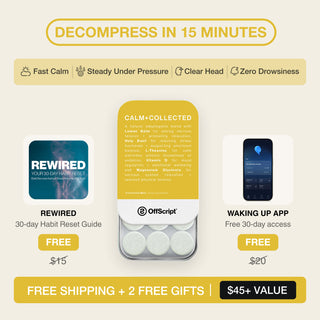
Several of these ingredients converge in OffScript's CALM+COLLECTED, which pairs L-Theanine with Lemon Balm, Holy Basil, Magnesium Glycinate, and Vitamin D. Rather than lean on a single compound, it stacks ingredients that work on different parts of the calm equation — the neurotransmitter side + the mineral foundation — so the calm arrives steady + clear instead of foggy. Here is what is in each mint, at the doses on the label:
Promotes calm, focused attention without drowsiness.
Traditional herb used to promote a settled mood.
Adaptogen traditionally used to support resilience under stress.
A gentle, well-absorbed form of magnesium.
Supports normal mood + immune function.
| Ingredient | Commonly Studied Dosage | Potential Side Effects |
|---|---|---|
| L-Theanine | 100-200 mg daily | Mild headache, dizziness |
| Ashwagandha | 300-500 mg daily | Gastrointestinal upset, drowsiness |
| Bacopa Monnieri | 300-600 mg daily | Fatigue, digestive issues |
| Rhodiola Rosea | 200-400 mg daily | Dry mouth, dizziness |
This table summarizes commonly studied dosages + potential side effects of these natural nootropics, giving a quick reference for those considering their use.
HOW DO NOOTROPIC INGREDIENTS WORK TO REDUCE ANXIETY?
Nootropic ingredients work through several mechanisms to ease anxiety. Understanding these mechanisms can help you choose the right supplements for your needs.
GABA MODULATION AND NEUROTRANSMITTER BALANCE EXPLAINED
Nootropics like L-theanine support GABA (gamma-aminobutyric acid) signaling in the brain, which is central to relaxation + easing anxiety. GABA is an inhibitory neurotransmitter that helps calm neural activity, nudging the system toward a more relaxed state. By supporting GABA activity, L-theanine can help soften feelings of anxiety + stress, making it a valuable part of a natural calm regimen.
ADAPTOGENS AND THEIR ROLE IN STRESS RESPONSE REGULATION
Adaptogens, such as ashwagandha and Rhodiola Rosea, help the body adapt to stress by regulating the stress response system. These herbs work by helping to balance cortisol, the hormone at the center of the stress response. By modulating the body's response to stressors, adaptogens can meaningfully reduce anxiety symptoms + improve overall mental well-being.
Further scientific inquiry supports the value of adaptogenic herbs like ashwagandha and Rhodiola Rosea in managing stress + promoting overall well-being.
Ashwagandha & Adaptogenic Herbs for Anxiety Relief
Nowadays, there is a rising number of stress-related health problems, such as fatigue, anxiety, and insomnia, which create serious potential threats to the health of physical and mental well-being. Therefore, there is emerging interest in the scientific and clinical community in adaptogenic herbs, or plant agents, that help individuals improve their ability to cope with stress and bring their bodies back to homeostasis. The literature suggests that adaptogens demonstrate clinically relevant, significant anti-stress, antioxidant, and immunomodulatory functions for use as supplementary adjuncts in managing stress and optimizing immune function.
The Role of Adaptogenic Herbs in Stress Management and Immune Support: The Anti-stress Properties of Natural Botanicals, MO Sabry, 2025
WHICH HERBAL REMEDIES FOR ANXIETY HAVE SCIENCE-BACKED PROOF?
Several herbal remedies have been studied for their role in easing anxiety. These offer natural alternatives worth understanding alongside conventional options.
MAGNESIUM: NEUROPROTECTION AND CALMING EFFECTS BACKED BY CLINICAL STUDIES
Magnesium plays a vital role in brain health and has calming effects on the nervous system. Clinical research indicates that magnesium supplementation can help ease anxiety symptoms by supporting neurotransmitter function + promoting relaxation. Commonly studied dosages range from 200-400 mg daily, depending on individual needs — and the glycinate form is prized for being gentle + well-absorbed.
RHODIOLA ROSEA: ENHANCING COGNITIVE RESILIENCE UNDER STRESS
Rhodiola Rosea has been studied for its ability to support cognitive resilience under stress. Research suggests it can support mental performance + reduce fatigue, making it particularly useful for people facing high-stress stretches. A typical dose of Rhodiola is between 200-400 mg daily, which can help support mental clarity + take the edge off anxiety.
HOW TO CHOOSE THE BEST ANXIETY RELIEF SUPPLEMENTS FOR YOU?
Selecting the right anxiety relief supplements involves weighing a few factors to ensure efficacy + safety.
- Ingredient Transparency: Look for supplements that state their ingredients + doses clearly, with nothing hidden behind a proprietary blend.
- Clinical Evidence: Choose products built on ingredients with research demonstrating a real effect on stress + anxiety.
- Personal Health Considerations: Consult a healthcare provider to determine which supplements are appropriate for your specific health needs, especially if you take other medications.
OffScript's CALM+COLLECTED is a strong option for anyone who wants a transparently formulated supplement that combines mechanism-backed ingredients for a natural sense of calm.
CALM UNDER PRESSURE
Promotes calm without dulling your edge — mechanism-backed, not sedating.
SHOP CALM+COLLECTEDWHAT SAFETY AND EFFICACY FACTORS SHOULD YOU KNOW ABOUT NOOTROPIC ANXIETY SUPPLEMENTS?
When considering nootropic anxiety supplements, it is worth being clear-eyed about safety + efficacy.
- Common Side Effects: While many nootropic ingredients are well-tolerated, some people may notice mild side effects such as digestive upset or drowsiness.
- Efficacy Based on Clinical Studies: Research supports the value of many nootropic ingredients, but effects are generally modest + individual responses vary.
- Consultation with Healthcare Providers: Always consult a healthcare professional before starting any new supplement, especially if you have pre-existing conditions or take other medications. Supplements support + optimize your body's own regulation — they are not a treatment for a diagnosed anxiety disorder.
HOW TO USE CALM COLLECTED AND FOCUS FLOW FOR MAXIMUM ANXIETY RELIEF?
To get the most from OffScript's CALM+COLLECTED and Focus Flow, consider these usage guidelines:
- CALM+COLLECTED: Let 1-2 mints dissolve daily, preferably in the morning or as needed, to support a natural sense of calm through the day.
- Focus Flow: For cleaner cognitive focus, let 1-2 mints dissolve in the morning or before mentally demanding tasks.
Following these guidelines helps you fold these supplements into your daily routine for steady, natural support. To learn more about our company + mission, visit our about page, or browse more topics in our health guide.
Key Takeaways
- The best-studied natural nootropics for anxiety support — L-theanine, ashwagandha, magnesium, and rhodiola — work through distinct mechanisms, so they complement rather than duplicate each other.
- L-theanine supports GABA signaling for acute, in-the-moment calm without sedation, while adaptogens like ashwagandha and rhodiola help regulate the cortisol-driven stress response over time.
- Effects are real but modest — these ingredients take the edge off an over-revved stress response; they are not a cure for a clinical anxiety disorder.
- Choose on transparency + clinical evidence: clear doses, no proprietary blends, and ingredients with research behind them.
- Supplements support + optimize your body's own regulation. If anxiety is persistent or severe, talk to a professional, and clear any new supplement with your doctor if you take medication.
Explore The Series
- Ashwagandha for Stress and Anxiety: What the Research Actually Says
- GABA Supplements and a Calm Mind
- Magnesium Glycinate for Stress and Sleep
References
- Hepsomali P, et al. "Effects of Oral Gamma-Aminobutyric Acid (GABA) Administration on Stress and Sleep in Humans: A Systematic Review." Frontiers in Neuroscience, 2020. Frontiers
- Abdou AM, et al. "Relaxation and immunity enhancement effects of γ-aminobutyric acid (GABA) administration in humans." BioFactors, 2006. Wiley
- Chandrasekhar K, Kapoor J, Anishetty S. "A Prospective, Randomized Double-Blind, Placebo-Controlled Study of Safety and Efficacy of a High-Concentration Full-Spectrum Extract of Ashwagandha Root in Reducing Stress and Anxiety in Adults." Indian Journal of Psychological Medicine, 2012. Journal
- Nobre AC, Rao A, Owen GN. "L-theanine, a natural constituent in tea, and its effect on mental state." Asia Pacific Journal of Clinical Nutrition, 2008. PubMed
- Kell G, et al. "affron® a novel saffron extract (Crocus sativus L.) improves mood in healthy adults over 4 weeks in a double-blind, parallel, randomized, placebo-controlled clinical trial." Complementary Therapies in Medicine, 2017. ScienceDirect
- Pickering G, et al. "Magnesium Status and Stress: The Vicious Circle Concept Revisited." Nutrients, 2020. MDPI
FAQ
Do nootropic ingredients actually help with anxiety?
Several do, with meaningful research behind them — L-theanine for acute calm and adaptogens like ashwagandha and rhodiola for the cortisol-driven stress response. The honest framing is support, not cure: these ingredients help take the edge off an over-active stress response rather than eliminate anxiety, and effects are generally modest.
What is the best nootropic ingredient for anxiety without drowsiness?
L-theanine is the standout for calm without sedation. It supports GABA activity, the brain's main calming, inhibitory signaling, so it can soften anxiety while keeping you alert and focused — which is why it is often paired with, rather than opposed to, mental clarity.
How long do these ingredients take to work?
It depends on the mechanism. L-theanine tends to act within an hour, so it is useful for in-the-moment composure. Adaptogens like ashwagandha and rhodiola work by gradually recalibrating the stress response, so the trials that showed benefits generally ran several weeks of consistent daily use.
Are natural anxiety supplements safe to take every day?
Many of these ingredients are well-tolerated at commonly studied doses, though some people notice mild effects like digestive upset or drowsiness. Daily use is common, but if you have a pre-existing condition, are pregnant, or take other medications, clear it with your doctor first — and see a professional if your anxiety is persistent or severe.
What is in CALM+COLLECTED?
Each mint pairs L-Theanine (200mg) for calm focus, Lemon Balm (200mg) and Holy Basil (100mg) for mood and stress resilience, Magnesium Glycinate (120mg) as a gentle, well-absorbed mineral foundation, and Vitamin D (20mcg) for mood and immune support. It is built to support your body's own calm machinery rather than override it.