




The pitch is elegant. Certain peptides stimulate your body to release more of its own growth hormone, so instead of injecting a hormone you nudge your own supply: more GH, more muscle, better recovery, leaner composition. Natural-ish, clever, allegedly safer.
The pitch is doing a lot of lifting that the evidence cannot. We do not sell peptides + we do not sell a muscle product either, so read this as a map from a company with no dog in the specific fight.
What The Mechanism Actually Buys You
The popular muscle peptides are mostly growth hormone secretagogues: compounds that trigger GH release. And the mechanism is real, in the narrow sense that several genuinely do raise GH pulses in studies.
Here is the gap the marketing jumps: raising a hormone is not the same as building muscle. The step everyone assumes, that modestly elevated GH in a healthy adult produces meaningful extra muscle, is exactly the step with the weakest evidence. GH is not the primary driver of training adaptations in healthy adults; mechanical tension + adequate protein are. Even administering actual growth hormone to healthy adults has produced underwhelming lean-mass results outside deficiency states, which is a poor omen for compounds that merely nudge it.
So the honest summary of the human outcome data for research-market muscle peptides: largely absent. Mechanistic studies, animal work, small hormone-level studies, yes. Controlled human trials showing more muscle in trained people, essentially none.
The Part That Should End The Conversation For Athletes
Growth hormone secretagogues are banned in tested sport, full stop. A research vial with unverified contents is also a contamination lottery on top of the deliberate violation. The compounds are covered in more depth in are peptides legal, but the athlete version is one line: this entire lane is career risk.
What Actually Builds Muscle, Ranked By Evidence
The unglamorous list, in order:
- Progressive resistance training. The signal everything else amplifies. Nothing injectable substitutes for it.
- Protein, roughly 1.6g to 2.2g per kilogram per day. The most evidence-backed number in sports nutrition.
- Creatine monohydrate. The most studied supplement in existence, oral, legal, cheap, + it works. The contrast with the peptide lane is almost comic: the boring white powder has hundreds of trials, the exciting vial has none.
- Sleep. Where recovery + the natural GH pulse actually happen. The largest GH release of your day occurs in deep sleep, free, every night, no vial required.
- Managed stress. Chronically elevated cortisol works against training adaptations. The evidence layer here is modest but real: rhodiola for fatigue under sustained demand (Darbinyan et al., 2000), ashwagandha with randomised placebo-controlled evidence on stress + cortisol over weeks (Chandrasekhar et al., 2012).
A person doing those five consistently outbuilds a person injecting research compounds inconsistently, + does it legally.
Where We Fit, Honestly
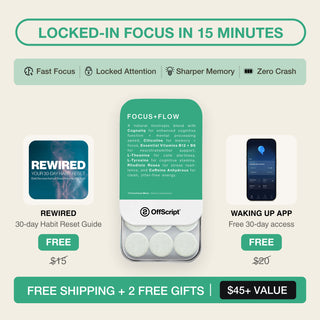
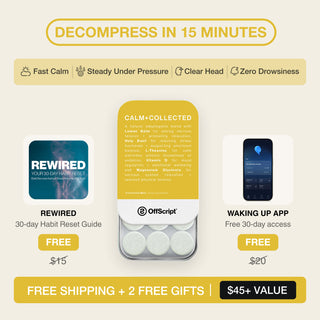
OffScript does not make a muscle product. What we make touches this goal at two edges: FOCUS+FLOW for the training-session end, where its caffeine + L-theanine pairing covers the one supplement effect pre-workouts genuinely deliver, + CALM+COLLECTED at the recovery end, supporting the stress side that works against adaptation. Neither builds muscle. Training + protein build muscle. We are comfortable being the company that says so.
Key Takeaways
- Muscle peptides mostly work by raising GH pulses, which is real + also not the same as building muscle.
- Human outcome data showing extra muscle in trained adults is essentially absent. Even injected GH underwhelms in healthy adults.
- For tested athletes the lane is banned outright, before the contamination lottery.
- Creatine is the standing rebuke to the category: boring, oral, legal + proven in hundreds of trials.
- The biggest natural GH pulse of your day happens in deep sleep, at no cost.
- Training, protein, creatine, sleep + managed stress outbuild the vial, legally.
Explore The Series
- Peptides For Weight Loss: What Nobody Selling Them Tells You
- Are Peptides Legal? The Actual Rules
- Peptide Therapy: What It Is + What It Costs
- Pre-Workout Without Caffeine: What Actually Works
- Cortisol + Sleep
- Ashwagandha For Stress: The Research
References
- Darbinyan V, et al. Rhodiola rosea in stress induced fatigue. Phytomedicine. 2000. PubMed
- Chandrasekhar K, Kapoor J, Anishetty S. A prospective, randomized double-blind, placebo-controlled study of safety and efficacy of a high-concentration full-spectrum extract of ashwagandha root. Indian J Psychol Med. 2012. PubMed
FAQ
Do peptides build muscle?
The popular muscle peptides raise growth hormone pulses, which is real, but raising a hormone is not building muscle. Controlled human trials showing extra muscle in trained adults are essentially absent, and even administering actual growth hormone to healthy adults has produced underwhelming lean-mass results. Mechanical tension and protein drive muscle growth; the peptide pitch skips that inconvenient step.
Are muscle peptides safe?
Unknown, which is different from safe. Most are sold as research chemicals because they are not approved for human use, meaning no verified purity, dose accuracy or sterility, in an injected product. There is no established human safety profile for the marketed uses. For tested athletes there is the additional certainty that growth hormone secretagogues are banned substances.
What works better than peptides for muscle?
The evidence ranking is unambiguous: progressive resistance training, protein at roughly 1.6g to 2.2g per kilogram daily, creatine monohydrate, sleep, and a managed stress response. Creatine alone has hundreds of trials behind it, is oral and legal, and outperforms the entire research-vial category on demonstrated results.
Do peptides increase growth hormone?
Several genuinely do raise GH pulses in studies. The catch is that the largest natural GH release of your day already happens in deep sleep, and modest additional GH elevation in a healthy adult has not been shown to produce meaningful extra muscle. The mechanism is real; the promised outcome is the unproven part.
Can athletes take peptides for recovery?
Tested athletes cannot: growth hormone secretagogues and many other peptides are banned by anti-doping frameworks regardless of retail availability, and unverified vials add contamination risk on top of the deliberate violation. Recovery for athletes runs through sleep, protein, programming and managed stress, all of which pass every test.
These statements have not been evaluated by the Food and Drug Administration. This product is not intended to diagnose, treat, cure, or prevent any disease. This article is educational and is not medical advice.