




Take the caffeine out of most pre-workouts + you are left with flavouring, a tingle + a very long ingredient list doing very little. That is the uncomfortable truth of the category, + it is why "stim-free" versions so often feel like nothing.
But some ingredients genuinely work without a stimulant, + some of the sensation people associate with a good pre-workout was never the caffeine anyway. Here is what survives the cut.
Why People Want To Drop The Caffeine
Usually one of four reasons: training in the evening + wanting to sleep afterwards, anxiety or palpitations from high-stimulant formulas, a tolerance that has crept up until 300mg feels like nothing, or already having had coffee + not wanting to stack more on top.
All four are reasonable, + the last one is more common than people admit.
What Still Works Without Stimulants
Creatine monohydrate
The most evidenced supplement in sports nutrition + entirely stimulant-free. It supports the phosphocreatine system that fuels short, high-intensity effort. It also does not work acutely, which is the part that confuses people. It works by saturating muscle stores over weeks, so timing is nearly irrelevant + taking it "pre-workout" is a convention rather than a requirement.
Beta-alanine
Buffers the acidity that builds during sustained high-intensity work, with the best evidence in efforts lasting roughly one to four minutes. Like creatine, it works through accumulation rather than acutely. The tingling is harmless + is a sensory side effect, not the mechanism. A fair amount of what people interpret as "the pre-workout kicking in" is this.
Citrulline malate
Supports nitric oxide production + blood flow, which is where the pump comes from. Effective doses in the research are high, generally 6g to 8g, + plenty of products carry a fraction of that so they can print the name.
Electrolytes + carbohydrate
Unglamorous + frequently the actual answer. If a session feels flat, being under-fuelled or under-hydrated is a far more likely cause than an insufficiently exotic formula.
What Was Only Ever The Caffeine
Being blunt about the rest. Remove the stimulant + the following largely stop justifying themselves: most proprietary "energy blends," taurine at the doses typically used, B vitamins presented as an energy source rather than as cofactors, + the majority of exotic herbal additions included to lengthen the label.
B vitamins deserve the specific correction, because it is the most common confusion in the category. They are real cofactors in energy metabolism, which means they help convert food into usable energy. They are not stimulants + they do not create alertness in someone who is not deficient.
The Honest Trade
Without caffeine you keep the performance ingredients + lose the perceived-exertion effect. That second part is not nothing: caffeine genuinely makes hard work feel less hard, which is a large part of why stimulant pre-workouts feel effective.
So a stim-free pre-workout is not a like-for-like swap. It is a different, calmer product, + expecting it to feel identical is the fastest route to disappointment.
The Middle Path: Less Caffeine, Better Caffeine
Many people searching for stim-free do not actually want zero. They want out of the 300mg-plus arms race, which produces jitters, a racing heart + a 9PM that goes badly.
A moderate dose paired with L-theanine is the better version of that trade. The pairing improved accuracy on demanding attention-switching tasks + reduced susceptibility to distraction, with EEG work showing alpha-band changes consistent with sustained attention. In practice it is the difference between wired + locked in.
Timing matters more than most people think. Caffeine has a long tail, + an evening session with a big stimulant dose costs you the night even when you fall asleep fine.
Where FOCUS+FLOW Fits
Straight: this is not a pre-workout. It has no creatine, no beta-alanine + no citrulline, so it will not do what those do.
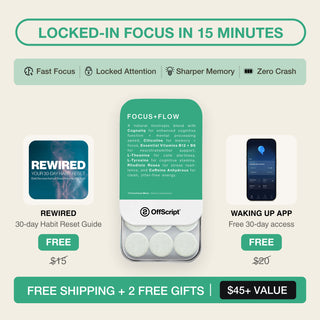
What it is: 100mg of caffeine, about a cup of coffee, paired with 150mg of L-theanine, in a mint that dissolves rather than a scoop you mix. For people who want the mental side of a pre-workout at a sane stimulant dose, particularly for an evening session, that is the relevant part. For pump, buffering + strength adaptations, take the actual ergogenic aids.
Patented coffee-fruit extract, clinically studied to support BDNF.
Calm, focused attention without the jitters.
Dopamine precursor for drive + focus under pressure.
Adaptogen that supports mental stamina under stress.
Clean, measured energy, smoothed by L-Theanine.
Raw material for acetylcholine, the memory + learning neurotransmitter.
Supports neurotransmitter production.
Supports cellular energy.
Key Takeaways
- Creatine, beta-alanine + citrulline malate work without stimulants + are the ingredients worth keeping.
- Creatine + beta-alanine work through accumulation, not acutely, so pre-workout timing is mostly convention.
- The beta-alanine tingle is a side effect, not the mechanism, + it is often mistaken for the product working.
- Citrulline needs 6g to 8g. Many products carry a fraction so they can print the name.
- B vitamins are cofactors, not stimulants. Removing caffeine removes the stimulant entirely.
- Caffeine reduces perceived exertion, so stim-free is a genuinely different experience, not a swap.
- Many people want less caffeine rather than none. A moderate dose with L-theanine is that middle path.
Explore The Series
- Clean Energy Without The Crash
- The Best Caffeine Alternatives for Focus + Alertness
- L-Theanine and Caffeine: The Perfect Natural Focus Stack
- Nootropics For Gamers
- Rhodiola Rosea for Mental Fatigue: What the Science Says
- Caffeine Pouches: Do They Actually Work?
References
- Owen GN, et al. The combined effects of L-theanine and caffeine on cognitive performance and mood. Nutritional Neuroscience. 2008. PubMed
- Kelly SP, et al. L-theanine and caffeine in combination affect human cognition as evidenced by oscillatory alpha-band activity and attention task performance. Journal of Nutrition. 2008. PubMed
- Wickham KA, Spriet LL. Administration of Caffeine in Alternate Forms. Sports Medicine. 2018. PMC
FAQ
Does pre-workout work without caffeine?
Partly. Creatine, beta-alanine and citrulline malate all work without stimulants and are the ingredients genuinely worth having. What you lose is caffeine's effect on perceived exertion, which is a large part of why stimulant pre-workouts feel effective. A stim-free product is a calmer, different experience rather than a like-for-like swap.
What is the best stimulant-free pre-workout ingredient?
Creatine monohydrate, by a distance, though it works by saturating muscle stores over weeks rather than acutely. For sustained high-intensity efforts of roughly one to four minutes, beta-alanine has good evidence. For blood flow and pump, citrulline malate at 6g to 8g, which is considerably more than many products contain.
Why does pre-workout make me tingle?
That is beta-alanine, and it is a harmless sensory side effect rather than the mechanism. It gets mistaken for the product taking effect, which is partly why it remains so popular in formulations. The actual benefit comes from accumulation in muscle over weeks, not from the tingle.
Can I take pre-workout in the evening?
Stimulant-free versions, yes. Caffeinated ones are a problem because caffeine has a long tail and will still be measurably present at bedtime, often degrading sleep quality even in people who fall asleep fine. If you train late and want some mental lift, a moderate caffeine dose taken earlier beats a large one close to the session.
Do B vitamins in pre-workout give you energy?
Not in the way the label implies. B vitamins are cofactors that help your cells convert food into usable energy, which is a genuine role, but they are not stimulants and produce no alertness in someone whose levels are already normal. In a caffeinated pre-workout, the perceived energy is the caffeine.
These statements have not been evaluated by the Food and Drug Administration. This product is not intended to diagnose, treat, cure, or prevent any disease. This article is educational and is not medical advice.