




Months of preparation come down to a few hours of performance, + most test-day advice ignores the machine doing the performing. Your score on the day is your knowledge multiplied by the state of your brain: its sleep, its glucose, its arousal level, its caffeine curve. This is the protocol for that machine, exam morning, hour by hour, for anyone facing finals, boards, the bar, or a certification that matters.
The protocol in one paragraph: full sleep two nights out (the night before matters, the night before that matters more), a protein-forward breakfast without a sugar spike, your normal caffeine dose + no more, timed so it peaks as the test starts, a two-minute breath reset before you enter, + no new supplements, foods, or routines you have not rehearsed. Test day is the day you run defaults, not experiments.
Two Nights Out: The Sleep You Actually Score With
The dirty secret of exam sleep is that the critical night is not the one before the test; it is the two or three before that. Sleep restriction compounds: in the landmark dose-response study, two weeks of six-hour nights produced deficits equal to two nights of total deprivation, while subjects rated themselves only mildly impaired (Van Dongen et al., 2003). Memory consolidation also happens during sleep, so an all-nighter converts material you knew into material you almost knew.
The practical rule: protect the final three nights like they are part of the exam, because they are. If nerves shorten the last night anyway, do not panic-caffeinate; one short night on a rested baseline costs surprisingly little.
Exam Morning: Fuel Without The Spike
Eat breakfast, but build it right: protein + fat forward, eggs, yogurt, nuts, oats, rather than juice + pastry. A fast-carb breakfast buys you a glucose spike during hour one + a dip below baseline right around the essay section. Steady fuel is a test-length asset.
Hydrate normally, not heroically. Mild dehydration degrades attention, but overcorrecting into a bathroom emergency mid-section is its own cognitive event.
The Caffeine Call: Your Dose, Timed, Nothing More
Caffeine genuinely helps alertness + reaction time; it blocks the adenosine that reads as mental fatigue (Fredholm et al., 1999). But test day punishes both directions of error. Skipping your usual coffee adds withdrawal fog on top of nerves; doubling it adds jitter to a system already running on adrenaline.
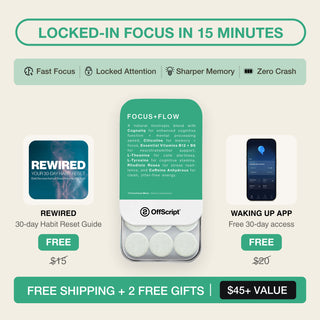
The rule: your normal dose, timed to peak at the start, + paired if possible. The caffeine + L-Theanine combination improved attention + reduced tiredness beyond caffeine alone in controlled trials (Haskell et al., 2008); (Kahathuduwa et al., 2017), which is exactly the calm-alert profile an exam wants. This is the slot FOCUS+FLOW was built for: 100mg caffeine + 150mg L-Theanine in a sublingual mint that works in about fifteen minutes, so you can take it walking into the building rather than guessing when a coffee will land. Every dose printed, + for a long multi-section exam, a second mint at the halfway break beats a giant morning dose that has faded by the final section.
The Last Thirty Minutes: Arrive, Breathe, Start
Arrive early enough to be bored. Rushing floods you with adrenaline you will spend section one paying down. In the final minutes, skip the frantic flashcard scroll, it retrieves nothing + spikes arousal, + spend two minutes on long exhales instead: in for four, out for six to eight. Exam nerves are the same physiology as stage nerves, + the same lever works; the deeper version of that protocol is in How to Stay Calm Before a Presentation.
Then start with what you know. Momentum on early questions recalibrates your nervous system from threat to task, + the first ten minutes of composed work sets the tone for the rest.
Multi-Day Exams + The Aftermath
For bar-style multi-day exams, the protocol repeats, which means the evening matters: no caffeine within six hours of bed, or day two starts in a hole (Drake et al., 2013). Wind down with a walk + an early night rather than a post-mortem of day one; the review changes nothing + costs sleep. If exam season has your baseline stress pinned high for weeks, the longer-horizon toolkit is in Best Supplements for Anxiety.
SHARP WHEN IT COUNTS
Caffeine + L-Theanine, timed to the minute you sit down. Every dose printed.
SHOP FOCUS+FLOWKey Takeaways
- Protect the final three nights of sleep; consolidation + alertness are built there, not in a last cram.
- Protein-forward breakfast, normal hydration, no glucose-spike fuel.
- Your usual caffeine dose, timed to peak at the start, ideally paired with L-Theanine for calm alertness.
- Two minutes of long exhales beats thirty minutes of frantic review in the final window.
- Nothing new on test day. Rehearse the whole protocol on practice-test mornings first.
Explore The Series
- How to Stay Calm Before a Presentation
- L-Theanine + Caffeine: The Focus Stack
- The High-Performance Guide to Focus + Flow State
- Best Supplements for Anxiety
References
- Van Dongen HP, Maislin G, Mullington JM, Dinges DF. The cumulative cost of additional wakefulness: dose-response effects on neurobehavioral functions from chronic sleep restriction and total sleep deprivation. Sleep. 2003;26(2):117-126. PubMed
- Fredholm BB, Bättig K, Holmén J, Nehlig A, Zvartau EE. Actions of caffeine in the brain with special reference to factors that contribute to its widespread use. Pharmacol Rev. 1999;51(1):83-133. PubMed
- Haskell CF, Kennedy DO, Milne AL, Wesnes KA, Scholey AB. The effects of L-theanine, caffeine and their combination on cognition and mood. Biol Psychol. 2008;77(2):113-122. PubMed
- Kahathuduwa CN, Dassanayake TL, Amarakoon AMT, Weerasinghe VS. Acute effects of theanine, caffeine and theanine-caffeine combination on attention. Nutr Neurosci. 2017;20(6):369-377. PubMed
- Drake C, Roehrs T, Shambroom J, Roth T. Caffeine effects on sleep taken 0, 3, or 6 hours before going to bed. J Clin Sleep Med. 2013;9(11):1195-1200. PubMed
FAQ
What should I take on test day for focus?
Your normal caffeine dose, nothing more, ideally paired with L-Theanine for calm alertness rather than jitter; that combination has repeated controlled-trial support. Time it to peak as the exam starts. And take nothing you have not already used on a practice-test morning; test day is not the day for experiments.
Should I pull an all-nighter before an exam?
No. Memory consolidates during sleep, so the all-nighter converts prepared material into half-remembered material while degrading the attention you need to use it. If time is short, sleep + a rested morning review beats a ragged night of cramming, every time.
What should I eat before a big exam?
Protein + fat forward: eggs, yogurt, nuts, oats. Skip the juice-and-pastry breakfast; the glucose spike it buys becomes a below-baseline dip right in the middle of the test. Hydrate normally rather than heroically.
How much caffeine should I have before a test?
Exactly your usual amount, timed so it peaks at the start. Skipping it adds withdrawal fog; doubling it adds jitters to exam adrenaline. For long exams, a smaller second dose at the break outperforms one giant morning dose that fades by the final section.
How do I stop test anxiety on exam morning?
Arrive early enough to be bored, skip the last-minute flashcard scroll, + spend two minutes on slow exhales, in for four, out for six to eight, before you walk in. Then open with questions you know to build momentum. Arousal peaks at the start + settles once you are working.
These statements have not been evaluated by the Food and Drug Administration. This product is not intended to diagnose, treat, cure, or prevent any disease.
