




People ask this question from two very different places. Some have a new prescription + want to know whether what they are feeling is what they are supposed to feel. Others do not have ADHD + are wondering what the fuss is about. The honest answer covers both, because the same drug produces noticeably different experiences depending on the brain it lands in, + the difference explains most of what matters about stimulants.
What The Drug Actually Does
Adderall is mixed amphetamine salts. Mechanically it increases the amount of dopamine + norepinephrine signaling in the brain, both by triggering release + by slowing reuptake. Those two neurotransmitters carry the drive + alertness signals: dopamine makes effort feel worth spending, norepinephrine tunes arousal + attention. Turn both up + tasks feel more grabbable, effort feels cheaper, + the fog of competing thoughts quiets. That is the shared core of the experience for everyone. What differs is what that amplification lands on.
With ADHD: Quieter, Not Higher
Many people with ADHD describe a well-dosed stimulant not as stimulation but as relief: the mental noise drops, one thought can be held at a time, starting a task stops requiring a running start. Some describe feeling calmer, + parents of treated kids often say the same thing, which surprises people who expect speed to look like speeding up.
The usual explanation: in a brain where dopamine + norepinephrine signaling runs below the level attention needs, the medication moves the system toward a functional range. The subjective result is organization, not euphoria. Being effectively dosed usually feels like an ordinary, boring, productive day, + that is the goal. If instead a prescribed dose feels like being wired, euphoric, or chemically flattened, that is exactly the feedback prescribers adjust doses on; say it plainly at the follow-up.
Without ADHD: The Loan You Pay Back
In a brain whose baseline signaling is already in range, the same amplification overshoots. The common description is energy, confidence + a sense of enhanced focus, sometimes edging into euphoria at higher doses, which is precisely why amphetamine is a Schedule II controlled substance with recognized dependence potential. Three honest footnotes belong next to that description.
First, the felt productivity + the real thing are not the same: studies of stimulants in people without ADHD have repeatedly found the sense of improvement outrunning measured performance, which sometimes does not improve at all. Second, the comedown is part of the pharmacology, not a user error: what goes up on borrowed signaling comes down through the same door, as fatigue, flatness + irritability. Third, sleep pays the bill. None of this is moralizing; it is the mechanism. A brain that did not need the loan still has to repay it.
Why This Difference Matters
The same-drug-different-brains contrast is the cleanest illustration of what medication is: a tool matched to a diagnosed deficit, prescribed + titrated by someone accountable for the outcome. It is also why "my friend takes it + feels amazing" tells you nothing about what it would do for you, + why self-diagnosing from a borrowed pill muddies the picture an actual assessment would clarify. If you suspect ADHD, the useful move is an evaluation, not an experiment. We wrote the honest version of what supplements can + cannot do in that situation in Natural Supplements for ADHD Adults.
The Part Where We Are Biased, Labeled Clearly
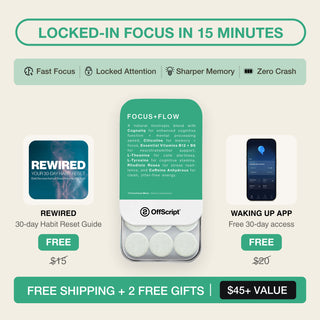
We make FOCUS+FLOW, a natural focus mint, so here is our stake stated outright: it is not comparable to Adderall, it does not treat ADHD, + anyone who implies a supplement replicates a Schedule II stimulant is lying to you. What it is: 100mg caffeine balanced with 150mg L-theanine, the attention pairing with replicated controlled-trial support in healthy adults (Haskell et al., 2008), with L-tyrosine as dopamine raw material for demanding stretches (Jongkees et al., 2015), rhodiola, CognatiQ + B vitamins, every dose printed. For people who were never candidates for a prescription + want clean, legal, fast focus, that is the honest lane a supplement lives in.
CLEAN FOCUS, NO SCRIPT
Balanced caffeine + printed doses, in a mint that works in about fifteen minutes.
SHOP FOCUS+FLOWKey Takeaways
- Adderall increases dopamine + norepinephrine signaling; the felt result depends on the brain's baseline.
- With ADHD, an effective dose typically feels like quiet + organization, not euphoria. Wired or flat means talk to your prescriber.
- Without ADHD, the same amplification overshoots: energy + confidence, with felt productivity often exceeding measured performance, plus a real comedown.
- The difference is why prescriptions are matched to diagnoses, + why a borrowed pill answers nothing.
- No supplement replicates a stimulant. Suspected ADHD deserves an assessment, not an experiment.
Explore The Series
- How Long Does Vyvanse Last?
- Where Is Adderall Illegal? Stimulant Rules by Country
- Life After Adderall: Rebuilding Focus Without the Prescription
- The ADHD Dopamine Crash
References
- Faraone SV. The pharmacology of amphetamine and methylphenidate: relevance to the neurobiology of ADHD. Neurosci Biobehav Rev. 2018;87:255-270. PubMed
- Ilieva I, Boland J, Farah MJ. Objective and subjective cognitive enhancing effects of mixed amphetamine salts in healthy people. Neuropharmacology. 2013;64:496-505. PubMed
- Haskell CF, Kennedy DO, Milne AL, Wesnes KA, Scholey AB. The effects of L-theanine, caffeine and their combination on cognition and mood. Biol Psychol. 2008;77(2):113-122. PubMed
- Jongkees BJ, Hommel B, Kühn S, Colzato LS. Effect of tyrosine supplementation on clinical and healthy populations under stress or cognitive demands: a review. J Psychiatr Res. 2015;70:50-57. PubMed
FAQ
How is Adderall supposed to feel if you have ADHD?
At an effective dose, most people describe quiet + organization rather than stimulation: less mental noise, easier task initiation, a boringly productive day. If a prescribed dose feels wired, euphoric or emotionally flattened, that is dose-adjustment feedback your prescriber needs to hear.
What does Adderall feel like without ADHD?
Typically energy, confidence + a sense of sharpened focus, sometimes euphoric at higher doses, because the amplification lands on a system already in range. Research has repeatedly found the felt improvement outrunning measured performance, + the comedown, fatigue, flatness, irritability, is part of the pharmacology.
Does feeling calm on a stimulant mean I have ADHD?
No single reaction is diagnostic; responses vary in both directions + a pill is not an assessment. If the question matters to you, a clinical evaluation answers it properly. Self-testing with someone else's medication is illegal, risky, + muddies the diagnostic picture.
Is there a natural supplement that feels like Adderall?
No, + distrust anyone who says otherwise. The mechanisms + effect sizes are not comparable. What the evidence supports for supplements: caffeine balanced with L-theanine for clean attention, + L-tyrosine for demanding stretches, studied in healthy adults. Useful, legal + honest, but a different category of thing.
This article is educational + is not medical advice. It does not recommend starting, stopping or changing any medication, + it does not encourage non-prescribed stimulant use. FOCUS+FLOW is a dietary supplement; it does not treat ADHD or any condition. These statements have not been evaluated by the Food and Drug Administration. This product is not intended to diagnose, treat, cure, or prevent any disease. Adderall® is a trademark of its owner; OffScript is not affiliated with it.