




In 1998, researchers gave healthy volunteers two grams of curcumin — a serious dose of the compound behind turmeric's reputation. Then they went looking for it in the bloodstream. They could barely find any. Blood levels were, in the researchers' own words, either undetectable or extremely low. Two grams in, effectively nothing out. Then they added 20mg of piperine, the active compound in black pepper, and ran it again. Curcumin availability rose by 2,000%.
Same molecule. Same dose. Twenty-fold difference in what actually reached the body. That gap has a name, and understanding it will change how you read every supplement label you pick up from here on out.
What is bioavailability, exactly?
Bioavailability is the fraction of a dose that reaches your systemic circulation in an active form — the blood that actually travels to your brain, your muscles, your cells. It's expressed as a percentage. An intravenous dose is 100% bioavailable by definition: it goes straight into the vein, no obstacles. Everything you swallow is measured against that benchmark, and almost everything you swallow falls short.
This is the number the supplement industry would rather you not think about, because the front of the bottle advertises the dose while bioavailability determines the delivery. A label reading "500mg" tells you what went into the capsule. It tells you nothing about what makes it to your bloodstream — and depending on the compound + the form it's in, that could be 95% or it could be under 1%.
The reason isn't a conspiracy. It's anatomy. Anything you swallow has to survive a gauntlet before it counts.
The first-pass problem: why your liver takes a cut
Swallow a capsule and it lands in your stomach, where acid begins breaking it down. What survives passes into the small intestine, where it has to dissolve, cross the intestinal wall, and enter the bloodstream. But that blood doesn't head straight for your brain. It drains into the hepatic portal vein, which routes everything through your liver first.
Your liver is the body's quality-control checkpoint. Its enzymes — principally the cytochrome P450 family — chemically modify anything they don't recognize, tagging compounds for excretion before they ever reach general circulation. Pharmacologists call this the first-pass effect, and it can decimate a dose. Some drugs require oral doses many times larger than their intravenous equivalents purely to compensate for what the liver strips out on the way through. The gut wall does some of this metabolism too, before the liver even gets a turn.
This is why intravenous morphine and oral morphine are dosed so differently, and it's why the same logic applies to nutrients + botanicals. Curcumin isn't poorly absorbed because it's weak. It's poorly absorbed because it gets conjugated and cleared with remarkable efficiency. Piperine works by slowing that clearance — not by adding more curcumin, but by letting more of what's already there survive the trip.
Form decides the dose: same nutrient, different outcome
Here's where bioavailability stops being academic and starts costing you money. Two supplements can list the identical nutrient at the identical milligram count and deliver meaningfully different results, because the form of the compound determines how much of it dissolves + crosses into you.
Magnesium is the cleanest example. Magnesium oxide is cheap, packs a high percentage of elemental magnesium by weight, and is practically insoluble in water — it depends on stomach acid to break it apart before any absorption can happen. Organic salts like citrate and glycinate dissolve readily and present magnesium ions ready for uptake along the gut. In a randomized crossover study, researchers found higher bioavailability from magnesium citrate than from magnesium oxide, measured by both urinary excretion + serum levels. The label on the oxide bottle may show a bigger number. The bottle isn't lying — it's just answering a different question than the one you care about.
The same principle runs through every category. Choline sources differ in how efficiently they cross into the brain. Chelated minerals behave differently from inorganic salts. Fat-soluble compounds absorb far better alongside a meal containing fat. None of this is exotic chemistry. It's just the part of the label nobody prints.
Why sublingual and buccal absorption change the math
There's one way to sidestep the first-pass problem entirely: don't go through the gut. The tissue lining your mouth is richly supplied with blood vessels that drain into the jugular vein and then into general circulation — bypassing the hepatic portal vein and the liver's first swipe altogether. That's the entire reason sublingual nitroglycerin works within minutes for angina while a swallowed version would be far too slow and far too degraded to help.
The mouth isn't uniform, either. The sublingual mucosa under the tongue is thinner and more heavily vascularized than the buccal mucosa of the inner cheek, which makes it more permeable and faster — but also more exposed to saliva washing a formulation away before it has time to absorb. Buccal tissue is slower, but it holds contact longer. Formulation scientists trade between those two properties constantly, and the practical answer for most real-world products is: let it sit in the mouth and dissolve slowly, so both surfaces get a turn.
Be honest about the limits, though. Transmucosal absorption favors smaller, more lipid-friendly molecules; larger or highly water-loving compounds cross poorly and end up swallowed anyway. Nobody gets 100% of every ingredient through the cheek. But the fraction that does cross there skips the liver entirely — and it starts working in minutes rather than in the 30 to 90 minutes a capsule typically needs to clear the stomach and dissolve.
How Focus+Flow is built around absorption, not just dosage
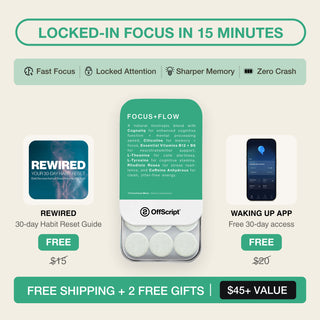
This is the reasoning behind making Focus+Flow a fast-dissolving mint rather than another capsule. A mint held in the mouth gives its ingredients direct, extended contact with sublingual + buccal tissue before anything is swallowed. Some of the payload takes the direct route into circulation. The rest follows the normal path. You get a faster onset than a capsule allows, without pretending the mouth is a magic bypass for everything in the formula.
Patented coffee-fruit extract, clinically studied to support BDNF.
Calm, focused attention without the jitters.
Dopamine precursor for drive + focus under pressure.
Adaptogen that supports mental stamina under stress.
Clean, measured energy — smoothed by L-Theanine.
Raw material for acetylcholine, the memory + learning neurotransmitter.
Supports neurotransmitter production.
Supports cellular energy.
Not every ingredient here has the same absorption story, and that's the point of naming them individually. Caffeine anhydrous is one of the rare compounds that's almost completely absorbed orally with no meaningful first-pass loss — which is exactly why it's dosed at a measured 100mg rather than the 200mg-plus you'll find in energy products. When you know a compound arrives nearly intact, you don't need to overshoot. L-Theanine at 150mg is there to smooth that caffeine into calm alertness. CognatiQ is dosed at 100mg because that's the amount used in the published human research, not a rounder number that looks better on a label.
FOCUS ON COMMAND
A fast-dissolving mint built around how ingredients actually get absorbed — not just how they read on a label.
SHOP FOCUS+FLOWThe takeaway
So: what is bioavailability, in one sentence? It's the difference between the supplement you bought and the supplement you actually received. Every milligram on a label is a claim about the capsule. Bioavailability is the claim about you — and it depends on the form of the compound, the route it takes, and how much of it your liver decides to clear before it ever gets a chance to work.
You don't need a pharmacology degree to use this. You need to ask two questions of anything you're considering: what form is this ingredient in, and how is it getting into me. Brands that have thought carefully about both will tell you without being asked. Brands that haven't will keep pointing at the dose.
If you'd like a focus formula that was designed around the second question as seriously as the first, take a look at Focus+Flow and try it for yourself. Your body already knows what to do with good raw materials. The job is getting them there.
Key Takeaways
- Bioavailability is the percentage of a dose that reaches your bloodstream in active form — an IV dose is 100% by definition, and everything swallowed is measured against it.
- The first-pass effect routes everything absorbed from your gut through the liver, where P450 enzymes clear a portion of it before it reaches circulation.
- Form matters as much as dose: magnesium citrate showed higher bioavailability than magnesium oxide in a randomized crossover trial, and piperine raised curcumin availability by 2,000%.
- Sublingual + buccal absorption bypasses the liver's first pass entirely for the fraction that crosses — faster onset, less waste, but it favors smaller lipid-friendly molecules.
- Focus+Flow is a fast-dissolving mint for this reason, with doses set to match the research rather than to look impressive on a label.
Explore The Series
- Citicoline vs. Alpha-GPC: Which Choline Source Actually Delivers
- Magnesium Glycinate: Benefits for Stress and Sleep
- Natural vs. Synthetic: An Honest Breakdown
References
- Shoba G, Joy D, Joseph T, et al. "Influence of piperine on the pharmacokinetics of curcumin in animals and human volunteers." Planta Medica, 1998;64(4):353–356. https://pubmed.ncbi.nlm.nih.gov/9619120/
- Herman TF, Santos C. "First-Pass Effect." StatPearls, NCBI Bookshelf, National Library of Medicine. https://www.ncbi.nlm.nih.gov/books/NBK551679/
- Kappeler D, Heimbeck I, Herpich C, et al. "Higher bioavailability of magnesium citrate as compared to magnesium oxide shown by evaluation of urinary excretion and serum levels after single-dose administration in a randomized cross-over study." BMC Nutrition, 2017;3:7. https://link.springer.com/article/10.1186/s40795-016-0121-3
- Bassi da Silva J, et al. "Oral Mucosa Models to Evaluate Drug Permeability." Pharmaceutics, 2023;15(5):1559. https://pmc.ncbi.nlm.nih.gov/articles/PMC10220859/
- Evans J, Richards JR, Battisti AS. "Caffeine." StatPearls, NCBI Bookshelf, National Library of Medicine. https://www.ncbi.nlm.nih.gov/books/NBK519490/
FAQ
What is bioavailability in simple terms?
Bioavailability is the percentage of a dose that actually reaches your bloodstream in an active form. An intravenous dose is defined as 100% bioavailable because it enters the vein directly. Anything you swallow has to survive stomach acid, dissolve, cross the gut wall, and pass through the liver first — so the amount printed on the label is almost always more than the amount you receive.
Why does the first-pass effect reduce how much of a supplement works?
Blood leaving your intestines drains into the hepatic portal vein, which routes it through the liver before it reaches general circulation. Liver enzymes, mainly the cytochrome P450 family, chemically modify unfamiliar compounds and tag them for excretion. Whatever gets cleared on that first pass never reaches your brain or muscles. Some compounds lose the majority of a dose this way.
Does the form of an ingredient really change absorption that much?
Yes, and often dramatically. Magnesium oxide is practically insoluble in water and relies on stomach acid to break down, while magnesium citrate dissolves readily — and a randomized crossover study measured higher bioavailability from the citrate form. Curcumin is another case: pairing it with piperine raised its measured availability by 2,000% in human volunteers. Same nutrient, very different delivery.
How does sublingual or buccal absorption improve bioavailability?
The tissue lining your mouth is densely vascularized and drains into the jugular vein rather than the hepatic portal vein, so whatever absorbs there enters circulation without passing through the liver first. That means faster onset and no first-pass loss for the fraction that crosses. The sublingual mucosa under the tongue is thinner and more permeable than the inner cheek, though saliva can wash a formulation away before it finishes absorbing.
Does everything in a dissolvable mint absorb through the mouth?
No, and any brand claiming otherwise is overstating it. Transmucosal absorption favors smaller, more lipid-friendly molecules; larger or highly water-soluble compounds cross poorly and are ultimately swallowed and absorbed through the gut like anything else. A dissolvable format gives ingredients extended contact with mouth tissue so part of the dose takes the direct route, with the remainder following the normal path.