




The crash is the part nobody warns you about properly. The medication works, the day goes well, + then somewhere in the late afternoon it falls out from under you: flat, irritable, foggy, occasionally tearful, + often hungrier than you have been all day.
It has a mechanism, + understanding it tells you which fixes are real + which are marketing.
What Is Actually Happening
Stimulant medication increases availability of dopamine + noradrenaline in the brain. As the dose clears, that availability drops back, + because you have spent the day above your own baseline, the return does not feel neutral. It feels like a deficit.
Three things stack on top of that.
You probably did not eat. Appetite suppression is one of the most reliable effects of stimulants. A lot of what people call a crash is a person who has had coffee + nothing else since 8AM meeting a blood sugar floor at 4PM.
You probably did not sleep well. The medication taken too late, or a night of poor sleep from yesterday's dose, compounds into the following afternoon.
You may have worked straight through. Sustained high focus without breaks has its own cost, medicated or not.
That matters because it means most of the crash is addressable without adding anything to your system.
What Actually Helps
Eat, on a schedule, whether or not you are hungry
This is the single highest-yield change + the one people skip because the hunger cue is chemically switched off. Protein-forward breakfast before or alongside the dose, + a real lunch on a timer rather than on appetite. Set an alarm if you need to. A great deal of the 4PM collapse is simply food.
Fix the timing before you touch the dose
With your prescriber. Sometimes an earlier dose, a different release profile, or a small adjustment to when the second dose lands removes the worst of it. Timing is usually the lever, + it is theirs to pull, not yours.
Protect sleep aggressively
Stimulants taken late degrade sleep, poor sleep worsens next-day symptoms + makes the next crash harder. It is a loop, + sleep is the place to break it.
Put a low-demand hour where the crash lands
If you know it arrives at 4PM, stop scheduling anything cognitively expensive there. Admin, walking, email. Working with the curve beats fighting it.
Move
A short walk at the onset does more than most people expect, + it is the cheapest intervention available.
What About Supplements
Being straight here, since we sell one.
Do not stack caffeine onto a stimulant to smooth a crash without asking your prescriber. Both are stimulants. Adding caffeine can raise heart rate + blood pressure, worsen anxiety, + push the crash later rather than removing it. It matters more if you have a heart condition, high blood pressure or an anxiety disorder.
L-tyrosine gets recommended constantly here, on the logic that it is a dopamine precursor. The evidence supports benefit under acute stressors that deplete catecholamines, such as sleep deprivation. It has not been shown to resolve a medication comedown, + we are not going to imply it does.
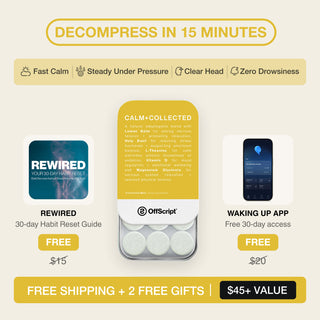
Magnesium + L-theanine are reasonable for the jagged, wired-but-flat edge some people get, + neither is a stimulant. The magnesium evidence on anxiety + stress is real but modest, + the key review described it as suggestive while limited by study quality (Boyle et al., 2017). L-theanine has good acute data on the stress response (Evans et al., 2021).
Food, sleep + timing outperform all of it. If you only change one thing, change lunch.
If You Are Not On Medication
Plenty of people searching this are describing a caffeine comedown instead, which follows a similar shape for different reasons + is far more tractable.
Caffeine alone raises arousal without doing much for the quality of attention, which is why a large coffee can leave you wired, scattered + then hollow. The most replicated fix is pairing it with L-theanine, which improved accuracy on demanding attention-switching tasks + reduced distractibility, with EEG work showing alpha-band changes consistent with sustained attention.
Dose size matters too. A smaller amount earlier beats a large amount at noon, + it is usually the total that produces the fall.
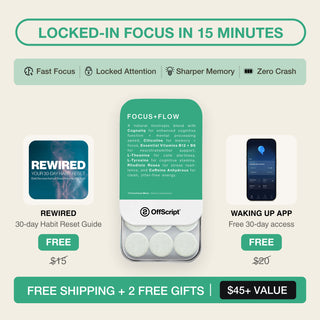
Patented coffee-fruit extract, clinically studied to support BDNF.
Calm, focused attention without the jitters.
Dopamine precursor for drive + focus under pressure.
Adaptogen that supports mental stamina under stress.
Clean, measured energy, smoothed by L-Theanine.
Raw material for acetylcholine, the memory + learning neurotransmitter.
Supports neurotransmitter production.
Supports cellular energy.
100mg of caffeine, about a cup of coffee. If you are prescribed a stimulant, clear it with your prescriber before adding it.
Key Takeaways
- The crash is the return from an elevated dopamine + noradrenaline state, which reads as a deficit rather than neutral.
- Appetite suppression means much of it is unrecognised low blood sugar. Eat on a schedule, not on hunger.
- Timing + formulation are usually the real lever, + that is a prescriber decision.
- Poor sleep and the crash reinforce each other. Sleep is where the loop breaks.
- Do not add caffeine to a prescription stimulant without asking your prescriber.
- A consistently harsh crash is clinical information worth reporting, not something to endure.
Explore The Series
- The ADHD Dopamine Crash
- What Does Adderall Feel Like?
- Life After Adderall: Rebuilding Focus
- OTC Adderall Alternatives
- The 2PM Crash Isn't A Willpower Problem
- Clean Energy Without The Crash
References
- Boyle NB, Lawton C, Dye L. The effects of magnesium supplementation on subjective anxiety and stress: a systematic review. Nutrients. 2017. PubMed
- Evans M, et al. A Randomized, Triple-Blind, Placebo-Controlled, Crossover Study to Investigate the Efficacy of a Single Dose of AlphaWave L-Theanine on Stress in a Healthy Adult Population. Neurol Ther. 2021. PubMed
- Owen GN, et al. The combined effects of L-theanine and caffeine on cognitive performance and mood. Nutritional Neuroscience. 2008. PubMed
- Kelly SP, et al. L-theanine and caffeine in combination affect human cognition as evidenced by oscillatory alpha-band activity and attention task performance. Journal of Nutrition. 2008. PubMed
FAQ
Why does Adderall make you crash?
Stimulant medication raises availability of dopamine and noradrenaline, and as the dose clears that availability falls back toward baseline. Because you have spent the day above your own baseline, the return registers as a deficit rather than as neutral. Skipped meals from appetite suppression and poor sleep both make it considerably worse.
How long does an Adderall crash last?
It varies with dose, formulation and individual metabolism, and typically occupies the late afternoon or early evening as the dose clears. A crash that is consistently severe or long is worth reporting to your prescriber, because it often indicates the dose, timing or release profile is not the right fit rather than something you have to tolerate.
What helps with an Adderall crash?
Eating on a schedule rather than on hunger is the highest-yield change, since appetite suppression means many people have not eaten properly before the crash arrives. Beyond that: protecting sleep, scheduling low-demand work into the window where it lands, and a short walk at onset. Timing and formulation adjustments help but are a prescriber decision.
Can I take caffeine to stop an Adderall crash?
Ask your prescriber before combining them. Both are stimulants, and stacking them can raise heart rate and blood pressure and increase anxiety and sleep disruption. It also tends to postpone the comedown rather than remove it. This matters more if you have a heart condition, high blood pressure or an anxiety disorder.
Does L-tyrosine help with a stimulant crash?
It is commonly recommended on the basis that it is a dopamine precursor, but the evidence supports a narrower claim: benefit under acute stressors that deplete catecholamines, such as sleep deprivation or high cognitive load. It has not been shown to resolve a medication comedown, and anyone telling you otherwise is going beyond the research.
These statements have not been evaluated by the Food and Drug Administration. This product is not intended to diagnose, treat, cure, or prevent any disease. This article is educational and is not medical advice.