




Between 2016 and 2021, the share of commercially insured Americans filling at least one prescription stimulant rose from 3.6% to 4.1%, with the steepest increases among adults aged 25–44, according to the CDC's Morbidity and Mortality Weekly Report. Some of those people have a diagnosis and a treatment plan that works. Plenty of others are simply searching for the best natural Adderall alternatives before they ever get to a prescription pad — because they'd rather support their attention than borrow against it.
This page is the short version: a comparison, not a manifesto. If you want the long-form walkthrough of the whole category, read our full guide to focusing without Adderall. What follows here is the shortlist — which natural ingredients have a real mechanism behind them, what each one actually does, + where the honest limits are.
First, What "Alternative" Should and Shouldn't Mean
A quick line in the sand, because it matters. Adderall is a prescription amphetamine used under medical supervision for a diagnosed condition. Nothing on this page treats, cures, or replaces it, and no supplement should be positioned that way. If you're currently prescribed a stimulant, do not stop or adjust it based on a blog post — that's a conversation for you + your prescribing clinician.
What "alternative" means here is narrower + more useful: an everyday, non-prescription option for people who want sharper focus, better recall, + steadier energy, and who'd prefer to get there by feeding their own neurochemistry rather than forcing it. That's an informed choice, not a medical one.
How to Judge the Best Natural Adderall Alternatives
The supplement aisle is where good intentions go to get confused. Four filters cut through most of it.
Is there a named mechanism? Not "supports brain health" — an actual pathway. Does the compound serve as a precursor to a neurotransmitter, a cofactor in its synthesis, or a signal that changes something measurable? If a label can't tell you how, treat the claim as decoration.
Is the dose disclosed? "Proprietary blend" usually means the studied ingredient is present in trace amounts, riding along on the reputation of research it isn't replicating. Real doses, printed on the label, or move on.
Is the research on humans? Rodent data is a hypothesis, not evidence for you. Look for randomized, placebo-controlled trials in people.
What's the trade-off? Everything has one. Prescription stimulants trade fast, strong effects for tolerance risk + a side-effect profile that a review in Brain and Behavior catalogs plainly: appetite suppression, insomnia, elevated heart rate + blood pressure, irritability, and the afternoon crash. Natural alternatives trade a subtler, slower-building effect for a gentler profile. Any brand claiming both strength + zero trade-off is selling you something.
The Shortlist: Ingredients That Earn Their Place
Judged against those filters, a handful of compounds survive. Here's what each does + why it's on the list.
CognatiQ — the one that isn't a stimulant at all
Brain-derived neurotrophic factor (BDNF) is closer to fertilizer than fuel: it supports the growth, maintenance, + survival of the neurons involved in learning + memory. CognatiQ is a patented whole coffee fruit extract studied specifically for its effect on it. In a study published in the British Journal of Nutrition, a single 100 mg dose of whole coffee fruit concentrate raised plasma BDNF by roughly 143% within two hours. That's a category apart from anything a stimulant does — it supports the cellular infrastructure that thinking runs on, rather than draining the account.
L-Theanine + Caffeine — the most reliable pairing in the category
Caffeine sharpens alertness and, past a point, tips into jitter. L-theanine, an amino acid from tea leaves, files down that edge. Together they outperform either alone: a controlled study in The Journal of Nutrition found the combination improved accuracy on demanding attention-switching tasks + reduced susceptibility to distraction, alongside shifts in alpha-band brain activity associated with relaxed focus. If you only adopt one thing from this list, adopt this pair.
L-Tyrosine — insurance for high-pressure days
L-tyrosine is the amino acid your body converts into dopamine + norepinephrine — the same messengers a stimulant exploits, approached from the supply side instead. Under stress or heavy cognitive load, the brain spends these catecholamines faster than it makes them. A review in Neuroscience & Biobehavioral Reviews found tyrosine supplementation supports cognitive performance specifically in demanding or stressful conditions, apparently by replenishing what stress depletes. Notably, it does very little on an easy day. That specificity is a point in its favor, not against it.
Citicoline — raw material for the attention neurotransmitter
Choline is what your body uses to build acetylcholine, the neurotransmitter central to attention + memory, and to construct the phospholipids that make up healthy neuron membranes. Citicoline is the best-studied way to deliver it: in a randomized, double-blind, placebo-controlled trial, citicoline improved memory performance versus placebo in healthy older adults. That's the form Focus+Flow uses — the label reads Choline (as Citicoline), 18mg, listing the nutrient first and its source form in parentheses.
Rhodiola Rosea — the honest asterisk
Rhodiola is an adaptogen with a long traditional record for mental stamina under stress. A randomized, double-blind, placebo-controlled trial of SHR-5 rhodiola extract reported an antifatigue effect on capacity for mental work in people operating under fatigue + stress. It's fair to note that a 2012 systematic review found the overall body of evidence contradictory and methodologically uneven. We include rhodiola because the fatigue-resistance signal is real + repeated; we're not going to pretend it's settled.
Rounding it out: B6 + B12 are cofactors in neurotransmitter synthesis + cellular energy metabolism — unglamorous, but they're the machinery that turns precursors into usable brain chemistry.
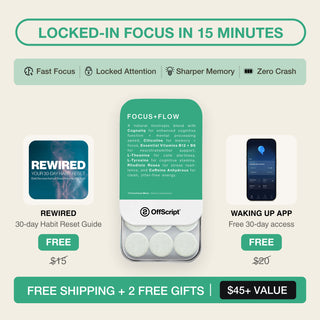
Here's how that shortlist looks assembled, at the doses printed on OffScript's Focus+Flow label:
Patented coffee-fruit extract, clinically studied to support BDNF.
Calm, focused attention without the jitters.
Dopamine precursor for drive + focus under pressure.
Adaptogen that supports mental stamina under stress.
Clean, measured energy — smoothed by L-Theanine.
Raw material for acetylcholine, the memory + learning neurotransmitter.
Supports neurotransmitter production.
Supports cellular energy.
FOCUS ON COMMAND
The shortlist, assembled at disclosed doses — no proprietary blend, no crash.
SHOP FOCUS+FLOWWhat the Best Natural Adderall Alternatives Won't Do
The part most comparison posts skip. Natural alternatives will not feel like amphetamine. They don't flood the synapse, and the first dose won't feel like a switch flipping. Anyone promising otherwise is either lying or has added something that shouldn't be in a supplement.
They also aren't a treatment. They don't diagnose, treat, or cure any condition, ADHD very much included. If focus problems are genuinely disruptive to your work or relationships, that deserves a real evaluation by a healthcare professional — not a self-directed experiment with capsules. And if you're already prescribed a stimulant, pregnant, nursing, sensitive to caffeine, or taking any medication, talk to your clinician before adding anything.
What they do offer is a different shape of benefit: support that accumulates, a side-effect profile that doesn't compound against you, + no rebound to pay back at 3pm. For a lot of high-functioning people, that trade is the right one — and it's a choice you get to make with your eyes open rather than by default.
If that sounds like the trade you'd take, try Focus+Flow for yourself and see how a clear head feels when it's supported rather than forced.
Key Takeaways
- Prescription stimulant fills rose from 3.6% to 4.1% of commercially insured Americans between 2016 and 2021, with the sharpest rise among adults 25–44.
- Judge any natural alternative on four things: a named mechanism, a disclosed dose, human trial data, + an honest trade-off.
- The ingredients that survive that filter: CognatiQ for BDNF, L-theanine + caffeine for calm alertness, L-tyrosine for pressure, citicoline for acetylcholine, rhodiola for mental stamina.
- These work on the supply side — feeding the brain's own production line rather than forcing existing neurotransmitters harder.
- None of them treat any condition or replace prescribed medication. Don't stop or change a prescription without your clinician.
Explore The Series
- Natural Focus Supplements: The Complete Guide to Focusing Without Adderall
- The Prescription Cycle: Why Stimulants Aren't the Answer
- The L-Theanine + Caffeine Focus Stack
References
- Danielson ML, et al. Trends in Stimulant Prescription Fills Among Commercially Insured Children and Adults — United States, 2016–2021. MMWR, CDC, 2023.
- Lakhan SE, Kirchgessner A. Prescription stimulants in individuals with and without ADHD: misuse, cognitive impact, and adverse effects. Brain and Behavior, 2012.
- Reyes-Izquierdo T, et al. Modulatory effect of coffee fruit extract on plasma levels of brain-derived neurotrophic factor in healthy subjects. British Journal of Nutrition, 2013.
- Owen GN, et al. L-Theanine and caffeine in combination affect human cognition as evidenced by oscillatory alpha-band activity and attention task performance. The Journal of Nutrition, 2008.
- Jongkees BJ, et al. Effect of tyrosine supplementation on clinical and healthy populations under stress or cognitive demands — A review. Neuroscience & Biobehavioral Reviews, 2015.
- Nakazaki E, et al. Citicoline and Memory Function in Healthy Older Adults: A Randomized, Double-Blind, Placebo-Controlled Clinical Trial. The Journal of Nutrition, 2021.
- Shevtsov VA, et al. A randomized trial of two different doses of a SHR-5 Rhodiola rosea extract versus placebo and control of capacity for mental work. Phytomedicine, 2003.
- Ishaque S, et al. Rhodiola rosea for physical and mental fatigue: a systematic review. BMC Complementary and Alternative Medicine, 2012.
FAQ
What are the best natural Adderall alternatives?
Judged on mechanism, dose transparency, + human trial data, the strongest candidates are CognatiQ (a patented coffee fruit extract studied for raising BDNF), the L-theanine and caffeine pairing for calm alertness, L-tyrosine as a dopamine precursor for high-pressure work, citicoline as the raw material for acetylcholine, and rhodiola rosea for mental stamina under fatigue. None of these is a substitute for prescribed medication.
Can a natural alternative replace my Adderall prescription?
No. Adderall is a prescription medication used under medical supervision for a diagnosed condition, and nothing sold as a supplement treats or replaces it. Do not stop or adjust a prescription based on anything you read online — that decision belongs to you + your prescribing clinician.
How strong will a natural alternative feel?
Subtler than a stimulant, and that's by design. Prescription stimulants force your existing dopamine + norepinephrine to work harder, which produces a strong, immediate effect. Supply-side ingredients give your brain precursors + cofactors to work with, so the benefit builds over days rather than arriving in an hour. Give it about two weeks before you judge.
Does Focus+Flow contain citicoline?
Yes. The label reads Choline (as Citicoline), 18mg — standard supplement-facts format, where the nutrient comes first and its source form sits in parentheses. So the choline in Focus+Flow is delivered as citicoline, the same well-studied form used in the memory research cited above.
Is it safe to combine these with coffee?
Focus+Flow already contains 100mg of caffeine anhydrous, roughly a cup of coffee, paired with 150mg of L-theanine to smooth the edge. Stack it on top of several more cups and you'll likely overshoot into jitter. Count it toward your daily total, and if you're caffeine-sensitive, pregnant, nursing, or taking any medication, check with a healthcare professional first.