




Let us deal with the honest part first, because most articles on this topic will not.
There is no over-the-counter substitute for a prescription stimulant. Amphetamine + methylphenidate work through mechanisms no supplement replicates, at a magnitude no supplement approaches. If you have diagnosed ADHD + a medication that works, nothing on this page replaces it, + any product marketed as "natural Adderall" is making a claim it cannot support.
That said, the search is usually not coming from someone trying to abandon treatment. It is coming from people who cannot get a prescription, are between prescriptions, are dealing with a shortage, do not have ADHD but want better focus, or want something for the days medication is not the answer. Those are reasonable positions + they deserve a straight answer rather than a sales pitch.
What The Evidence Actually Supports
Grouped by how much confidence the research justifies.
Caffeine plus L-theanine: the strongest case
This is the one combination with genuinely replicated cognitive data in healthy adults. Caffeine on its own raises arousal, which is not the same as focus + is why coffee alone can leave you wired + scattered. L-theanine changes the character of it.
Controlled trials found the pairing improved accuracy on demanding attention-switching tasks + reduced susceptibility to distraction, with EEG work showing alpha-band changes consistent with more sustained attentional deployment.
Honest framing: this is a modest, real effect on attention in healthy people. It is not a stimulant-equivalent + the studies were not run in ADHD populations.
L-tyrosine: situational, not daily
Tyrosine is a precursor to dopamine + noradrenaline. The logic is that under conditions which deplete those neurotransmitters, supplying more raw material helps.
The evidence supports a narrower claim than the marketing does. Tyrosine shows benefit specifically under acute stressors that deplete catecholamines, such as sleep deprivation, cold, or high cognitive load. It does not appear to improve cognition in rested, unstressed people. So it is a tool for a hard day, not a daily nootropic, + it is not a treatment for anything.
Rhodiola rosea: fatigue, not attention
An adaptogen with reasonable evidence for reducing mental fatigue under prolonged demand rather than sharpening focus in the moment. Useful for the tail end of a long day. Different mechanism, different claim.
Citicoline: plausible, thinner evidence
A choline source feeding acetylcholine production, which is involved in attention + learning. The mechanism is sound + there is some supportive work, but the evidence base is smaller than the category's enthusiasm for it.
Things frequently recommended with weaker support
- Omega-3s. Worth taking for general health. The ADHD-specific evidence is mixed + effect sizes where found are small.
- Zinc, iron, magnesium. Correcting a genuine deficiency can matter. Supplementing past normal levels does not help + iron in particular is harmful in excess. Test rather than guess.
- Ginkgo, bacopa. Long histories, modest + inconsistent findings, generally on memory rather than executive function.
- Anything sold as "natural Adderall." The name is the tell.
The Part That Is Not A Supplement
Uncomfortable but true: the largest non-prescription gains usually come from things nobody wants to hear.
Sleep is the big one. Short sleep produces a near-perfect impersonation of attention problems, + no compound reverses it. Exercise has meaningful evidence for executive function. Structure, externalised systems + removing decisions from your environment do more for follow-through than any capsule.
If you are running on six hours + trying to supplement your way out of it, the supplement is not the variable.
How To Evaluate Any Product In This Category
- Individual doses disclosed. A proprietary blend means you cannot know whether anything is present at a studied amount. Walk away.
- Doses that match the research. Fairy-dusting a famous ingredient at 10mg so it can appear on the label is the oldest trick here.
- Claims that stay inside the evidence. "Supports focus" is honest. "Works like Adderall" is not, + is also a regulatory problem for whoever wrote it.
- Something managing the stimulant. A product that is caffeine with decoration will feel like caffeine, including the part where it wears off badly.
What We Make
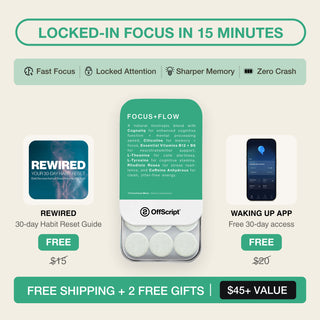
FOCUS+FLOW is a fast-dissolving mint built around the combination with the best evidence, at doses that match it. We are not going to tell you it replaces a prescription, because it does not.
Patented coffee-fruit extract, clinically studied to support BDNF.
Calm, focused attention without the jitters.
Dopamine precursor for drive + focus under pressure.
Adaptogen that supports mental stamina under stress.
Clean, measured energy, smoothed by L-Theanine.
Raw material for acetylcholine, the memory + learning neurotransmitter.
Supports neurotransmitter production.
Supports cellular energy.
Note the caffeine: 100mg, about a cup of coffee. If you are already prescribed a stimulant, that is a conversation for your prescriber before you add it, not after.
Key Takeaways
- Nothing over the counter substitutes for a prescription stimulant. Products claiming otherwise are overstating.
- Caffeine paired with L-theanine has the strongest replicated evidence for attention in healthy adults, + the effect is modest.
- L-tyrosine helps under acute stressors like sleep deprivation, not as a daily cognitive enhancer.
- Rhodiola targets mental fatigue rather than moment-to-moment focus.
- Correcting a real deficiency helps. Supplementing past normal does not, + excess iron is harmful.
- Sleep, exercise + external structure outperform everything in this category.
- Suspected ADHD needs an assessment, not a supplement aisle.
Explore The Series
- Natural Supplements for ADHD in Adults
- Alternatives to Prescription Stimulants
- Life After Adderall: Rebuilding Focus
- L-Tyrosine: Dopamine Precursor For Pressure
- Why L-Theanine + Caffeine Is The Smartest Stack
- What Does Adderall Feel Like?
References
- Owen GN, et al. The combined effects of L-theanine and caffeine on cognitive performance and mood. Nutritional Neuroscience. 2008. PubMed
- Kelly SP, et al. L-theanine and caffeine in combination affect human cognition as evidenced by oscillatory alpha-band activity and attention task performance. Journal of Nutrition. 2008. PubMed
- Reyes-Izquierdo T, et al. Modulatory effect of coffee fruit extract on plasma levels of brain-derived neurotrophic factor in healthy subjects. British Journal of Nutrition. 2013. PubMed
- Darbinyan V, et al. Rhodiola rosea in stress induced fatigue. Phytomedicine. 2000. PubMed
FAQ
What is the best over-the-counter Adderall alternative?
There is no over-the-counter equivalent to a prescription stimulant, and products marketed as one are overstating what they do. The combination with the strongest replicated evidence for attention in healthy adults is caffeine paired with L-theanine, which improves accuracy on demanding attention tasks and reduces distractibility. The effect is real but modest, and the research was not conducted in people with ADHD.
Do natural Adderall alternatives actually work?
They work for what they actually do, which is narrower than how they are usually sold. Caffeine with L-theanine modestly improves sustained attention. L-tyrosine helps under acute stressors such as sleep deprivation. Rhodiola reduces mental fatigue. None of these replicate the mechanism or magnitude of amphetamine or methylphenidate, and none treat ADHD.
Can I take supplements instead of my ADHD medication?
Do not stop or change prescribed medication without speaking to your prescriber. ADHD is a diagnosable, treatable condition, and stopping effective treatment in favour of supplements generally makes things worse. If your medication is not working well, that is a conversation with your doctor rather than a reason to self-manage.
Is it safe to take caffeine with Adderall?
Ask your prescriber before combining them. Both are stimulants, and stacking them can raise heart rate and blood pressure and increase anxiety and sleep disruption. This matters more if you have a heart condition, high blood pressure or an anxiety disorder. Persistent palpitations or chest pain need medical attention, not a dosage tweak.
What helps focus more than supplements?
Sleep, exercise and external structure. Short sleep produces a convincing impersonation of an attention disorder and no compound reverses it. Exercise has meaningful evidence for executive function. Systems that remove decisions from your environment do more for follow-through than anything in a capsule. Supplements sit on top of those, not instead of them.
These statements have not been evaluated by the Food and Drug Administration. This product is not intended to diagnose, treat, cure, or prevent any disease. This article is educational and is not medical advice.