




The moment GLP-1 drugs became famous, a wave of supplements renamed themselves. Fibre became a "GLP-1 booster." Berberine became "nature's Ozempic." Whole product lines appeared with GLP-1 on the label + nothing pharmacological inside.
Some of what is sold under this banner is real nutrition science wearing a trendy name. Some is flat overselling. Sorting them is straightforward once you hold onto one sentence: no supplement replicates a GLP-1 drug, + anything implying it does is marketing. We sell supplements, so mark our incentives, + notice that sentence cuts against them.
What GLP-1 Actually Is
GLP-1 is a hormone your gut releases when food arrives, signalling fullness + slowing stomach emptying. The drugs are engineered molecules that mimic it at massive, sustained levels, which is why their effect is so large.
Your body already makes GLP-1 at every meal. The honest supplement question is not "can I replace the drug" but "can I support my own, ordinary satiety signalling." The answer is yes, modestly, mostly through food-adjacent ingredients.
What Has Real Evidence For Satiety
Protein. The most reliable satiety lever in nutrition. Protein-forward meals stimulate satiety hormones including GLP-1 more than carbohydrate or fat, + preserve muscle besides. Nobody can patent this, which is why nobody advertises it.
Viscous fibre. Glucomannan, psyllium + oat beta-glucan slow gastric emptying + feed the gut processes that trigger satiety signalling. Effects on fullness are real; effects on weight in trials are modest, kilograms not double digits, + honest framing says so.
Berberine. The most oversold ingredient of the era. It has genuine research on blood sugar metabolism, + calling it nature's Ozempic stretches that far past breaking. It also interacts with several medications, which the memes skip.
The stress link, our actual lane. Chronically elevated stress hormones push appetite toward cravings + snacking, + drive fat storage patterns, covered honestly in cortisol belly. Supporting the stress response is not appetite suppression, + it removes one real driver of eating past fullness. The evidence layer: holy basil with randomised placebo-controlled stress outcomes (Lopresti et al., 2022), L-theanine reducing the acute stress response in a triple-blind trial (Evans et al., 2021), magnesium as the cofactor with evidence a systematic review called suggestive but limited (Boyle et al., 2017).
The Honest Comparison
The drugs produce large effects because they flood a receptor at pharmaceutical levels for days at a time. Food + supplements nudge your own hormone at meal-time levels for hours. That is why fibre gives you modest fullness + semaglutide changes lives + why the supplement aisle cannot close that gap with better adjectives.
What the natural path offers instead is different, not disguised-weaker-drug: no prescription, no needles, no rebound cliff when a medication stops, + habits that keep working because they are habits. Slower, honest, durable.
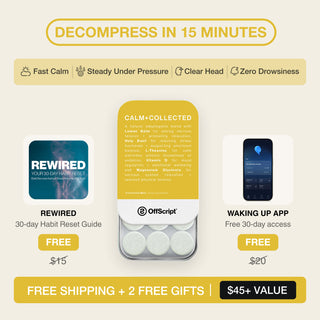
CALM UNDER PRESSURE
The stress side of appetite, handled honestly. Not a weight-loss product.
SHOP CALM+COLLECTEDKey Takeaways
- No supplement replicates a GLP-1 drug. That sentence sorts the whole category.
- Your body makes GLP-1 at every meal. Supporting ordinary satiety signalling is the honest goal.
- Protein + viscous fibre are the real evidence. Effects are genuine + modest.
- Berberine has legitimate metabolic research + is the most oversold ingredient of the era, with real drug interactions.
- Chronic stress drives cravings + storage patterns. Supporting it is our lane, + it is not appetite suppression.
- "Natural Ozempic" on a label is the signal to put it down.
Explore The Series
- Life After Ozempic: Keeping The Results
- What To Take Alongside A GLP-1
- GLP-1 + Sleep
- Cortisol Belly: What Stress Really Does
- Peptides For Weight Loss
- How To Lower Cortisol Naturally
References
- Lopresti AL, et al. A randomized, double-blind, placebo-controlled trial investigating the effects of an Ocimum tenuiflorum (holy basil) extract on stress. Front Nutr. 2022. PubMed
- Evans M, et al. A Randomized, Triple-Blind, Placebo-Controlled, Crossover Study to Investigate the Efficacy of a Single Dose of AlphaWave L-Theanine on Stress in a Healthy Adult Population. Neurol Ther. 2021. PubMed
- Boyle NB, Lawton C, Dye L. The effects of magnesium supplementation on subjective anxiety and stress: a systematic review. Nutrients. 2017. PubMed
- Lopresti AL. Modulation of the hypothalamic-pituitary-adrenal (HPA) axis by plants and phytonutrients: a systematic review of human trials. Nutr Neurosci. 2022. PubMed
FAQ
Do GLP-1 supplements actually work?
Not the way the name implies. No supplement replicates a GLP-1 drug, which floods the receptor at pharmaceutical levels for days. What has real evidence is supporting your body's own satiety signalling: protein-forward meals, viscous fibre such as glucomannan or psyllium, and managing the stress response that drives cravings. Those effects are genuine and modest, measured in better fullness and habits rather than drug-scale weight loss.
What is the best natural GLP-1 booster?
Food, honestly. Protein stimulates satiety hormones including GLP-1 more reliably than any pill, and viscous fibre slows stomach emptying and feeds the gut processes behind fullness signalling. Among supplements, fibre products have the most direct case. Anything marketed as natural Ozempic has left the evidence behind.
Is berberine really nature's Ozempic?
No. Berberine has legitimate research on blood sugar metabolism, and the comparison to semaglutide stretches it far past breaking: different mechanism, different magnitude, different evidence base. It also interacts with several medications, including diabetes drugs, so anyone on medication should ask a doctor before taking it.
Can I take supplements instead of Ozempic?
If a doctor has prescribed a GLP-1, that decision and any change to it belongs with them: do not swap prescribed treatment for supplements. If you were never on the drug and want the natural route, the honest version is protein, fibre, sleep and stress management with modest supplement support underneath, and realistic expectations about pace.
What should a GLP-1 support supplement contain?
If the label is honest: viscous fibre at a real dose, possibly protein-adjacent ingredients, and no drug comparisons. If the goal is the stress-driven side of appetite, the evidence points to L-theanine, a studied botanical like holy basil, and magnesium. Every dose should be printed, and any label promising drug-like appetite suppression is the signal to walk away.
These statements have not been evaluated by the Food and Drug Administration. This product is not intended to diagnose, treat, cure, or prevent any disease. This product is not a weight-loss product. This article is educational and is not medical advice.